Skorton outlines challenges and a vision for Cornell in State of the University address
By Daniel Aloi
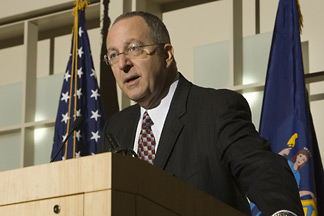
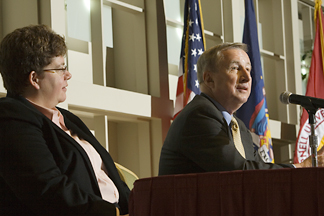
President David Skorton led Cornell's leadership on virtual tours of the university in the present day and in 2015 during his first State of the University address Oct. 27. He outlined past accomplishments, new initiatives and the challenges that need to be met as the university approaches its sesquicentennial year. It was a view of a future that will likely be brought about by Cornell's five-year, $4 billion capital campaign, launched just the day before.
Speaking in Statler Auditorium during the annual joint meeting of Cornell's Board of Trustees and University Council, Skorton said, "By any measure, Cornell is and has been an enormously successful academic enterprise. But it is critical to remember two things: First, our students, staff, faculty and alumni are not satisfied with the status quo, and they should not be; and, second, Cornell's role since its founding has been as a solver of world problems, as a transformer of life throughout the world. There are challenges here and now that must be met."
Among those challenges: recruiting a new generation of faculty and achieving gender equity among their ranks; addressing students' financial needs; supporting humanists in the face of dwindling public funding; improving facilities; and maintaining a leading academic health center. All of these areas need to be addressed "to attract the students and faculty of tomorrow," Skorton said.
"Cornellians, of course, view these challenges as opportunities to take dramatic and bold leadership. What institution can match Cornell's combination of academic distinction and public service to change the world? None of which I am aware. Cornell is alone in its class in its combination of talent and purpose, of resources and resolve, of vision and mission."
Skorton then described a vision of Cornell in 2015, taking his audience on a tour of new facilities including Gates Hall, Milstein Hall, the life sciences and physical sciences complexes, and Weill Cornell Medical College's new biomedical research building in New York. Skorton described future tour guides detailing the research, learning and interdisciplinary collaboration occurring at each location, and their impact on the world -- from a conference on sustainable design to new engineering courses on alternate sources of energy, to "a bustling life science complex bringing together physical scientists, engineers and social scientists with [faculty from] Weill Cornell Medical College. The incredible range of ideas and backgrounds brings together plant, animal and human life sciences to understand the living world in a way that has never been attempted before," he said.
The College of Agriculture and Life Sciences in 2015, he said, is full of students, faculty and "visitors from every corner of the globe. Their pioneering work is not only educating Cornell students, but is feeding the billions, relieving hunger and poverty throughout the globe."
Skorton also expressed a passion for Cornell's service mission and stressed initiatives to provide "a satisfying and balanced life" in the Cornell work/life environment, and the need to be competitive for national scientific research funding.
"Cornellians are dreamers, yes, but this is no dreamy scenario," he said. "We have concrete and focused plans and strategies to deal with many of the problems I have identified and to achieve our goals for the sesquicentennial. ... We are seeking the right balance between the resources we need and the students we must serve."
Skorton listed three priorities to permit the university to achieve the "overarching goal that has guided Cornell since 1865: to serve the needs of the world" -- to enroll and educate the most deserving students at all levels; to "recruit, support and inspire the next generation of faculty in every college and in every program"; and to have state-of-the-art facilities.
Before Skorton spoke, Jay Waks, ILR '68, Law '71, chair of the University Council, outlined another challenge: to reflect Cornell's rich diversity at the council level.
"The council has not kept pace with our student body and alumni. Only 13 percent are persons of color; less than half that rate for recent alumni," said Waks, who urged council members to nominate new members with this in mind.
A town hall session followed Skorton's speech, with the president fielding questions from the audience along with Provost Biddy Martin and Antonio Gotto, dean of Weill Cornell. Peter C. Meinig, chairman of the board of trustees, noted that the audience included 84 current and former trustees and 530 University Council members.
"I was very impressed, in particular with President Skorton; he had an extremely intelligent approach to the future," council member Bob Ramin, Arts '82, M.B.A. '85, said after the meeting. "He's obviously a very thoughtful person, and he did a lot of homework in amalgamating the complexities that make up Cornell, and making a plan. He is more than up to that challenge."
Media Contact
Get Cornell news delivered right to your inbox.
Subscribe