'Establishing community': Improving the Cornell experience for students of Asian descent
By George Lowery
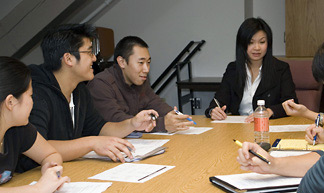
Among Ivy League institutions, Cornell keeps pace with most schools with its 26.8 percent minority undergraduate enrollment. But it outpaces most as one of the most economically diverse major research universities.
This inclusiveness has a long history because since its inception Cornell has embraced students of all backgrounds and ethnicities. In staying true to this original mission, the university has expanded its initiatives to improve faculty, staff and student diversity and the knowledge and analytical skills needed to think critically about human diversity and to appreciate it.
Until only a few decades ago, increasing diversity on campus meant attracting more women. Today, when most on campus think about minorities in the undergraduate body, they cite the numbers of African-Americans (4.6 percent), Hispanics (5.4 percent) or Native Americans (0.5 percent). The group that doesn't come immediately to mind, because they are the majority within the minority, are Americans of Asian descent, along with international Asian students, a group that comprises almost 20 percent of Cornell undergraduates and more than half of the university's graduate students.
"A fundamental issue that groups such as Asian-Americans face on campus is that they are not underrepresented, but they are still a minority, and they can be overlooked," says Susan Murphy, vice president for student and academic services.
Cornell's official definition of "Asian" is, "A person having origins in any of the original peoples of the Far East, Southeast Asia, the Indian subcontinent or Pacific Islands."
As members of Cornell's largest community of color, these students bring to the university extraordinary talents and strengths, but they are subject to vulnerabilities and challenges that their non-Asian peers and professors may know little about.
In 2002, Murphy and Provost Biddy Martin commissioned the Cornell Asian and Asian American Campus Climate Task Force report. The report's findings in 2004 included:
- More than half of the 20 student suicides occurring at Cornell between 1996 and 2004 were by students of Asian descent.
- Bias-related incidents at Cornell, including verbal, physical and sexual attacks, often involve women of Asian descent.
- Only 6.5 percent of faculty and 2 percent of nonacademic staff at Cornell are Asian.
- Students of Asian descent who graduated in 2000 were least satisfied with their Cornell experience because of faculty inaccessibility, quality of academic advising and counseling services.
- Students of Asian descent underutilize mental health services.
- Asian and Asian-American students are subject to the "model minority" stereotype, which holds that they do not need services beyond those offered to the general student body.
- Finally, while suffering the consequences of being racially marked, Asian and Asian-American students at Cornell have been rendered "conceptually invisible."
The good news: Many Asian and Asian-American students, staff and faculty, along with non-Asian colleagues, are working to improve the Cornell experience, find solutions and offer one another support.
For many Asian and Asian-American students, the academic demands of a Cornell education are compounded by cultural expectations to excel, parental involvement and intense pressure they place upon themselves, which can lead to social isolation and depression.
"Establishing community lessens stress," notes Sophie Sidhu, assistant dean of students for diversity education and outreach. "Asian and Asian-American students want a safe space to be with friends. Students who want to be part of a community generally come from a background of strong cultural traditions and expectations and are looking for a place to share those experiences."
The Asian and Asian American Forum (AAAF), a student group Sidhu advises, has taken dissemination of the task force findings as one of its primary missions. "We're hoping that the more this information gets out there, the more the Cornell community at large will want to get involved," says Sidhu. "I'm thrilled that this group of students is dedicated to sharing the task force findings in creative ways."
One of the task force's recommendations is to provide more specialized mental health services for students of Asian descent. AAAF helps do that to some extent. "AAAF is an outlet, a discussion forum, a source of support and an advocacy group all in one," says Linda Yu '08, who co-chairs the Asian and Asian American Forum. "AAAF is important to me and vital to the Cornell campus because it's so flexible in its approach to mental health issues within a part of the student body that is often a forgotten minority."
Another student-run group, Cornell Minds Matter, focuses exclusively on mental-health advocacy. Founded by Rahul Banerji '07, the group seeks to reduce the stigma associated with mental illness through discussions and improve the overall emotional health of all Cornell students.
The task force report notes that Asian and Asian-American students are often reluctant to seek formal counseling.
"Cornell has been very busy developing and implementing a number of recommendations of the task force report, mainly around improving access to support services, such as CAPS [Counseling and Psychological Services] and the university community's ability to detect students who are in trouble," says Gannett Health Services counselor Wai-Kwong Wong, who co-chaired the task force. He noted that CAPS now has nine informal walk-in sites, known as "Let's Talk," scattered around campus to give students who might otherwise not make a formal appointment the opportunity to speak with a counselor. CAPS also has hired another counselor of Asian descent who is fluent in Mandarin.
"There has been a lot going on behind the scenes that most people aren't aware of, a lot of time and effort toward creating a better safety net for our students, not just Asian and Asian-American students, but for the entire community," Wong adds.
Another of the task force's recommendations is to create an Asian and Asian-American student center. "Our students don't have a common space that draws them," Sidhu notes. "While students do find their own niches and organizations, the students I've been working with are looking for that home-away-from-home that they don't find on campus."
As a result, many tend to congregate and socialize in the offices of the Asian Studies Program in Rockefeller Hall.
"Unlike the other ethnic-studies programs, where the academic unit is complemented by an array of student support services, the Asian American Studies Program officially is only an academic program," says Viranjini Munasinghe, associate professor of anthropology and Asian-American studies and director of the Asian American Studies Program. She stresses the need for a centrally located Asian and Asian-American students community or cultural center as well as more student support services for Asian and Asian-American students.
The small number of Asian counselors as well as faculty and staff at Cornell also contribute to students' feeling they are not being heard. "There's a cultural barrier and specific family circumstances that contribute to some of the academic and social troubles Asian students run into here," says Ray Kim, assistant dean in the College of Arts and Sciences and adviser to the student-mentoring group PEER (Promoting Enriching Experiences and Relationships). "It's difficult when you have to explain your cultural background. Explain where you're coming from to get basic emotions across to an adviser.
"My office has been incredibly supportive of my efforts to help the Asian and Asian-American community be more cohesive and have more coordination among the different subpopulations," adds Kim, who also said that Cornell needs more academic advisers of Asian descent. He also expresses concern that many of the students who worked hard on the task force graduated without seeing an official response to the task force. "Hopefully, President Skorton's call for increased attention to diversity issues will help us come together as a community to address these issues," he says.
"The task force report has raised fundamental questions about how Cornell structures its services for minority students, and we are giving a great deal of thought to complex issues of staffing, space and programming," says Murphy. "Staff and administrator across campus are rethinking a variety of issues and looking for the most effective ways support our Asian and Asian-American students."
No one doubts that Cornell continues to strive to be a welcoming place for Asian and Asian-American students. "I feel optimistic about working with such a dedicated group, who are proactively trying to get this information out there in the hopes that it will inspire a universitywide response," Sidhu says. "Our goal is to build a vibrant, multicultural student community that is fully supportive of Asian and Asian-American students and their particular needs. Several steps have been taken, but we have a long way to go."
The task force report is available at http://www.gannett.cornell.edu/downloads/campusIniatives/mentalhealth/AAATFreport2004.pdf .
Learning by example
The Cornell Alumni-Student Mentoring Program (CASMP) connects principally first-year minority students with Cornellian mentors. Created in 2004 and sponsored and funded by the Provost's Office, CASMP originally focused on serving Cornell's African-American, Latino and Native American students. This year CASMP expanded its scope to increase participation by Asian-American students and alumni, although all students regardless of ethnic background have always been welcome to participate in the program. As a result of these efforts, CASMP has seen its numbers of Asian-American alumni participating in the mentoring program grow by 287 Cornellians. Currently 83 Asian-American freshmen have chosen to take part in the program and have been matched with a mentor.
"We want to establish positive, one-to-one relationships that last throughout each student's undergraduate years," says CASMP director Alicia S. Torrey '83. "Alumni offer students very useful advice on everything from achieving academic success in a particular college to taking advantage of resources to dealing with the isolation of Ithaca. We have received strong response from Asian-American alumni who are eager to mentor students."
We invite your comments on this story and will post your thoughts here. Only signed e-mail will be considered.
Media Contact
Get Cornell news delivered right to your inbox.
Subscribe