Ithacans network in Greece to build sister-city relationship
By Anne Ju
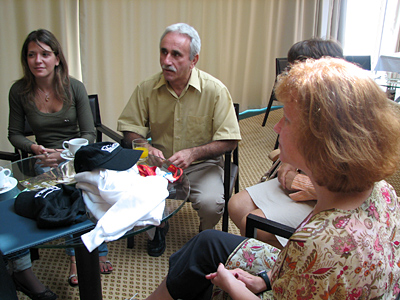
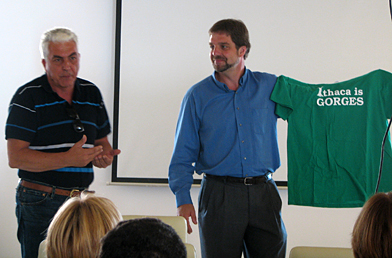
Like any new relationship, it started out formal; a little awkward as introductions were made and hands were shaken.
But with perseverance and a little luck, that first meeting between Greeks and Ithaca counterparts on Oct. 6 during an official tour of the Greek island of Cephalonia may blossom into a lasting friendship -- one that crosses many miles of land and sea.
A small group of Cornellians and Ithacans traveled to Elios Proni, Greece, for a week in October to cement this fledgling relationship with Ithaca's new Greek sister city. Led by Cornell's Institute for European Studies, the group made the journey to meet Elios Proni's people and to bring some of Greece back to Ithaca to share.
The "twinning" of Ithaca and Elios Proni, a municipality in the south of Greece's Ionian island of Cephalonia, was made official through a grant to Cornell's Institute for European Studies from the European Union Commission. The "Getting to Know Europe" grant encourages cultural linkages between American and European cities.
Elios Proni Mayor Makis Metaxas invited close to 30 civic, business and educational leaders from across the municipality and island to discuss common issues with the Ithaca visitors.
The air mixed with both Greek and English, the room broke down into three groups: education, government and business/tourism. City of Ithaca Clerk Julie Holcomb, representing Ithaca Mayor Carolyn Peterson's office, noted the stark differences between the two communities. For instance, when the municipality of Elios Proni allows outside organizations to hold special events on city property, they do not require permits, insurance or fees.
Most interesting to Maryterese Pasquale-Bowen, an Ithaca High School social studies teacher who joined the educators' discussion group, was that teachers in Greece are assigned to positions all over the country, rather than getting to choose or request assignments.
"I am interested in continuing this conversation, as I see many disadvantages to this system," Pasquale-Bowen noted. "I would like to understand the advantages."
As Cephalonia has a growing tourism industry, with its beaches, wineries and island geography, Tompkins County Convention and Visitors' Bureau Director Fred Bonn exchanged ideas and information with Greek counterparts in tourism, wine and business communities.
He noted that while the Greek island does not have nearly as many wineries as the Finger Lakes region, it faces some similar roadblocks. Yangos and Martine Metaxas, who own and operate Metaxas Wine Estate on the island, said it is challenging marketing to tourists who are interested in local wine.
"My experience in the development of the Finger Lakes Wine Center was of interest to them, and they felt that a cooperative program among the small wineries might be able to use our center as a model," Bonn said.
The Elios Proni mayor, who had a hand in nearly every activity for the Ithaca group during their stay, expressed excitement at the relationship beginning to take shape.
"I will always be there to support this relationship," Makis Metaxas said. "Maybe I will not be mayor in a few years, but I will give all my strength for this relationship to be alive."
The rest of the travelers' stay in Cephalonia included visits to museums, libraries and schools, as well as a meeting with Cephalonia and island of Ithaca Prefect Dionisis Georgatos.
Media Contact
Get Cornell news delivered right to your inbox.
Subscribe