Community coalition reviews resources available to protect student mental health
By Nancy Doolittle
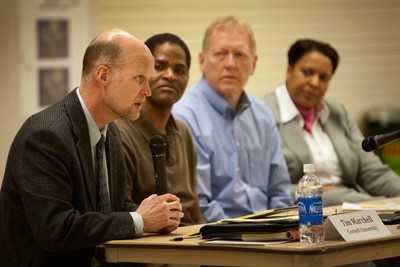
Campus-Community Coalition panelists, from left, Tim Marchell, Dr. LeBron Rankins, Jim Hull and Lesli Myers discuss student mental health resources in a forum March 25.
"Every day we … say to one another, 'Good morning, how are you?' and typically the perfunctory response is 'I'm fine,'" said Lesli Myers, an assistant superintendent for the Ithaca City School District at a March 25 Campus-Community Coalition forum at Ithaca High School. But, she added, when someone responds with something like "not so good," we should not just ignore that, but find out why and point that person to the appropriate resources.
She also summed up the recurring theme of the forum when she said, "The bottom line is, we take our students' needs seriously."
The coalition, a group of staff and students from Cornell, Ithaca College (IC) and Tompkins Cortland Community College (TC3) provides a channel for communitywide communication and joint problem solving. Its public forums have recently addressed such topics as landlord-tenant rights, safety concerns, H1N1 and underage drinking.
In the wake of recent student deaths on the Cornell campus, the forum, facilitated by Gary Stewart, deputy director of community relations at Cornell, provided updates on student mental health services at local schools and colleges with a panel discussion of representatives from the educational institutions before an audience of about 30 community members.
The panelists stressed that all the schools have on-site mental health professionals as well as peer student concern groups and work closely with community resources in matters of intervention and referral.
Jim Hull, dean of student life at TC3, and LeBron Rankins, psychologist in the Counseling Center at Ithaca College, both noted that Tompkins County's Suicide Prevention and Crisis Services also provides excellent services to help callers in distress as well as grieving friends and family members who wonder if they could have prevented a suicide or other incident of distress.
Tim Marchell, Cornell's director of mental health initiatives, reviewed ramped-up activities at Gannett's Counseling and Psychological Services (CAPS), including extended hours, promoting a Caring Community Web site and facilitating access to services with walk-in counseling at various sites around campus. He also discussed the several Notice and Respond programs he has held for faculty and staff to help them recognize and respond to signs of distress. "We are all in this together as part of a larger community," he said.
The question-and-answer period focused not only on the efforts of these institutions, but also on the broader challenge of encouraging people of all ages to seek help when they experience difficulties. Myers, for example, noted that the high school health curriculum embeds some information about these issues in its courses, and that everyone could do more through greater attention to danger signs.
Rankins suggested greater faculty involvement in integrating discussion about seeking care for mental and emotional health issues in their classes where appropriate. Hull pointed to the use of the Web and social media for disseminating information.
Marchell said that while American society has made progress in talking about and accessing mental health services, "we still have a way to go."
Media Contact
Get Cornell news delivered right to your inbox.
Subscribe