Graduate students identify ways to improve their experience
By Susan Kelley
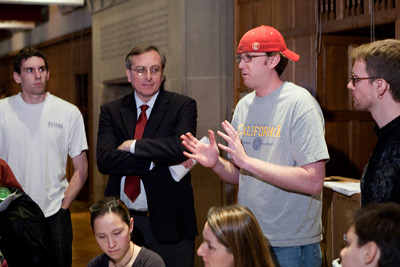
In the next five years, graduate students would like the university to expand the Big Red Barn and improve career services and housing for graduate students.
The Graduate and Professional Student Assembly (GPSA) held a meeting March 1 in Willard Straight Hall to identify ways to improve the quality of life for Cornell's 6,000 graduate and professional students over the next five years. "We're running this as a town hall so that anyone across the university involved with graduate students can come and talk about these issues," said Billie Gould, a doctoral candidate who represents graduate students in ecology and evolutionary biology.
Participants included ILR professor Edward Lawler and Provost Kent Fuchs, who co-chair the university's strategic planning process.
The meeting precedes the GPSA's March 15 vote on a resolution to integrate the text of the Graduate Community Initiative into the university's strategic plan.
The initiative calls for the university to help graduate students form a cohesive community that would cross fields and programs, supported by university services and resources.
Michelle Leinfelder, a doctoral candidate in horticulture, pointed out that she and another doctoral candidate represented graduate students on the Strategic Planning Advisory Council's working group on research, scholarship and creativity. Graduate students are also represented in the council's working groups on public engagement and education.
During the meeting, members of the GPSA's student advocacy committee outlined the initiative's key points: expansion and improvements to the Big Red Barn as a meeting place for graduate students; more career services tailored to the needs of graduate students and their spouses, including a career services center; and construction of graduate student housing. Other issues included child care, diversity, transportation and the environment, and professional schools and satellite campuses. The audience broke into four groups to discuss those issues.
The strategic plan should include more active mental health outreach to graduate students, said Michael Walsh, doctoral candidate in biology and environmental engineering who represents graduate students on the Cornell Board of Trustees. "A lot of our stress has come from our academics, whether it's our research or working with our colleagues," he said.
Other audience members commented that the plan should include quality of life issues, not just academics, and that the GPSA should coordinate and work with the Faculty Senate regarding the graduate student perspective on the strategic plan.
Fuchs charged the Strategic Planning Advisory Council, formed in October 2009, with writing a strategic plan that will guide the university to its sesquicentennial in 2015. The council is gathering input on the current draft outline and will complete a final plan this summer.
Media Contact
Get Cornell news delivered right to your inbox.
Subscribe