A.R. Ammons celebrated at Wake Forest symposium
By David Burak
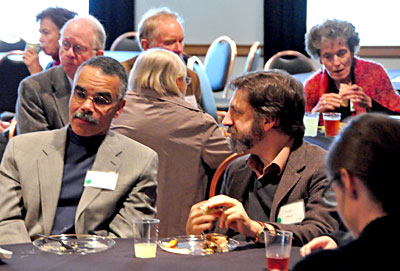
The spirit of A.R. "Archie" Ammons still stands tall. The late Goldwin Smith Professor of Poetry and a two-time recipient of the National Book Award was recently celebrated through two days of events honoring his work as a poet, painter, teacher and colleague.
Wake Forest University, Ammons' alma mater, hosted the mid-November gathering, sponsored by WFU's Z. Smith Reynolds Library, with support from the North Carolina Council for the Arts. Noted literary critic Helen Vendler, Harvard's A. Kingsley Porter University Professor, was the keynote speaker. As Ed Wilson (a.k.a. "Mr. Wake Forest") noted, Vendler once contended (in a piece she wrote for The New Yorker) that when Ammons' collected work is published, he would be considered one of the most important poets of the 20th century.
"Ammons' poems satisfied a basic intellectual need," Vendler pointed out to the audience of about 150. "His poems, like 'Easter Morning,' indicate that he knew much about the motion of the universe." She also noted that Ammons had "invented his own cosmology," substituting higher natural forces like wind, water and mountains for the traditional deities of Judeo-Christian and Greco-Roman belief systems.
Cornell English professor Roger Gilbert, co-editor of "Considering the Radiance: Essays on the Poetry of A.R. Ammons" and the author of an upcoming biography of Ammons, spoke about some of Ammons' teachers. Gilbert noted the reverential perspective Ammons had on his grade school teacher Mabel Powell, high school teacher Ruth Baldwin, Wake Forest science professor Bud Smith and University of California-Berkeley poet Josephine Miles.
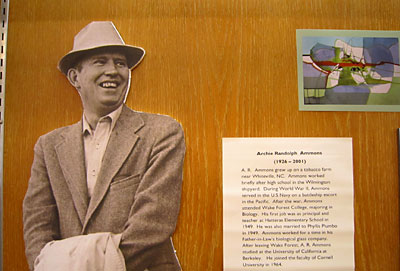
Powell provided a strict classroom that instilled a sense of self-discipline in the young Ammons. Speaking to the entire student body, Baldwin praised the 14-year-old Ammons' essay on small cows that produced significant quantities of milk. ("This was my first good review," Ammons once said.) Smith instilled a love of biology, and, though Ammons never took a course from Miles, she read and commented upon his early poetry in a way that gave him hope for success in that realm of endeavor.
"His teachers taught Ammons to trust his gift and follow his muse," Gilbert concluded.
In the closing lecture, Kenneth McClane, Cornell's W.E.B. DuBois Professor of Literature, who had been close to Ammons as both a student and a colleague in Cornell's Creative Writing Program, provided an emotionally charged set of reflections on Ammons' efforts as a "champion for the underdog."
"The more downtrodden you were, the more likely Archie would give you attention," McClane said. He noted that Ammons felt that impositions of traditional styles and forms of verse writing "were deadly to a young poet's development of his own voice."
McClane also praised Ammons' extraordinary restlessness and unpredictability, as well as his fairness. "Archie's sense of the sanctity of each of us was inspirational to his students," McClane said.
The program, "Single Threads Unbraided," also included an opening of a permanent exhibit of watercolors painted by Ammons in the latter part of his life. Elizabeth Mills, professor of English at Davidson College, provided an in-depth assessment of the styles and qualities employed by Ammons. The presence of several members of the Ammons family, including Ammons' wife, Phyllis, and his son, John, provided an additional dimension to the proceedings, particularly during the play based on a dramatic reading of Ammons' letters to the woman he loved.
Media Contact
Get Cornell news delivered right to your inbox.
Subscribe