Cornell Plantations' expanded 36-acre Caroline Pinnacles has rare species
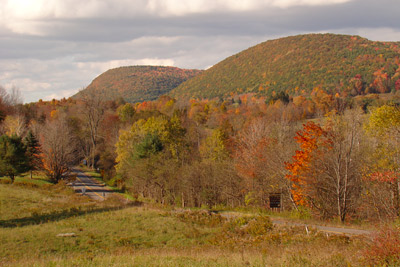
Cornell Plantations has acquired a 10-acre addition to its 26-acre, steeply sloping Caroline Pinnacles natural area in the town of Caroline. The addition, which was acquired through a land trade and donation, increases the Plantations' protected lands in the Bald Hill and Caroline Pinnacles natural areas to 254 acres.
"Our interest in protecting the Caroline Pinnacles originates from the educational value it possesses and the significance of its unique natural features," said Todd Bittner, director of the Cornell Plantations Natural Areas program. "For the past 150 years, naturalists, botanists and Cornell students have explored the steeply sloping hillsides to study the area's unique environments."
Caroline Pinnacles derives its name from one of the region's most dramatic examples of a valley slope over-steepened by glaciers, which gouged at the valley side as they moved back and forth through the White Church Valley over the millennia.
Directions to Caroline Pinnacles
Head east out of Ithaca on Route 79. About 2.4 miles past the Pine Tree Road intersection, turn right onto Brooktondale Road. About 2.6 miles from Route 79, just before leaving Brooktondale, turn right onto White Church Road (Lounsberry Road is on the left). Go about 3.7 miles, and the preserve will be on your left, forested and sloping uphill. You should be able to park along the road on either side, if you pick your spot carefully. If you reach a light tan, small house close to the road on the right, you have gone too far.
Walk straight uphill. It's long and steep. When you reach the top, there are informal paths along the top edge of the steep slope. Enjoy the views.
Its west-southwest-facing aspect promotes harsh, dry growing conditions. Near the pinnacle's top, rock outcrops are present, and the stature of the oak forests is dwarfed by exposure. The resulting open forests are dominated by chestnut oak), red oak and black oak. Of particular significance is the presence of two plant species, hair grass (Deschampsia flexuosa) and lyrate rock-cress (Arabidopsis lyrata), which have their only known occurrence in the Cayuga Lake basin here. At least 18 locally rare or scarce species of vascular plants and vertebrates, including mountain laurel (Kalmia latifolia), pitch pine (Pinus rigida) and coal skink (Eumeces anthracinus), are also found in this unusual, dry, warm, rocky habitat.
For more information on Caroline Pinnacles, including maps and directions to the site, visit the Plantations website.
The mission of the Cornell Plantations Natural Areas Program is to preserve and maintain natural areas in the Central Finger Lakes region, in order to foster natural heritage conservation, research and educational efforts.
Media Contact
Get Cornell news delivered right to your inbox.
Subscribe