Gleason will dig into King Herod's palaces in NYC talk
By George Lowery
Throughout his long and unpopular reign, Herod I (c. 74-4 B.C.), king of Judea in Jerusalem, addressed his political needs through architecture during an ambitious building program of palaces, villas and fortresses, including Masada.
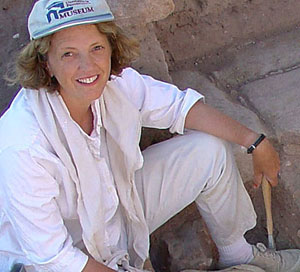
Kathryn Gleason, Cornell associate professor of landscape architecture and an archaeologist, who has been excavating the king's gardens and grounds since 1985, will talk about the architectural expression of Herod's kingship March 23 at 7 p.m. at the 92nd St. Y in Manhattan.
The Jewish historian Josephus, writing in Rome nearly a century after Herod's reign, described "incredible architecture that until very recently was thought to be a gross exaggeration of the truth," said Gleason. As an Oxford University doctoral student in archaeology, Gleason began working with Israeli archaeologist Ehud Netzer, who "was most responsible for uncovering the architecture of Herod the Great," said Gleason. Her lecture is dedicated to Netzer, who died last year. His discoveries "show that Josephus, far from exaggerating, only hinted at the sophisticated nature of Herod's building projects."
Masada is built on a desert mountaintop. Once, while Herod was in Rome, his family nearly died of thirst there before rain saved them. Gleason said Herod then used every available method of water harvesting to ensure the fortress would have plentiful water. Jewish rebels at Masada later staved off a Roman siege with the help of Herod's water system.
Herod's family had converted to Judaism a couple of generations earlier. Because he was not a member of Judea's priestly ruling family, Herod had none of the religious privileges of his predecessors. Netzer observed that Herod found an architectural solution to this situation by building the Second Temple with a regal place for himself on the temple mount, extending the platform out from the sacred area. "Herod could be visibly present during important religious festivals while respecting the limits of his position," Gleason said.
Herod ruled during a time of architectural innovation. His projects stand out for their location in "spectacularly beautiful places. He picked very difficult sites and used advanced engineering technology to overcome the challenges of the site," Gleason said. "At Caesarea, he built a harbor where there was no natural harbor by importing volcanic ash from Italy to make hydraulic mortar for concrete breakwaters, poured in place in the sea." He also combined elements he had seen in his travels around the Mediterranean to create architectural forms that met his needs.
Despite his lack of popular support -- Herod ruled at Rome's will -- "He kept Judea a relatively independent -- and larger -- Jewish kingdom rather than a Roman province, which happened after his death," Gleason said. Good trade relations made Herod's reign a time of prosperity.
Yet Herod, infamous among Christians for the slaughter of the innocents in Bethlehem, was also noted for his brutality. He married the daughter of the former ruling family but later killed her and a number of his own sons. "He is often thought to have been paranoid, but I don't know if you're paranoid if people genuinely are trying to kill you," Gleason said. "The drama and treachery of his court was not unusual in Rome, but even the Emperor Augustus famously quipped that he would 'rather be Herod's pig than his son.'"
Gleason will frame her talk by describing Herod's funeral procession from Jericho to Herodium, noting Herod's accomplishments along the route, as well as Netzer's contributions. Later this spring, she will return to Herod's palace at Caesarea, sited in the surf of the Mediterranean. It's a dramatic setting for a summer dig, "rather like doing a dig on the Jersey shore: hot inland, cool on the site," she said.
Media Contact
Get Cornell news delivered right to your inbox.
Subscribe