Composer Frith explains his techniques for weaving music and sound in film
By Joseph Mansky
A woman walks into a coffee shop where a romantic song is playing in the background. The music abruptly stops -- she pays for her drink in complete silence. She glances at the man beside her, and with an orchestral flourish, the song resumes. She rushes out, and as she crosses a busy street the music suddenly cuts out again.
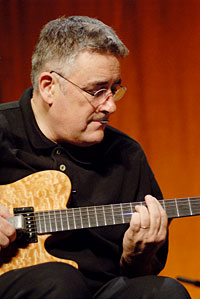
This scene, from the beginning of Jean-Luc Godard's 1961 film "A Woman Is a Woman," "demonstrates the extent to which we accept the conventions of what film music is supposed to do," said composer Fred Frith, speaking on "Composing Music for Film" to a full room in the A.D. White House Feb. 29 as part of the Fred Frith Festival at Cornell.
Frith, a professor of composition at Mills College in Oakland, Calif., and a professor of improvisation at the Hochschule für Musik in Basel, Switzerland, is also a multi-instrumentalist who has been active in a broad spectrum of music-making since the late 1960s. He is internationally renowned as an electric guitarist, improviser, songwriter and composer for film, dance and theater.
In the Godard clip "the music is completely inappropriate, coming in at completely the wrong moments," he said, demonstrating "how everything is programmed, how everything is referential."
Frith, the self-described "king of the universe" when it comes to "low-budget film music-making," also showed clips from films he has worked on, as examples of the "many film music functions that we recognize."
"How music and sound interweave," Frith said, "has really changed in the last 15 or 20 years." Before, sound and music tracks were largely kept separate. Now, particularly in documentary films, he said, "allowing the location's sound to take over from the music in a dramatic way is quite a rich territory to mine."
For example, in the 1995 documentary "Middle of the Moment," the directors asked Frith to "provide them with typical road music" for a scene in which a nomadic tribe in North Africa was traveling through the desert.
"For me, it was clear that there was plenty of dramatic music already there," he said. Frith simply told them to "turn up the volume of the soundtrack and not have any music at all." The clack of hooves and creaking wagons provided an "infinitely rich rhythmic sound," he noted -- so why add music?
Frith described generic background music as "the unromantic low end of film music making." By contrast, one of his greatest pleasures is improvising to join "the dots." Improvisation, he said, is "very direct emotionally -- composed music can't quite get to the same kinds of places," he said.
In documentaries, "the function of the music is really to provide a kind of a grounding so that everything is held in a frame," Frith asserted. He said that he often treats voices as if they were "the voices of blues singers," as if "you're hearing the voices of a vocalist and I'm the accompanist."
In "Thirst," a 2004 documentary about public vs. private ownership of water, children swim in a muddy pond in India as a man speaks about water privatization. The music in the background gradually blends into the sound of an old man lamenting in song the oppressive price of water.
"This idea that you can gradually meld music into the music that's already there is, for me, the richest part of working in documentary film," Frith said.
The Fred Frith Festival is sponsored by Cornell Cinema, the Cornell Electroacoustic Music Center, Cornell Composers' Forum and Cornell Department of Music.
Joseph Mansky '12 is a writer intern for the Cornell Chronicle.
Media Contact
Get Cornell news delivered right to your inbox.
Subscribe