Cornell seeks to serve the local community, says Skorton
By Nancy Doolittle
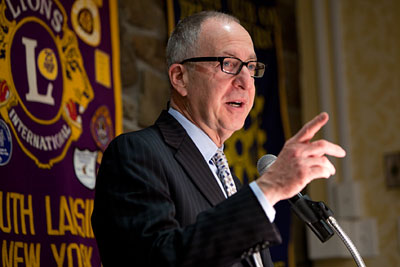
Cornell interprets its land-grant mission broadly and takes its public service role seriously, said President David Skorton during his annual address April 18 to local service clubs at the downtown Holiday Inn to an audience of more than 150.
But many individuals and organizations in the area also contribute to the well-being of the university and the local community, he said, acknowledging the work of the leaders, for example, from the Kiwanis, Sertoma, Rotary and Lions clubs in Dryden, Lansing, Groton, Trumansburg and Ithaca.
Cornell's public engagement efforts range from offering educational programs to the community through such units as Cornell Plantations, the Lab of Ornithology, the Herbert F. Johnson Museum of Art and Cornell Cooperative Extension of Tompkins County, to addressing global concerns through such endeavors as the Atkinson Center for a Sustainable Future, which has just spearheaded a partnership with CARE International to address issues of food security and climate change, Skorton said.
The Einaudi Center for International Studies shares its expertise with New York state schools and other colleges, he said, while the university's international students add to the cultural texture of the Ithaca area. Out of about 4,100 colleges and universities in the United States, "we are in the top 25 in the number of international students, regardless of size," he said.
While some of Cornell's educational and research programs focus in part on public service, others foster economic development, he said, such as the Cornell Center for Technology Enterprise and Commercialization and partnerships with the Tompkins County Area Development and the Southern Tier Regional Economic Development Council.
Many faculty members, staff and students also serve the local community by serving on boards of organizations, contributing to the United Way and volunteering through the Cornell Public Service Center and the Cornell Tradition. In fact, Skorton said, Cornell was recently named to the President's Higher Education Community Service Honor Roll, with Distinction, for its commitment to public service, the "highest federal accolade" a university can receive for its public engagement efforts, he said.
In answering audience questions, Skorton discussed the financing of the CornellNYC Tech campus, noting that the funding for its first phase is already in place. In addressing gorge safety, which he said was "one of our most important problems," Skorton said that a gorge safety group made up of faculty, students and staff is working on implementation of safety measures including, not only barriers and fencing, but also education, patrolling, enforcement and appropriate partnerships with the city and county. He noted that the educational challenge will be difficult to solve permanently, because each year more than 3,000 new students arrive on campus. Asked about the status of Cornell's commitment to housing development, Skorton reaffirmed the university's partnership with the city and county, but acknowledged that the recession had slowed down the pace of progress.
Media Contact
Get Cornell news delivered right to your inbox.
Subscribe