With song and sound, student weaves narrative of hope
By Nancy Doolittle
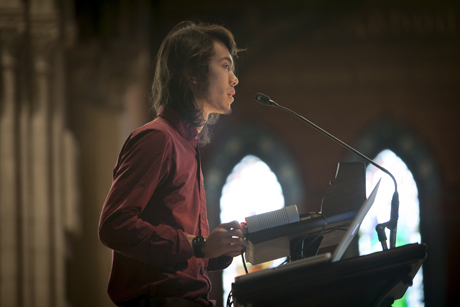
The thump of the heart and swoosh of an unborn child in the womb … the first cry of a newborn … the sounds of a playground … cheers along a sports field – Kai Keane ’14 connected hope to the recordings of these sounds in what he called an “auditory journey” at the Soup and Hope talk March 14 in Sage Chapel. Like sound, hope is “a dynamic quality that fluctuates throughout our life cycle,” he said.
An anthropology major at Cornell, Keane began his reflections by playing piano, accompanied by vocalist Mary Millard. “Music has been very important to us to help balance out our hectic academic life, and it is something that also gives us hope,” he said.
Keane used the sounds of childhood to define hope as “the pure positive excitement and expectation for the future.” He grew up in Ithaca and traveled to seven developing nations during his high school and college years. His travels have provided him with examples of children, who “almost universally” are full of hope, and of adults who have maintained that hope in later years.
In a rural village in Guatemala, for instance, Keane taught a class to children in elementary school, most of whom said they wanted to be doctors or nurses when they grew up, so they could help their community.
Keane has also met students from Burma who had grown up in refugee camps, and he was struck with how positively they viewed their childhood camp experiences.
When he visited South Sudan shortly after they gained their independence, Keane recalled, he encountered children playing soccer and singing their national anthem. “All I heard from this song was hope,” Keane said, “hope for a peaceful future and growth of their nation.”
Keane contrasted this “pure hope” to the feelings that come with growing up, when hope can become diluted through other feelings. Though hope can diminish with age, people can choose to live in hope, he said, making “a decision to keep a positive outlook on life.”
He provided two examples – one from his visit to Soweto, South Africa, and one as a director of a team of Cornell students in a project called Sustainable Neighborhoods Nicaragua – of leaders of community-oriented projects maintaining their sense of hope by believing that what they do makes a difference.
He also recounted meeting the youngest atomic bomb survivor of Hiroshima, Koko Kondo, in Japan in 2010. At Hiroshima, Kondo had lost many of her family members and her ability to have children, and has since been an activist speaking against nuclear bombs, leading a peace tour in Japan every year.
Keane then dedicated his Soup and Hope talk and songs to Joseph Quandt ’16, a Cornell student who died recently and who “always radiated a certain childlike hope.” Dealing with the repercussions of his loss has made Keane realize “how crucial it is to maintain an attitude of hope, especially when that seems like the hardest thing to do.”
“Imagine your life today through the lens of you when you were 6,” Keane encouraged his audience. “Listen to the hopeful sounds in your memories – and keep that child’s voice in your head.”
Media Contact
Get Cornell news delivered right to your inbox.
Subscribe