JFK called 'icon of hope' by faculty panelists
By Sam Wolken
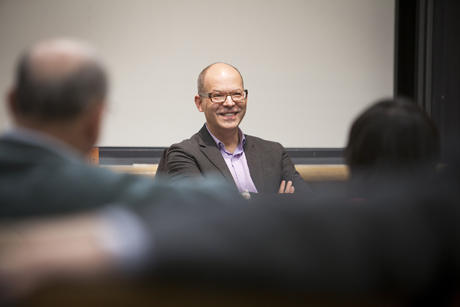
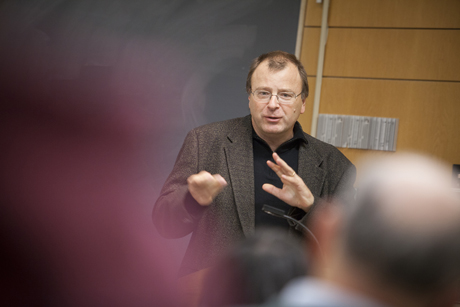
President John F. Kennedy was seen as an icon of hope who represented a different kind of political age when people believed that the government could work together toward positive changes, said Fredrik Logevall, history professor and vice provost for international affairs. He spoke Nov. 22 at a roundtable discussion on Kennedy’s legacy 50 years to the day after his 1963 assassination in Dallas.
Joining Logevall were government professors Elizabeth Sanders and Nicolas van de Walle, who moderated.
“He, rightly or wrongly, embodies in the minds of many people a rare moment in public activism,” said Logevall, a historian who specializes in U.S. foreign relations. “He reminds us of an age when it was possible to believe that politics could speak to society’s moral yearnings, that government could be a force for good in society and that it was possible to imagine what we could do together.”
Sanders suggested that Kennedy embodies Janus, the Roman god with two faces: “the cold warrior and the reformer and the person who might have made the world more peaceful had [his] prominence not been cut short.”
To the familiar comment that Kennedy was a flagrant womanizer, Sanders pointed out: “He also did things for women’s rights that were hardly demanded because there was not a noticeable women’s movement yet. Kennedy talked about it when it wasn’t stylish and few were demanding it.” Sanders listed several of these accomplishments, including an equal pay act and his advocacy for national and statewide women’s organizations.
Van de Walle compared the progress on social issues in America under Kennedy’s watch to other democratic nations: “I’m pretty confident in saying desegregation would have happened regardless of who was president because the U.S. was so behind the developed world in that set of policies by the early 1960s.”
The professors discussed several counterfactuals, or “what if” alternative historical narratives, which may have occurred if Kennedy had not died. Most frequently, these explore how Kennedy would have handled Vietnam and the mounting pressure of the Cold War.
Logevall argued for an optimistic counterfactual regarding Kennedy’s potential handling of the Cold War. As evidence, he cited a speaking tour through the western United States that Kennedy completed in October 1963. On the tour, Kennedy “emphasized the need to get along with the Soviet Union, to lower the temperature in superpower relations, to continue the progress that had been made,” Logevall said.
Answering questions from the audience, Logevall urged restraint when formulating counterfactuals, which he said must be predicated on “modest, minor changes that leave as many variables in place as possible.”
Logevall and Sanders were reluctant to engage the topic of conspiracy theories regarding Kennedy’s assassination. However, Logevall expressed a belief that Lee Harvey Oswald was working alone.
The Einaudi Center, the Department of Government and the Department of History sponsored the discussion.
Sam Wolken ’14 is writer intern for the Cornell Chronicle.
Media Contact
Get Cornell news delivered right to your inbox.
Subscribe