Things to Do, Feb. 12-19, 2016
By Daniel Aloi
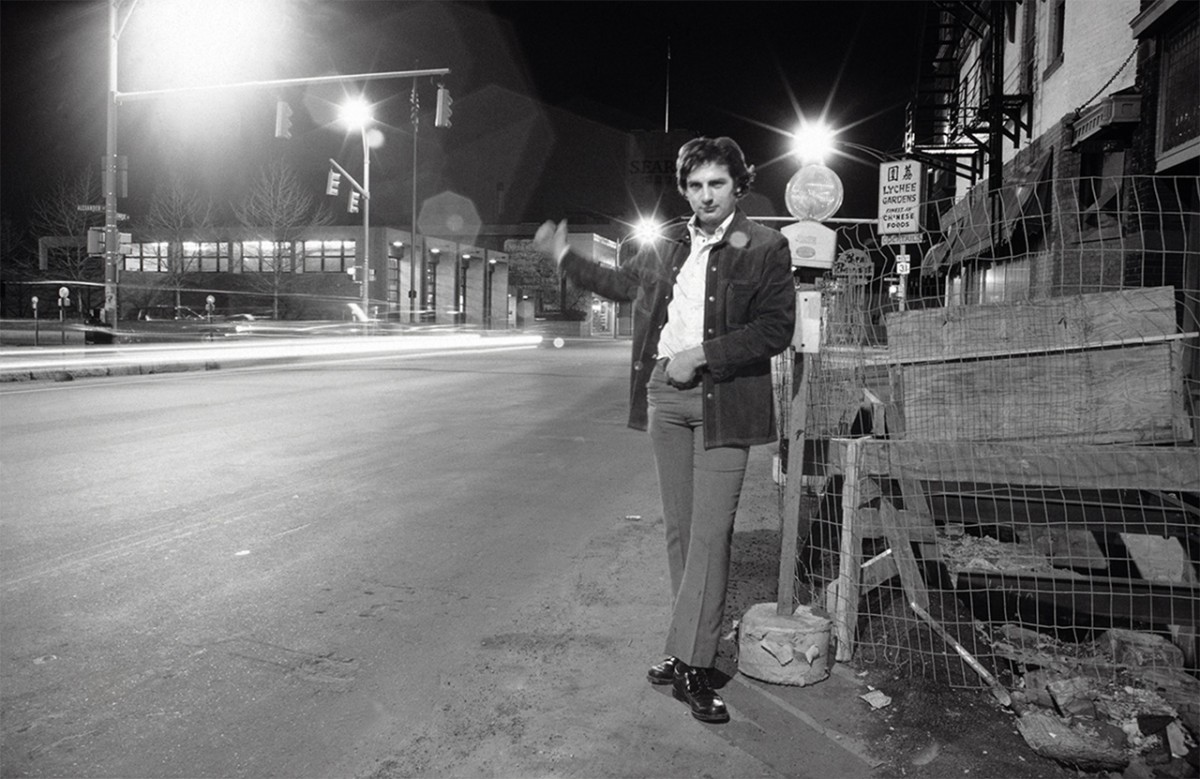
Cornell photographer Bill Staffeld shows his work from the '70s in Hartell Gallery, documenting night scenes and city life in Rochester and the Hudson Valley.
Have a Heart
The Cornell United Way Campaign hosts a one-day giving opportunity for the Cornell community Feb. 12, with “Have a Heart” giving tables in the East Hill Office Building, from 10 a.m. to 2 p.m.; The Cornell Store, from 10 a.m. to 4 p.m.; and Robert Purcell Community Center, from 11:30 a.m. to 1:30 p.m.
Pledge cards will be available for those considering making a gift, and volunteers will on hand to help community members learn more about how contributions to the United Way of Tompkins County improve the lives of people in Tompkins and surrounding counties.
On-screen romance
For Valentine’s Day Weekend, Cornell Cinema features the 2015 romantic comedy “Man Up,” starring Lake Bell and Simon Pegg, Feb. 13 at 7 p.m. and Feb. 14 at 4:30 p.m.; and a new 35mm print of Jean Vigo’s 1934 classic “L’Atalante,” Feb. 14 at 7 p.m. – also part of Cornell Cinema’s month-long “Cats!!” series.
Also showing this week: “(Sing along with) Frozen,” Feb. 13 at 2 p.m. ($5, $4 kids 12 and under), and the Ithaca premiere of “Theeb,” Feb. 18 and 20. Jordan’s entry for the Best Foreign Film Oscar, the adventure story follows two young Bedouin brothers on a trek through the desert while war rages around them. Co-sponsored with the Department of Near Eastern Studies.
Advance tickets are on sale for a special Laurie Anderson double feature Friday, Feb. 19 at 7 p.m., with “Heart of a Dog” (2015); a rare 35mm print of her 1986 performance film “Home of the Brave;” and an informal reception with complimentary beverages and hors d’oeuvres. Tickets are $20 at CornellCinemaTickets.com and will be $25 at the door.
Behind the broccoli craze
Best-selling author and investigative journalist Michael Moss visits campus as a 2016 Messenger Lecturer this week to speak on the food industry and marketing healthy foods, and discuss the ethics of storytelling. Two of his three events are free and open to the public and all are sponsored by the University Faculty.
Moss writes about the food industry in the context of health, safety, nutrition, politics, corporate interests, and the power of the individual to gain control of what and how he or she eats. He is the author of “Salt Sugar Fat: How the Food Giants Hooked Us” (2013) and won the Pulitzer Prize for Explanatory Journalism in 2010 with other New York Times writers, who were recognized “for relentless reporting on contaminated hamburger and other food safety issues.”
His first talk, “A Journey into the Underbelly of the Processed Food Industry,” is Wednesday, Feb. 17 at 4:30 p.m. in B25 Warren Hall.
A workshop with Moss, "You are Your Own Journalist: The Evolving Ethics of Storytelling," is Feb. 18 at 9 a.m. in 401 Physical Sciences. Attendance is limited to 25 graduate students.
Moss also presents "Broccoli, the Alpha Vegetable: Hard-core Messaging for Healthier Eating," with a panel discussion Feb. 18 at 2:30 p.m. in 401 Warren Hall. (The title comes from a fictitious advertising campaign for broccoli that Moss helped create for a 2013 Times article on food marketing.)
African hip-hop
Assistant professor of music Catherine Appert presents “To Make Song without Singing: Hip-Hop and Popular Music in Senegal,” Feb. 18 at 4:30 p.m. in 124 Lincoln Hall. The Musicology Colloquium is sponsored by the Department of Music.
Appert’s study of Senegalese popular music centers on globalization and diaspora, the ethnographic study of musical genre and the intersections of music and memory. In 2011 her work was included in “Native Tongues,” the first published volume on African hip-hop.
She earned her Ph.D. from the University of California, Los Angeles. Her work in Senegal was supported by the Fulbright-Hays Program, the American Council for Learned Societies with the Mellon Foundation, and the UCLA International Institute.
The ’70s city at night
Bill Staffeld, photographer for the College of Architecture, Art, and Planning (AAP) since 1984, spent much of the 1970s and early 1980s documenting post-industrial upstate New York cities and towns in transition. A selection of this work is on display in “Upstate '70s: The Soul of a Documentary Photographer,” in the John Hartell Gallery in Sibley Dome. A closing reception is Friday, Feb. 19 at 5 p.m., with music by Pete Panek.
Around 1972, as an independent study with Rochester Institute of Technology faculty, Staffeld began shooting on slow-speed, black-and-white negative films, using a reversal chemical process to achieve positive transparencies. He began wandering at night with camera and tripod through neighborhoods near downtown Rochester, photographing the streets and people he encountered using long time exposures.
Moving downstate, Staffeld also photographed Hudson River towns, mostly during the day, with the same approach. Returning to Rochester in 1977, he resumed photographing at night, this time around the vibrant commercial strip of Monroe Avenue. By the late 1970s, only the shadows of former things and beings remained. This spirit world would only reveal itself in the moment Staffeld unwound the dripping wet film from the reel, causing an excitement that still persists as his creative incentive.
Staffeld was mentored at Apeiron Photographic Workshops by several renowned photographers including Lisette Model, Charles Harbutt and Ralph Gibson. He has documented the creative lives of Cornell students, staff and faculty for decades, always with an eye for celebrating what is best and most unique about AAP’s programs in Ithaca, New York City and Rome.
Media Contact
Get Cornell news delivered right to your inbox.
Subscribe