Faculty reveal life-changing creative works
By Kathy Hovis
When Leslie Adelson, professor of German literature, was living in Berlin and just beginning her research on contemporary German literature, she came across a short story or “miniature” by Alexander Kluge that’s been with her ever since.
The story of a young boy whose strengths were buried as he was made to conform to society’s expectations moved her in a way she wouldn’t fully understand until years later.
“When I stumbled on this one, I was just totally mesmerized,” Adelson said of Kluge’s story, “Plugging Up a Child’s Brain.” “I felt like this story was looking right at me and into my soul. The experience of not being seen and the power of a brief exchange with someone else who made me feel seen were experiences that resonated with me.”
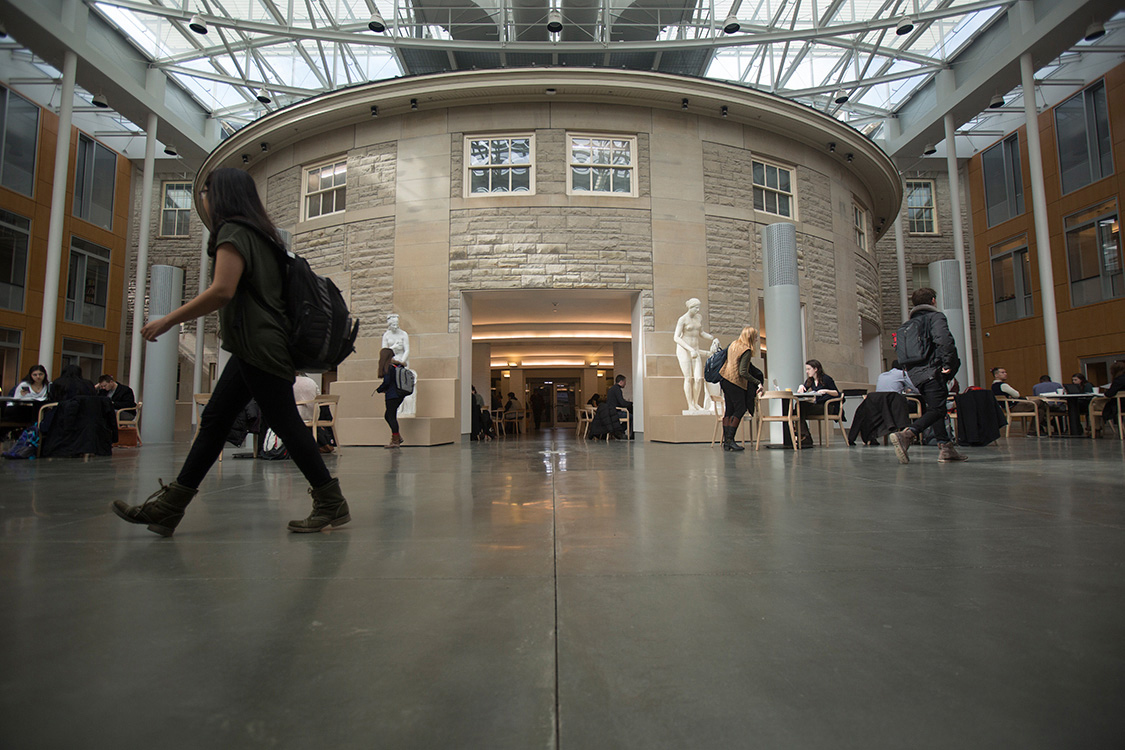
Adelson will share the impact of this work on her life and career as part of the “Transformative Humanities” series of talks and brown bag lunches that starts Friday, March 4, in Klarman Hall’s Groos Family Atrium.
Adelson has done extensive research on Kluge, who was born in 1932 and experienced the Third Reich and the Allied bombing of his hometown as a boy. Although Kluge is better known as a filmmaker, he began writing short stories in the 1960s and has published thousands of new stories since 2000.
“A nexus of hope and despair or liberation and catastrophe is common to most of his stories,” Adelson said.
More than 35 faculty members are writing essays for the series, and 18 of them will share their thoughts during the Friday conversations. The other essays will be available on the New Century for the Humanities website and a smaller group of them will appear in a commemorative booklet being published in coordination with the formal dedication of Klarman Hall, May 26.
Pedro Erber, Ph.D. ’09, associate professor of Romance studies, said his essay will focus on a book by Naoki Sakai, professor of Japanese literature and history at Cornell.
Erber discovered the book during research in Japan after finishing his master’s in philosophy in Brazil and said it was the main reason he pursued a doctoral degree in Asian studies at Cornell.
Gretchen Ritter, the Harold Tanner Dean of the College of Arts and Sciences and a professor of government, will talk about the transformative power of “To Kill a Mockingbird” in her early life on April 22.
“That book has long served as a touchstone for my cultural and social imagination,” Ritter writes. “I remain attuned to artists and authors who draw from the hopeful striving of American culture – the sense of openness and possibility, the large landscapes, the chance to turn away from what came before, to reinvent and create anew. I am moved as well by those who articulate and portray the distress and anger that emerge when our experiences fall short of our national aspirations.”
Said Scott MacDonald, senior associate dean for arts and humanities in the College of Arts and Sciences: “Humanities faculty believe in, and speak often with our students, their parents, and the broader public about, the importance of the humanities for shaping deep and meaningful human lives. These short reflections by our faculty will illustrate how encounters with the stuff of the humanities have in fact been transformative. They will make concrete, personal and real the ideals we very often talk about only in general or abstract ways.”
Schedule of Friday ‘Conversations’
The “Transformative Humanities” talks, part of the College of Arts and Sciences’ New Century for the Humanities celebration, are scheduled for 12:20-1:10 p.m. March 4 and 18 and April 8, 15, 22 and 29.
- March 4: Leslie Adelson (German studies), Grant Farred (Africana studies), Mary Beth Norton (history)
- March 18: Ishion Hutchinson (English), Kate Manne (philosophy), Annette Richards (music)
- April 8: Bruno Bosteels (Romance studies), Paul Fleming (German studies), Courtney Roby (classics)
- April 15: Austin Bunn (performing and media arts), Judith Peraino (music), Shawkat Toorawa (Near Eastern studies)
- April 22: Margo Crawford (English), Gretchen Ritter (government), Steven Strogatz (mathematics)
- April 29: Ross Brann (Near Eastern studies), Cynthia Robinson (history of art), Nick Salvato (performing and media arts)
Other contributors will include Andrea Bachner, comparative literature; Lawrence Blume, economics; Jonathan Boyarin, anthropology and Jewish studies; Tad Brennan, philosophy and classics; Debra Castillo, comparative literature; Jonathan Culler, English; James Cutting, psychology; Peter Gilgen, German studies; Bill Kennedy, comparative literature; Lori Khatchadourian, Near Eastern studies; Paul McEuen, physics; Jerrold Meinwald, chemistry; Tim Murray, comparative literature and English; Noliwe Rooks, Africana studies and feminist, gender and sexuality studies; Thomas Seeley, neurobiology and behavior; and Penny von Eschen, history.
Kathy Hovis is a writer for the College of Arts and Sciences.
Media Contact
Get Cornell news delivered right to your inbox.
Subscribe