Media studies at Cornell ask questions of culture
By Linda B. Glaser
President Franklin D. Roosevelt’s radio “fireside chats” reached into the homes of frightened Americans to reassure them during the Great Depression and World War II. The chats were made possible by newly sensitive microphones that created an emotional intimacy with the audience – but also required Roosevelt to use a dental implant to reduce the whistle caused by the microphone.
Scholars in the field of media studies and its subdiscipline, sound studies, examine topics like Roosevelt’s chats and how the medium and message interact. Though the field is young, technical and production-oriented study of media has been around for a long time, and media studies includes everything from podcasts to the history of books to Aristotle’s interest in the ways voices move through the air.
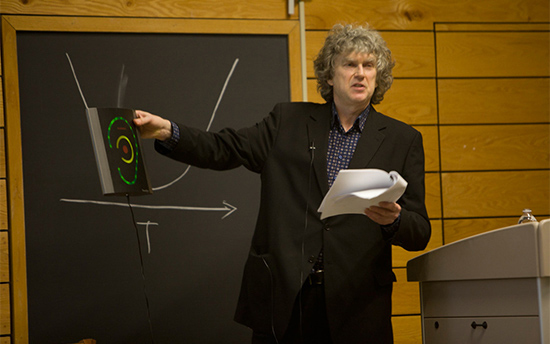
On Feb. 29, the College of Arts and Sciences brought together faculty working in the area of sound studies in a Big Ideas panel, part of the New Century for the Humanities celebration. Held in the Groos Family Atrium in Klarman Hall, the event featured Benjamin Piekut, associate professor of music; Kim Haines-Eitzen, professor of Near Eastern studies; and Trevor Pinch, the Goldwin Smith Professor of Science and Technology Studies and professor of sociology.
Pinch recalls that when he taught a sophomore writing seminar on sound studies in 2004, the field barely existed. “Now there are journals, handbooks, conferences and new programs,” he says. “It is one of the most exciting new interdisciplinary fields in the academy.”
The Society for the Humanities has been an important hub for media and sound studies. Its 2011-12 focal theme was “Sound: Culture, Theory, Practice, Politics.”
“At that stage, sound studies felt like a new discipline that was still forming,” says Roger Moseley, assistant professor of music and a faculty fellow at the society that year. “For us, it was a mutual voyage of discovery. As a music scholar, I had to question my assumptions about the relationship of sound and music, which meant acquiring new skills and unlearning some old ones.”
Although Cornell doesn’t have a dedicated sound studies program, according to Piekut there are probably more faculty working in the field at Cornell than just about anywhere else in the U.S.
As Pinch noted in his Big Idea talk, media studies is a highly interdisciplinary field, drawing on many methodologies and fields of study, such as computer sciences, the physical sciences, psychology, fine arts, history, sociology and literature. Cornell’s long history of cross-disciplinary collaboration and fruitful cross-pollination of ideas is important, because the objects of media studies often defy easy categorization.
Media studies research and teaching at Cornell elaborates on traditional techniques of scholarship, bringing in new objects of analysis and combining disciplines. There is an important wing of media studies that proceeds from deconstruction and high theory, areas in which Cornell has a long history of strength, notes Jeremy Braddock, associate professor of English, and other approaches have developed out of cultural and literary studies, history and philosophy.
“It’s a really exciting moment to be in the humanities because the variety of new technologies available to us can extend the work we’ve been doing for generations,” says Tom McEnaney, assistant professor of comparative literature. “We’re reinventing the basic media platforms in which we make art and narratives, so everything from the past looks new again.”
Braddock says the invention of a new technology can reorganize society in ways that are unintended and not clearly perceived for a long time after. “This is the reason for media studies and the reason humanists have a crucial role to play,” he says.
As Brett de Bary, professor of Asian studies and comparative literature, notes: “The work of interpreting new cultural developments, making meaning of them, is what the humanities is all about. Because when you confront the new, it’s not a matter of looking for answers – you don’t even know what the right questions are yet.”
Linda B. Glaser is a staff writer for the College of Arts and Sciences.
Media Contact
Get Cornell news delivered right to your inbox.
Subscribe