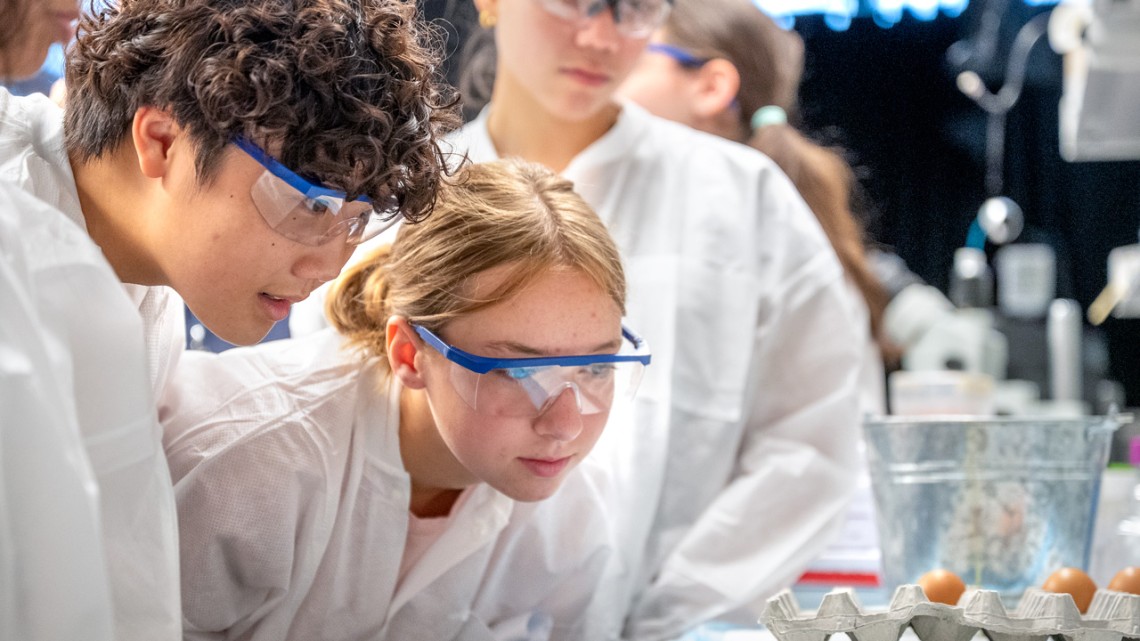
Brandon Hsieh, of New York City, and Sunny Zuger, of Washington County, participate in a lab activity session at 4-H Career Explorations June 26 in Weill Hall.
4-H teens come to Cornell to explore potential career paths
By Juan Vazquez-Leddon
Cornell hosted more than 180 middle and high school students from across New York state for the annual 4-H Career Explorations Conference, held June 25-27. The event, hosted by Cornell and New York State 4-H, gave students from 31 New York counties a taste of college life while exploring possible careers, including those with emerging technologies like artificial intelligence.
That was the focus of a session called “Scientific Literacy and AI,” led by Allison Hermann, research and extension-outreach manager for the Laboratory for Rational Decision Making in the College of Human Ecology, and graduate students in the lab, Jordan Roue, M.A. ’24; Sarah Edelson ’10, M.A. ’21; and Aadya Singh. They introduced students to scientific methods, describing how scientific research is conducted, starting with an observation or question and the steps necessary to reach a conclusion.
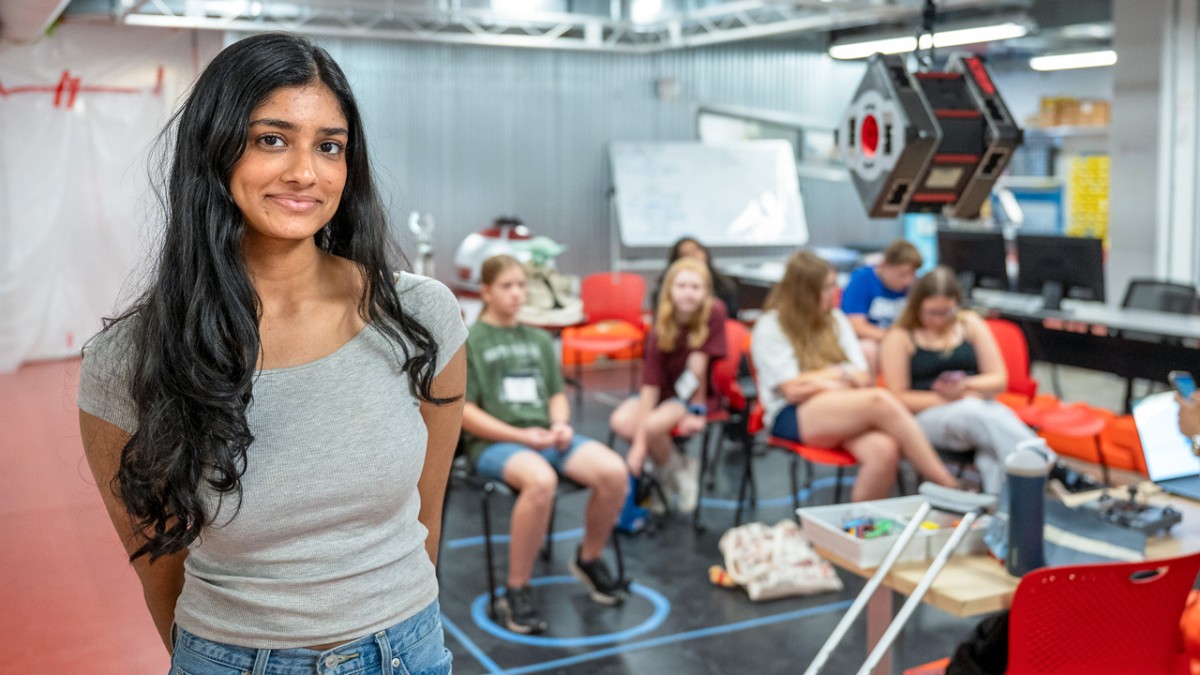
Surabhi Bachhav ’28, a computer science major in the College of Engineering, helped lead a session for 4-H youth on using robotics to grow plants.
“Science is constantly changing and moving forward; it takes a path,” Hermann said. “It can get confusing when you read something and things change. Maybe a different method was used, and that can influence the result.”
Hermann and Roue then briefed students on differentiating misinformation, which is false information some may believe to be true, from disinformation, which is information created with malicious intent.
They also introduced students to various forms of AI. Narrow (also known as weak) AI systems perform a specific task and don’t think or make decisions, via platforms like Siri or Alexa. In contrast, general (also known as strong) AI and superintelligent AI can think, learn and apply knowledge with a capacity that can match or surpass humans, although they’re still hypothetical at this stage. Hermann and Roue engaged the students in conversations about the pros and cons of AI and its applications.
“We have to be open but critical thinkers about the info we get from AI and be smart and responsive about how we use it,” Hermann said. “You’re at the beginning of this revolution. This will be affecting your lives.”
Other sessions focused on new career paths. They included “Farming with Robots,” in which students used robots to build an autonomous smart garden; “AI in Ag & Forestry,” which covered how AI is helping farmers and foresters make decisions to adapt to climate change; and “4-H Influencers,” which taught 4-H’ers storytelling skills and social media best practices to promote 4-H in their communities.
Students from North Rockland High School in Rockland County, New York, learned how to conduct scientific research through the Youth Investigators program, presented by the Program for Research on Youth Development and Engagement (PRYDE). The program, housed within the Bronfenbrenner Center for Translational Research, teaches youth how to form research questions, various research methods for collecting data and their limitations, and how to present their findings.
“I’m thrilled that there were so many young people who are interested in the role research plays in their lives,” said Kristen Elmore, PRYDE director. “The research question they explored is an important issue for them as well as on our campus.”
This year’s research question: “How do social identities impact pathways to college and career?” The students used three methods for collecting data: photovoice, a method which uses photography and storytelling to document lived experiences; secondary data analysis, using institutional data from school districts and universities; and interviews with students from the College of Human Ecology, focused on their college choice and experiences.
Students presented their findings on the final day, concluding that ethnic and racial identity, along with economic status, does affect the universities people choose to attend. Students, they said, typically choose a university where their identities are represented, which can help predict whether they graduate.
The students also recommended educating college-bound students and their families on the financial needs for college life, and connecting college-bound students from underrepresented groups with peers already in college.
Weill Hall hosted the “Where Life and Engineering Meet” program, which gave students a glimpse into biomedical engineering careers. Students were introduced to cell culture – the process of growing cells outside of their natural environment – and were able to dissect the heart of a chick embryo, and view it under a microscope. The process was fascinating but challenging for Elana Placio, a rising sophomore from Rockland County.
“It was kind of hard to do and it was very tiny, even with the microscope,” Placio said, noting she was also intrigued to learn about the different characteristics the chick embryos express each day during incubation, from day 3, when you can hear the embryo’s heart beating, to day 11, when the embryo’s heart is fully grown.
Placio said she came to learn but also to enjoy her first visit to Cornell.
“I chose to be here because I want to be a microbiologist. I’m really interested in pathogens,” said Placio.
Whether expanding on current interests or finding a new one, Career Explorations gave students a chance to consider their future, said Alexa Maille, New York State 4-H director.
“This year we focused on allowing 4-H’ers to explore careers they might not have heard of yet or thought possible for themselves.”
That was true for Madison Kiley, a North Rockland rising sophomore who is now considering a new career path.
“Before this I was really sure I wanted to do something in medicine,” Kiley said, “but after this I realized I want to do something in social work.”
Juan Vazquez-Leddon is the communications director for the Bronfenbrenner Center for Translational Research.
Media Contact
Get Cornell news delivered right to your inbox.
Subscribe