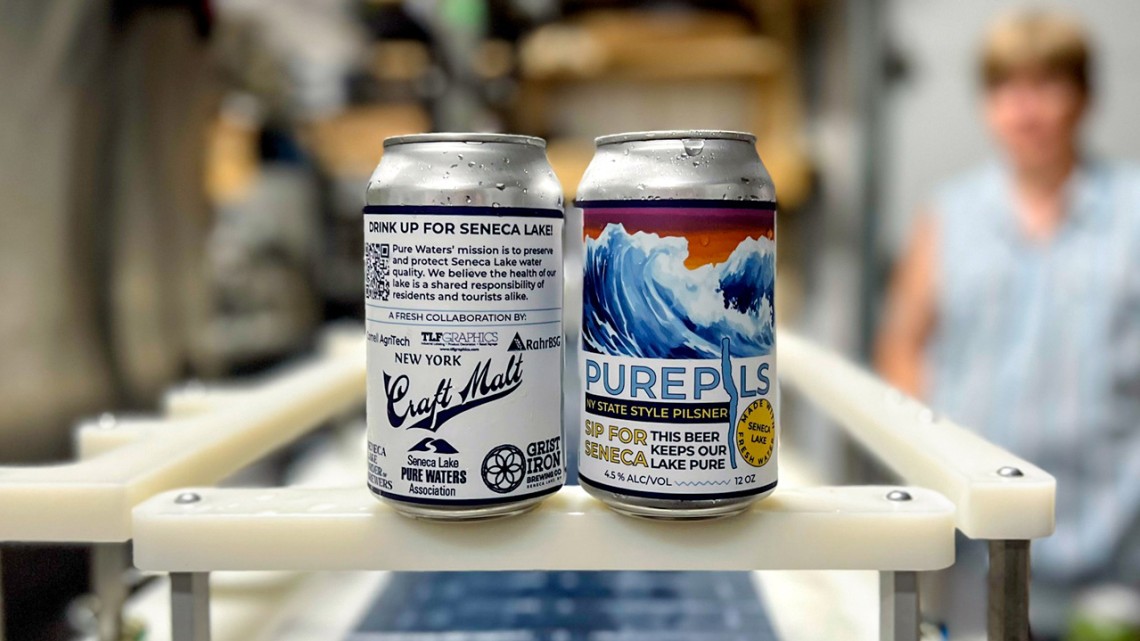
Cans of PURE Pils, the beer created this year with the help of the Cornell AgriTech hop breeding program.
Cornell AgriTech hops featured in Seneca Lake summer beer
By Laura Reiley, Cornell Chronicle
A heritage variety of hops likely grown in the Finger Lakes during Prohibition is now a key ingredient in a limited-edition beer created by Seneca Lake brewers for a regional beer celebration.
The beer, called PURE Pils, is made with a hop variety called Reality G, grown by the Cornell AgriTech hop breeding program. AgriTech is now focusing more closely on the variety.
Breweries around Seneca Lake teamed up to create the light pilsner-style beer with donated local ingredients as part of PURE Brew Week, July 25-Aug. 3. The event is a collaboration among Cornell AgriTech, the Seneca Lake Order of Brewers (SLOBs) and Seneca Lake Pure Waters Association.
PURE Pils, which also features barley grown in Penn Yan, New York, will be available at participating taprooms and restaurants around the lake. The beer’s proceeds will benefit the Seneca Lake Pure Waters Association, a watchdog organization that advocates for water quality in Seneca Lake.
The hops represent a promising development for local brewers, said Derek Edinger ’94, M.S. ’95, brewer and co-owner of Brewery Ardennes Taproom and Kitchen in Geneva, New York.
“We’re excited about everything Cornell is doing with the breeding program,” he said. “We’re all trying to use as many local ingredients as we can, but there’s more demand for New York hops than there are hops being grown here.”
Larry Smart, a professor in the Horticulture Section of the School of Integrative Plant Science in the College of Agriculture and Life Sciences, received Reality G from a farm in Virgil, New York. Smart has been collecting and researching heritage hop cultivars that were likely planted and grown in upstate New York during Prohibition. He has over 60 hop varieties in his demonstration hop yard in Geneva, with 32 plants of each variety.
It’s likely that Reality G has successfully survived in the landscape for decades without care or management. And it had another benefit over other cultivars Smart has grown: It had a high yield relative to other varieties and acceptable brewing quality.
“This was probably grown decades ago, and we have heard many anecdotes from folks who said their grandfather started growing hops on their farm during Prohibition to make their own beer,” Smart said.
At its peak, New York state was a huge hops producer, with tens of thousands of acres planted in 1890, Smart said. By 1905 or 1910, downy mildew wiped out New York’s hops industry and production shifted to the Pacific Northwest.
“Pretty much anything that has survived without any care is likely to have some resistance to downy mildew,” he said.
For PURE Pils, he and his team narrowed down the list of possible hop options to four varieties. “We passed the hops on to craft brewers to assess the brewing quality and collect consumer feedback,” he said.
Before a hop cultivar like Reality G can become a regular part of New York’s brewing landscape, Smart says a first step is making sure it is free of viruses.
“We will send it to a lab at Washington State University, which takes the plants and tests them to see if they harbor any viruses, and then clean it up, so that if a farmer wants to start planting, they are starting with clean material,” Smart said.
The next step is to identify nurseries interested in propagating it. “We don’t have hop nurseries in New York right now – we’ve sought grant money to try to encourage that,” he said.
For the past few years, the PURE Brew project has highlighted the importance of Seneca Lake water quality and has helped raise brand awareness for both Seneca Lake Pure Waters and the participating breweries in SLOBs, said William Roege, president of the association.
“We greatly appreciate the breweries’ support. All the funds are plowed back into a myriad of educational and citizen-science programs that have long-term benefits for the lake,” Roege said. “As a side benefit, the beer tastes very good.”
Media Contact
Get Cornell news delivered right to your inbox.
Subscribe
