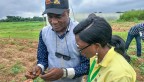
Cornell-led initiative boosts access to healthy cassava seed in Tanzania
By Canaan Boyer
A $4.8 million gift will allow Cornell and partners to expand a project to improve Tanzania’s cassava seed system.
The work is led by Cornell’s Equitable Agricultural Research Lab (EQUAL Lab) in the College of Agriculture and Life Sciences (CALS).
The funding will support Muhogo Bora, which means “Better Cassava for All” in Swahili, a collaboration between Cornell, the Tanzania Agricultural Research Institute (TARI) and the International Institute of Tropical Agriculture (IITA). Launched in 2021, Muhogo Bora works to ensure farmers have access to reliable, healthy planting material through a growing network of entrepreneurs, especially women and young farmers. The goal is to empower cassava entrepreneurs to distribute improved planting material in underserved communities in rural Tanzania, to strengthen the local seed system.
The gift, from an anonymous European foundation that made an initial $2.7 million donation, will support Muhogo Bora’s work through 2027. The funding will enable the project to expand its cassava seed entrepreneur network in underserved areas; strengthen support systems such as formal associations and links to markets; and introduce nutritious crops like orange-fleshed sweet potato and iron-rich beans. School-based demonstration plots will link agriculture, nutrition and education to improve food security and community resilience.
“This continued support reflects the progress we’ve made towards transforming the cassava seed systems in Tanzania,” said Hale Ann Tufan, associate professor in the School of Integrative Plant Science in the College of Agriculture and Life Sciences and co-principal investigator of Muhogo Bora. “Building on testing our model in the first phase, in this next chapter we will include interventions that enhance women cassava farmers’ market and reduce social barriers to their engagement in cassava seed systems.”
During its first phase, the Muhogo Bora project demonstrated the power of community-led agricultural innovation to drive rural transformation. It empowered 242 rural farmers – 67% of them women and youth – as cassava seed entrepreneurs (CSEs) across 192 villages in four regions of Tanzania. This level of inclusion is nearly triple what previous CSE-model projects have achieved. These CSEs distributed over 1.8 million improved cassava seeds, planted on 470 acres, reaching more than 5,000 farmers directly and an estimated 164,000 individuals indirectly. Improved varieties yielded up to 75% more than local ones, generating new income and food security for farming households.
“In Phase II, we’re taking this model to the next level,” said Kiddo Mtunda, the project’s technical lead in Tanzania. “By helping seed entrepreneurs organize into formal associations, we’re making it easier for them to access finance, certify their seeds together and market as a group. It’s about building a support system that lasts – one that helps farmers support their families, grow their businesses and lead lasting change in their communities.”
Canaan Boyer is the program manager for the Muhogo Bora project in the School of Integrative Plant Science
Media Contact
Get Cornell news delivered right to your inbox.
Subscribe