Durjoy Bhadra ’29, on the ropes course at Greek Peak Mountain Resort in Cortland, New York.
First-gen students, families, find camaraderie at Cornell
By Laura Gallup
When Durjoy Bhadra ’29 arrived on campus for his first year at Cornell, he worried that the Ivy League institution might be too big and prestigious for him to ever really feel at home.
“Not many people from my neighborhood or community go to these sorts of schools,” said Bhadra, a global development major in the College of Agriculture and Life Sciences. “I was afraid that I would be initially alone, and there would be no one like me, no one who shared my previous experiences growing up.”
But that changed, after Bhadra participated in First at Cornell, an all-expenses paid pre-orientation program that aims to ease the transition to college for first-generation students and their families. Bhadra was one of 40 students who attended First at Cornell Aug. 14-17, with sessions on campus and at Greek Peak Mountain Resort in Cortland, New York. The program included sessions on campus for their parents and families Aug. 16-17.

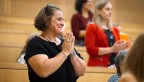
Transfer student Melissa Chowdhury, center, with her parents at the Statler Ballroom.
By the evening that he had arrived on campus, Bhadra was making his first s’more at a campfire alongside new friends under a sky full of stars. He’d never seen stars so clearly from his home in the Bronx.
“Even though we only spent a couple of days together, it feels like these people are my family now,” Bhadra said.
First at Cornell supports a significant portion of the student body, with 18% of the class of 2029 identifying as first-generation – those whose parents or legal guardians have not earned a four-year degree in the U.S. or abroad. It is run through the First Generation and Low-Income Student Support (FGLI) office.
“First at Cornell is about building a bridge,” said Michelle Van-Ess Grant, senior associate dean of students for Cornell’s Centers for Student Equity, Empowerment, and Belonging, which houses FGLI. “We want our first-generation students and their families to know from day one that they belong here, that their stories and strengths matter, and that they have a community ready to walk alongside them. By bridging gaps in access and connection, we are affirming that Cornell is not just a place they attend, but a place they can truly call home.”
The program began last year as a pilot project that served 16 students and 57 family members over the course of two days, thanks to an anonymous donor. With the support of a second anonymous donor, the program expanded this year, welcoming students from 10 states, with majors spread across six colleges and schools.
First at Cornell began over the summer with email communications and Zoom events hosted by program leaders detailing how to navigate Cornell’s many resources. At Greek Peak, the sessions focused on bridging knowledge gaps, normalizing common transition challenges and identifying strengths and strategies for academic success, and team-building through ropes courses.
Bhadra joined Van-Ess Grant on an early morning walk around Greek Peak where he learned about her first-gen experience as the child of Ghanian immigrants.
“It was really just nice and reassuring to know that as peers and as friends, we’re all here for each other,” Bhadra said. “But also, the faculty and staff, they’re also here for us.”
Parents and families joined a separate pre-orientation session on campus. It included free accommodations in Ithaca, a welcome reception, campus tours and workshops on Cornell’s academic structure, academic advising, semester structure, class schedules, Cornell terminology, how to support their students, residential living and opportunities for students to get involved.
For Bhadra’s parents, the experience offered relief and a sense of belonging. His mother, seeing the campus and meeting supportive staff, students and other families, told him that the program felt like a “first” not just for him, but for their whole family. His father added that even though he wasn’t the one attending college, he felt like he was learning a lot, too.
Bhadra emigrated to the United States when he was 2 and grew up translating English for his parents.
“Going through high school, I had this goal in my heart that I would go to one of the Ivy League colleges, and start a legacy for myself, for my family, and just start building something that my family wasn’t able to build,” said Bhadra. “Now I can build, not just for me, but for them as well, so that we all can share it together.”
The weekend culminated in a dinner in the Statler Ballroom and a Q&A panel discussion featuring students, faculty and staff. Many were also first-gen students, who talked openly about their own struggles adjusting to life at college.
“Before this program, I was initially really nervous and scared, and I wouldn’t take initiative and go somewhere if I was really scared about it,” Bhadra said. “But after this program, I’m ready to go visit all the offices on campus. I feel like I’m more confident in myself, and when I need help – I’m willing to build connections and get that extra help.”
Laura Gallup is a communications lead for Student and Campus Life.
Media Contact
Get Cornell news delivered right to your inbox.
Subscribe