Tropical kingbird
Lab of Ornithology hits 2 billion bird sightings, 3 million recordings
By Angelina Tang
The Cornell Lab of Ornithology and its eBird program, a participatory-science platform in which anyone around the world can submit bird sightings and sounds for scientists to use in research, recently hit a pair of major milestones.
The eBird program has officially hit 2 billion bird sightings, reflective of its surge in popularity in recent years and its enormous data contribution to the study of bird populations and habitats. The Lab also reached another milestone in August – 3 million sound recordings.
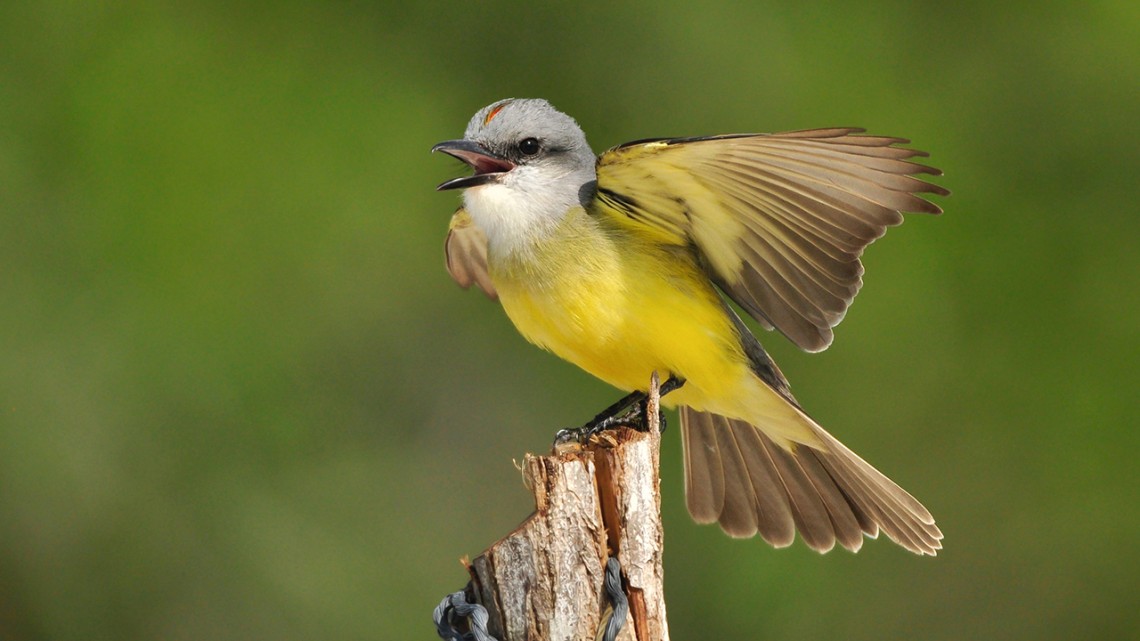
Somewhat fittingly, the 2 billionth sighting was registered by Alfonso Auerbach, a dedicated eBirder who has uploaded more than 8,000 checklists of bird observations since 2014. He glimpsed a tropical kingbird on June 2 in Honduras while on an afternoon walk; he didn’t think much of it when he uploaded it to eBird, but it turned out to be historic.
“It was a pleasant surprise,” Auerbach said. “It is an honor for me to contribute to this interesting record.”
The eBird program seeks to gather data on bird observations for scientists while providing resources to the birding community. When birders keep track of the number and species of birds they find and add these checklists of birds to eBird, their observations become part of a global database that scientists and land managers use for research and conservation. eBirders provide much-needed data at a scale that scientists could not achieve alone.
When eBird launched in 2002, the majority of users from the United States and Canada, but the program quickly gained traction in Mexico, and soon its popularity spread. Since then, eBird – which supports 99 languages – has amassed more than 150 million checklists from more than 1 million users around the world.
“In the early days, we had aspirations for being able to use eBird as a platform that would be able to gather a lot of data, but we didn’t really have any idea how we were going to do it,” said Christopher Wood, eBird program director. “There’s been all of this work across every aspect of eBird that has enabled growth like this … it’s humbling to be part of a team that’s doing this.”
eBird has helped bring birders together, connecting them with each other, nature and birds. “Posting a checklist [on eBird] always leaves me with great satisfaction,” Auerbach said. “I love posting, and on days that I don’t, I feel that something is missing.”
Researchers have used eBird data in more than 1,250 studies published in scientific journals. A paper published in Science in May used 36 million eBird observations to conclude that bird populations are declining most in areas where they have historically thrived across North America. Thousands of researchers and conservation practitioners download eBird data every year, according to eBird project co-lead Jenna Curtis, thanks to the size and scope of the eBird database.
Bird sound recordings shared with eBird checklists also power research, conservation, and the lab’s popular free Merlin Bird ID app. Tracy Mosebey submitted an eBird checklist that contained the 3 millionth recording – a common raven in Fulton, Pennsylvania.
“The collaborative efforts of millions of people around the world observing the birds around them and sharing that information with others gives us insight that we wouldn’t have any other way,” Curtis said. “It’s all part of this larger impact that eBird has in being able to help us understand birds better, and thus protect them.”
Wood is hopeful that as the platform continues to expand, its database can be leveraged in more partnerships with groups such as federal agencies and non-governmental organizations, whose decisions can impact which natural environments are protected and restored. These organizations can also encourage the public to take actions to protect birds in their own backyard, such as treating their windows to be bird-safe.
Mirroring its global user base, eBird has partnerships all over the world in order to make a more direct impact on local communities and birds. “We collaborate with hundreds of partner organizations across every continent,” Curtis said, “supporting local conservation efforts and ensuring that eBird and its data remain accessible and useful to communities worldwide.”
Curtis is excited for eBird’s future, noting that the program is projected to reach 3 billion bird sightings in only two more years.
“There’s a map of eBird coverage that looks like a map of the world at night, and every point of light is the location of an eBird checklist,” she said. “I would love to see that whole map filled in.”
Angelina Tang ’28 is a student editorial assistant for the Cornell Lab of Ornithology.
Media Contact
Get Cornell news delivered right to your inbox.
Subscribe