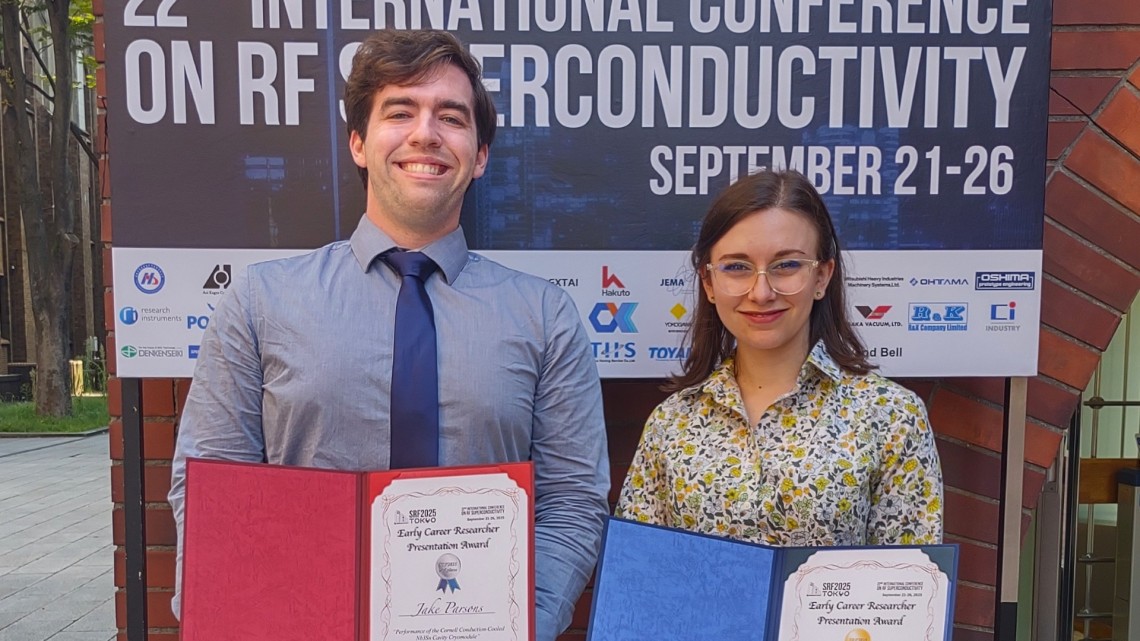
Nicole Verboncoeur (right) and Jake Parsons represented Cornell at SRF2025 in Tokyo, earning 1st and 2nd Prize honors for their research in superconducting radio-frequency science.
News directly from Cornell's colleges and centers
Cornell graduate students sweep top honors at international SRF conference
By Rick Ryan
Two graduate students from Cornell's Laboratory for Accelerator-based Sciences and Education (CLASSE), and the Center for Bright Beams (CBB), earned top international recognition at the 2025 International Conference on Superconducting Radio Frequency (SRF2025) held September 21–26 in Tokyo, Japan.
Nicole Verboncoeur won 1st Prize in the Early Career Researcher Presentation category for her work on measuring the superheating field in superconducting materials. Jake Parsons received one of two 2nd Prizes for his work developing a conduction-cooled superconducting RF (SRF) cryomodule. The awards were selected by the conference’s Scientific Program Committee based on the novelty, impact, and presentation quality of the work.
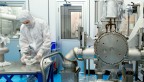
Verboncoeur’s talk, “Measurements of RF Magnetic Field Limits of Nb and Nb₃Sn,” presented her pioneering results on the fundamental magnetic field limits of superconducting materials used in particle accelerators. Using a unique sample host cavity designed and built at Cornell (called C-SHRP^3), Verboncoeur achieved record-high RF fields over 0.5 Tesla in microsecond pulses.
Her results confirmed that the limit of the metastable Meissner state, or the "superheating field", for niobium is approximately 200 mT. Using C-SHRP^3, she also performed the first ever superheating field measurements of Nb3Sn and found the fundamental material limit to be approximately 400 mT at 0 degrees Kelvin. These results represent the first ever temperature dependent measurement of an alloyed superconductor and set the record for the highest field applied to a superconductor in the Meissner state.
Verboncoeur is currently finalizing two journal articles for submission on this research.
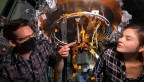
Parsons’ presentation, “Performance of the Cornell Conduction-Cooled Nb₃Sn Cavity Cryomodule,” highlighted the development of a compact, efficient SRF cryomodule cooled entirely by commercial cryocoolers, eliminating the need for liquid helium. Designed for high continuous-wave power operation, the prototype demonstrates the feasibility of conduction-cooled SRF systems that could one day power applications in medicine, clean water technology, and security scanning.
The SRF conference, first held in 1980, is an international meeting devoted to superconducting radio-frequency science and technology. Rotating between Europe, North America, and Asia, the biennial conference brings together researchers, engineers, and industry partners to share advances in materials, cavity design, and applications across physics and engineering.
Verboncoeur and Parsons’ awards reflect Cornell’s continued strength in SRF research and the important role its students play in advancing the field.
This work was supported by the US National Science Foundation, NSF, under Grant # PHY-1549132, the Center for Bright Beams, as well as the DOE under Grant # DE-SC002103
Media Contact
Get Cornell news delivered right to your inbox.
Subscribe