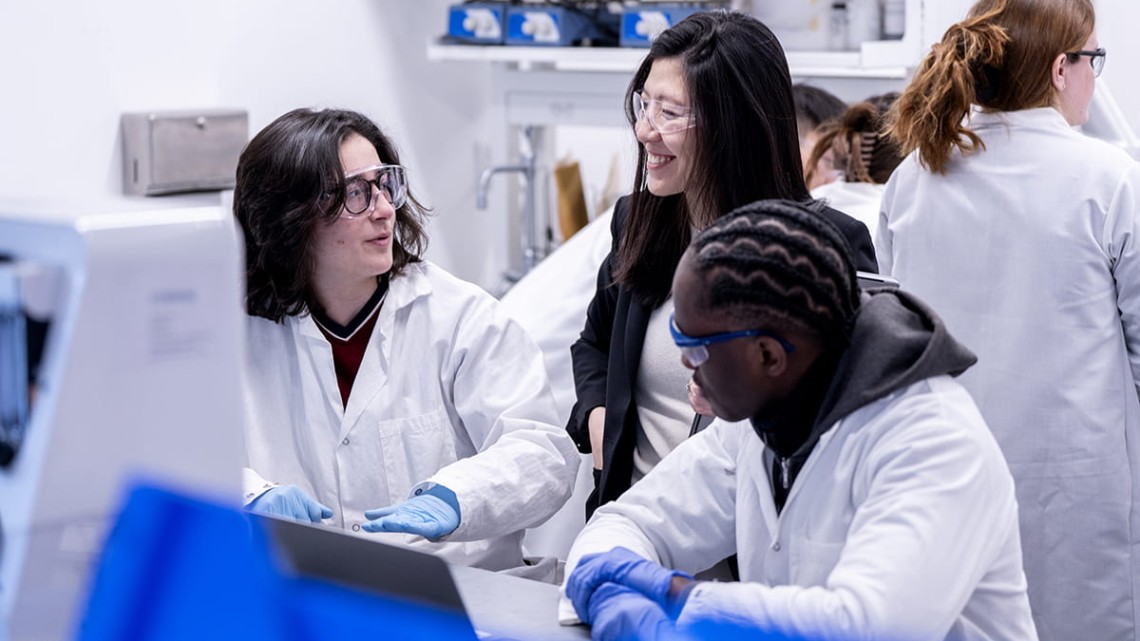
Rong Yang, assistant professor in the R.F. Smith School of Chemical and Biomolecular Engineering, Cornell Engineering, works with students in her polymeric materials lab to foster creativity, collaboration, and real-world problem-solving. Yang takes a holistic approach with mastery-based grading in assessing her students' learning.
News directly from Cornell's colleges and centers
Faculty share creative, alternative approaches to assessment in new CTI case studies
By Carolyn Keller
When you think about taking a big test, the words that typically come to mind are “cramming,” “high-stakes,” “prelims” and “all-nighter.” For students, the words seem to conjure stress by default.
But what if that wasn’t the case? What if words like “creative” or “alternative” applied to assessments instead?
Beginning in Fall 2024, several initiatives have researched and implemented new approaches to assessment at Cornell, with a goal of being able to share and circulate faculty ideas and experiences. These efforts resulted in the Center for Teaching Innovation creating two new series of case studies: one from the recipients of last year’s Creative Teaching Awards,’ themed “Innovative Assessment Practices,” and another from the Provost’s Working Group on Innovation in Assessment (PWGIA).
Assessment: stressful for students and faculty alike
The release of the Cornell Mental Health report in 2022 generated an ongoing push to develop and integrate innovative assessment approaches. The report found that competitive grading cultures and high-stakes testing models contribute negatively and unequally to stress and well-being amongst Cornell undergraduates, potentially impeding their ability to learn.
Developing inventive approaches to assessing student learning is “a challenge that extends across our disciplines,” Kavita Bala, provost, said in remarks at the Provost’s Teaching Innovation Showcase, held last April. “You don’t actually know what our students are learning. And that's a really tough nut to crack. What do [students] learn in that four months that they’re with you, and how much of that do they remember 20 years from now?
“Because that is your real goal,” she added. “Your real goal is to teach them something that they learn and keep with them… This aspect of thinking about how students learn is fundamental to what we do, and one of the hardest things for us to really get our arms around.”
Exams and essays may be a way for professors to determine how much their students are learning, whether they’re on track for their future courses, and whether they’re being prepared well for their future careers. But it’s worth considering whether current faculty approaches to assessment are meeting the ongoing challenges and creativity required to ensure students are truly learning.
Could exams be structured differently? Are there other ways to determine what and how much students are learning? And what might that look like?
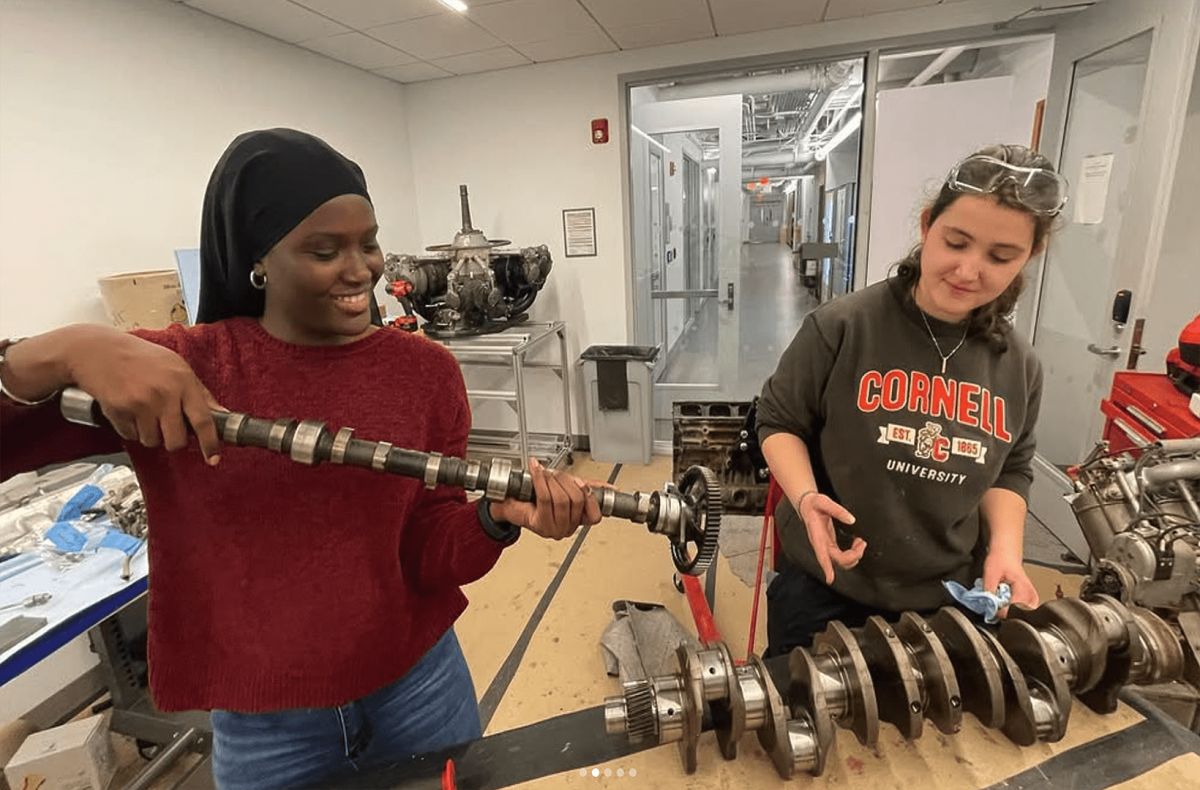
For Brian Kirby, the Meinig Family Professor of Engineering in the Sibley School of Mechanical and Aerospace Engineering, Cornell Engineering, giving students in his fluid mechanics course first-hand experience with real engineering equipment helps them synthesize and remember the course material.
Creative Teaching Awards: Innovative Assessment Practices
Case studies have been a part of the Creative Teaching Awards since their inception in 2023. Each year the office of the Vice Provost for Academic Innovation and CTI invite Cornell faculty to apply to the awards, whose theme changes annually. The 2024-2025 theme, “Innovations in Assessment,” recognized seven faculty across five projects and three colleges for their innovative approaches to measuring student learning.
Faculty projects included game-inspired, self-graded assessments for real-estate financial modeling; a holistic approach to mastery-based grading in chemical engineering; using oral assessments to reinforce and evaluate student learning in fluid mechanics; creating zines and a zine fest to demonstrate creativity and cultural competency in Spanish language learners; and using low-stakes assessments to improve teaching in micro and macro economics courses.
For the case studies, faculty recipients work with CTI instructional designers to document their efforts in the classroom, as a means of providing inspiration and support to their colleagues. Intended to be adapted for a variety of courses and learning environments, the case studies are crucial to the Creative Teaching Awards, as they aim to create space for faculty conversation and collaboration.
For Steve Jackson, vice provost of academic innovation, this ongoing work of evaluating teaching practices and rethinking approaches to assessment, poses an essential question: What can faculty learn from each other?
“We want to call out the great things faculty are already doing, but then also share it around the university,” Jackson said. “What can engineers learn from humanists? What can vet school faculty learn from the law school? One of the things I'm most struck by from last year's event and the work we've been doing around the university is how widespread our shared commitments as teachers are.”
Each case study, while more informal that what you’d see in an academic journal, offers a blueprint for integrating a fresh idea or teaching strategy into a course. The studies’ components include a summary and context for the faculty member’s approach, as well as a section on challenges, reflections and future directions, and a description of how the approach could be adapted in other courses.

A zine-making project in multiple Spanish language courses in the Department of Romance Studies, College of Arts & Sciences, fostered collaboration, creativity, and critical thinking among students. It involved workshops and hands-on activities and culminated in a Zine Fest, allowing students to share their work and engage with their fellow Spanish language students on multiple levels of mastery. The project was led by Silvia Amigo-Silvestre, senior lecturer of Spanish, A&S, and Emilia Illana Mahiques, lecturer of Spanish, A&S.
Eventually, CTI plans to build a library of case studies, to build on the growing collection from the Creative Teaching Awards. While not all case studies will have an assessment theme – last year’s CTA case studies revolved around creative responses to generative AI – this year’s next series of case studies from the Provost’s Working Group on Innovations in Assessment will also focus on new ideas for measuring student learning.
The Provost’s Working Group on Innovation in Assessment
Sponsored by the offices of the Vice Provost for Academic Innovation and the Vice Provost for Undergraduate Education, and led by Tim Riley, director of the Active Learning Initiative and professor of mathematics in the College of Arts & Sciences, and Rob Vanderlan, executive director of the Center for Teaching Innovation, the PWGIA consists of twelve faculty fellows who meet monthly during the academic year.
Participating faculty fellows design and implement innovative, student-centered alternative or authentic assessments into one of their courses, with plans to share their results with the Cornell community via case studies that can be adapted and put into practice.
Alternative and authentic assessments may sound strange to those whose exam experiences have been limited to cumulative exams, bubble sheets and the six- to eight-page paper. But they’re ultimately just centered on offering students other ways to demonstrate what they’ve learned.
Instead of traditional exams and quizzes, alternative assessments evaluate student learning through perhaps a portfolio, project, or presentation. Authentic assessments do the same by creating complex tasks that may mimic real-world applications, or scenarios in which students must apply their knowledge and learning in a professional or workplace setting.
Examples of this include alternative approaches to group quizzes and exams in a computer systems engineering course; using labor-based grading and reflections to develop students’ writing skills in a first-year writing seminar; supporting student well-being with peer-led study groups in a principles of biochemistry course; and using “ungrading” – a practice that moves away from or eliminates numerical or letter grades – in a communications course to incorporate feedback and critical reflection in developing student portfolios.
Centering student learning
Each of the case studies showcases faculty dedication to student learning, to the art of teaching, and its correlating art of assessment.
“Innovation in how we teach our students is, of course, a critical priority,” Bala said. “And [the Creative Teaching Awards] is an award series that's aimed at recognizing the methodologies and teaching implementations that bring new and exciting ideas to the classroom and to the education experience of our students. Our goal in honoring these efforts is to encourage this cross-pollination of these ideas.”
While the possibilities the case studies offer may be unfamiliar, the blueprints they offer can be a road map to rewarding, effective, and lower-stress ways to evaluate student learning.
Media Contact
Get Cornell news delivered right to your inbox.
Subscribe