News directly from Cornell's colleges and centers
Cornell Engineering sets ambitious goal for community-engaged learning
By Reeve Hamilton
Through a new collaboration with the David M. Einhorn Center for Community Engagement, Cornell Engineering will ensure that every undergraduate student in the college participates in high-quality, community-engaged learning experiences – providing all students the opportunity to apply their technical skills to real-world community challenges.
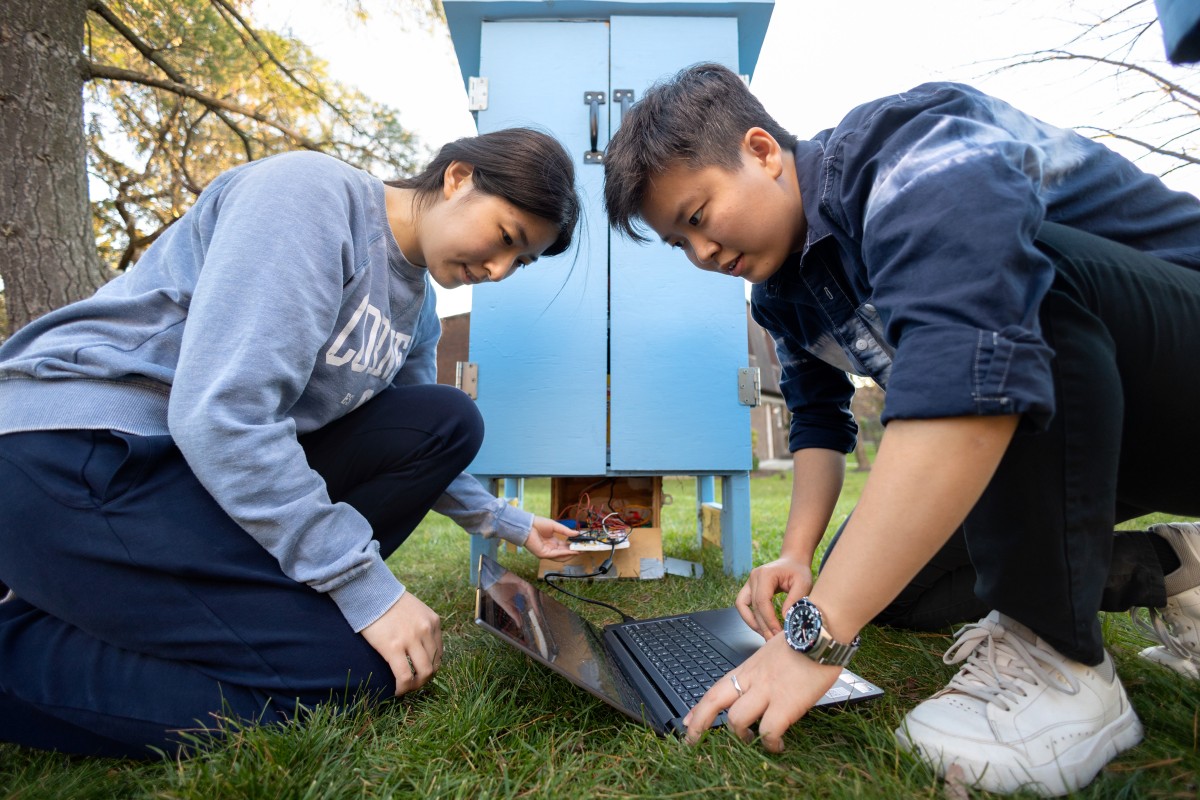
Cornell Engineering students examine a smart food-sharing pantry they designed and built for Mutual Aid Tompkins, equipped with custom wireless technology for real-time monitoring.
The Einhorn Center will provide $1 million over three years, as part of its Engaged College Initiative, to support an ambitious “engaged engineering” framework that combines Cornell Engineering’s strengths in experiential learning with impactful partnerships. The framework will provide multiple pathways for students to experience community-engaged learning at a range of scales, from hyper-local to global, with a variety of collaborators, including nonprofit organizations and industry partners.
“Community engagement has been central to Cornell Engineering’s identity since Cornell opened our doors as New York state’s land-grant institution nearly 160 years ago,” said Lynden Archer, the Joseph Silbert Dean of Engineering. "By partnering with the Einhorn Center, we're creating a comprehensive framework that will prepare students to become not only technically excellent engineers but also socially conscious problem-solvers — graduates who understand how to work with communities to create sustainable, impactful solutions."
The initiative addresses a growing demand among engineering students for learning experiences that connect their technical education to societal needs. Currently, Cornell Engineering students can participate in various community-engaged activities through courses, project teams, undergraduate research, internships and other opportunities. This includes ‘living laboratory’ projects, in which new technologies, techniques and ideas are tested and deployed in collaboration with campus partners.
As a designated Engaged College, Cornell Engineering will establish additional support structures for strategic planning and coordination, faculty development, curriculum development, and data gathering and analysis related to community engagement. Throughout and beyond the initial three-years of the partnership, the Einhorn Center staff will also provide expertise, consultation, data and other resources to help ensure success.

Cornell Engineering students carry sections of a pedestrian bridge they designed and built to help the campus community safely cross Fall Creek.
“We're thrilled to partner with a college that has deep roots in the university’s founding mission and a strong commitment to addressing society's most pressing challenges,” said Katherine McComas, vice provost for engagement and land-grant affairs. “The ‘engaged engineering’ framework will prepare all engineering students to be leaders who can bridge technical expertise with real-world impact."
To achieve its ambitious 100 percent participation goal, the college will work with its schools and departments to develop signature engaged programs tailored to their unique disciplinary strengths, with particular focus on integrating community engagement into the design courses and capstone projects that form the cornerstone of engineering education.
“By incorporating genuine community partnerships into our courses, we enhance students' learning experiences and outcomes by demonstrating the clear relevance and impact of their education,” said Max Zhang, the Irving Porter Church Professor in the Sibley School of Mechanical and Aerospace Engineering and a provost's fellow for public engagement. “However, course design is only one avenue to pursue for enhancing engagement. Ultimately, it is essential that we foster a college-wide culture that celebrates and supports our public engagement mission at every level.”
Zhang led the development of the college’s successful proposal to the Einhorn Center with Alan Zehnder, senior associate dean for undergraduate programs, and Miranda Swanson, associate dean for student services. He noted that many of the college’s established centers and institutes are well-positioned to contribute to the “engaged engineering” initiative, including the Selander Center for Engineering Leadership, the McCormick Teaching Excellence Institute, Student Project Teams, the Office of Inclusive Excellence, Engineering Communications Program, and the Office of Innovation and External Collaboration.
Cross-campus collaboration will also be essential for the initiative’s success, Zhang said. Cornell Engineering joins a growing network of units participating in the Engaged College Initiative, including the College of Architecture, Art, and Planning; the College of Human Ecology; the College of Agriculture and Life Sciences; Cornell SC Johnson College of Business; the School of Industrial and Labor Relations and the Cornell Jeb E. Brooks School of Public Policy.
“Beyond the impacts on the student experience, my firm expectation is that the partnership with the Einhorn Center will stimulate more – and more creative – mechanisms for our faculty to engage the broader public and enhance understanding about how and why our research makes a difference,” Archer said.
Media Contact
Get Cornell news delivered right to your inbox.
Subscribe