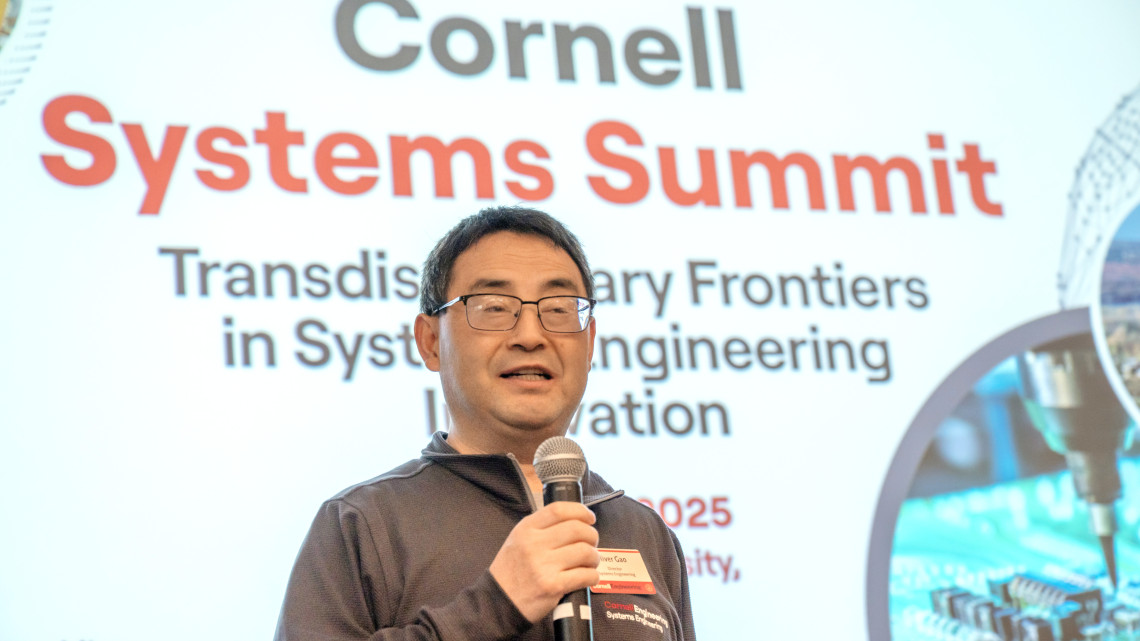
Oliver Gao, director of Systems Engineering, welcomes attendees to the second annual Cornell Systems Summit Nov. 2–4, 2025.
News directly from Cornell's colleges and centers
Cornell Systems Summit addresses future of systems engineering
By Diane Tessaglia-Hymes
The second annual Cornell Systems Summit was held Nov. 2–4 on the Cornell campus, bringing together international experts to discuss the future of systems engineering across sustainability, health systems and semiconductor manufacturing.
Hosted by Cornell’s Systems Engineering program – which is celebrating its 25th anniversary – the event featured keynote talks, panel discussions, student lightning presentations, hands-on demonstrations of student-built robots, and the bestowing of the inaugural Distinguished Systems Engineer Award.
“Our goal is to explore what’s next for research and education related to systems, and how to use this knowledge to maintain a cross-discipline dialog in the future,” said Clifford Whitcomb, executive director of systems engineering and summit organizer.
Whitcomb also emphasized the need to strengthen systems engineering education from K–12 through graduate programs, expand workforce development, and address the emerging challenges AI poses to model-based systems engineering, digital engineering, and sustainability – and to make this information available beyond Cornell.
Alan Zehnder, senior associate dean for undergraduate programs and professor in the Sibley School of Mechanical and Aerospace Engineering, highlighted Cornell Engineering’s investments in faculty development, teaching excellence, experiential learning and leadership training. Other guest speakers included Alan Benjamin, research analyst and portfolio manager, Fidelity Investments; Lindsay Anderson, professor and chair of the Department of Biological and Environmental Engineering in the College of Agriculture and Life Sciences; Yazdi Bagli, executive vice president, enterprise business services at Kaiser Permanente; Kashyap Yellai, science director for innovative research, Semiconductor Research Corporation; and Federica Robinson-Bryant, founder of Denotion Research Group.
Panel sessions explored workforce development, systems in higher education, and the integration of systems competencies into STEM and STEAM curricula. Expert speakers examined the rapidly evolving skillsets required for systems engineers – digital engineering, coding, domain knowledge, negotiation and practical problem framing – and noted that AI will reshape the field within the next five years and that industry-wide competencies will need to be redefined to match the changes. Panelists then met to synthesize summit findings and outline next steps, which the Systems Engineering program will use to plan the 2026 Summit.
Seven Cornell Systems Engineering Ph.D. students presented their work in five-minute lightning talks covering topics such as self-driving cars, cybersecurity, AI, sustainable energy systems and managing drought risk in New York City.
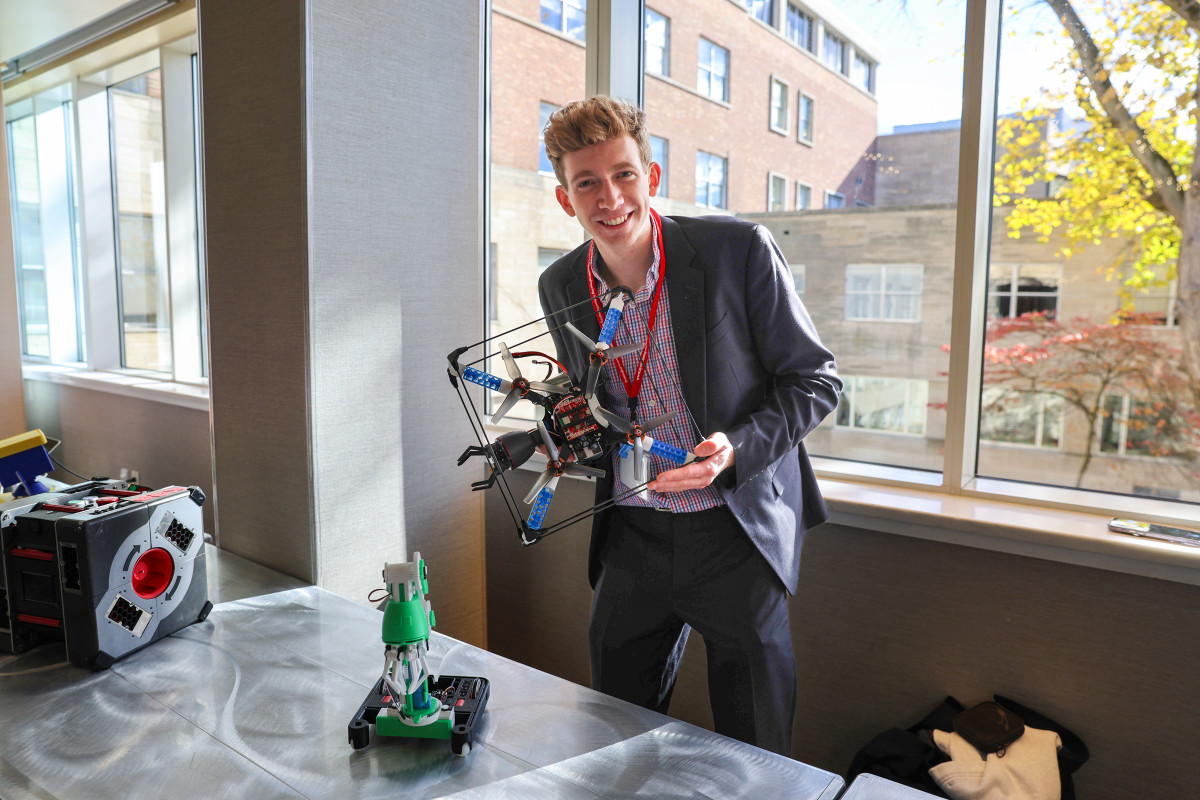
Keegan Lewick, M.Eng. ’25, holds his Air XRP drone.
Student projects using the 3D-printable XRP robotics platform drew strong interest. Demonstrations included an animatronic robot that used sound to detect distance in order to track a moving object; a modular robotic arm that used Cornell-designed, standardized hex-clip connectors instead of screws; and the Air XRP drone.
“This drone is 3D printable and is a safe, indoor, quad-copter with carbon fiber rods and flexible parts to absorb impact,” said Keegan Lewick, M.Eng. ’25, who designed and created the drone.
“Robotics development using the XRP is an excellent way to learn systems engineering,” said David Schneider, director of systems M.Eng. programs and XRP Consortium advisory board chair. “Doing it well requires integrating experience in computer science, mechanical and electrical engineering, and systems engineering to bring it all together successfully.”
He noted that the XRP is being used currently in 180 counties and that the consortium will address governors at the National Governors Association Winter Meeting in February 2026 to encourage nationwide classroom use.
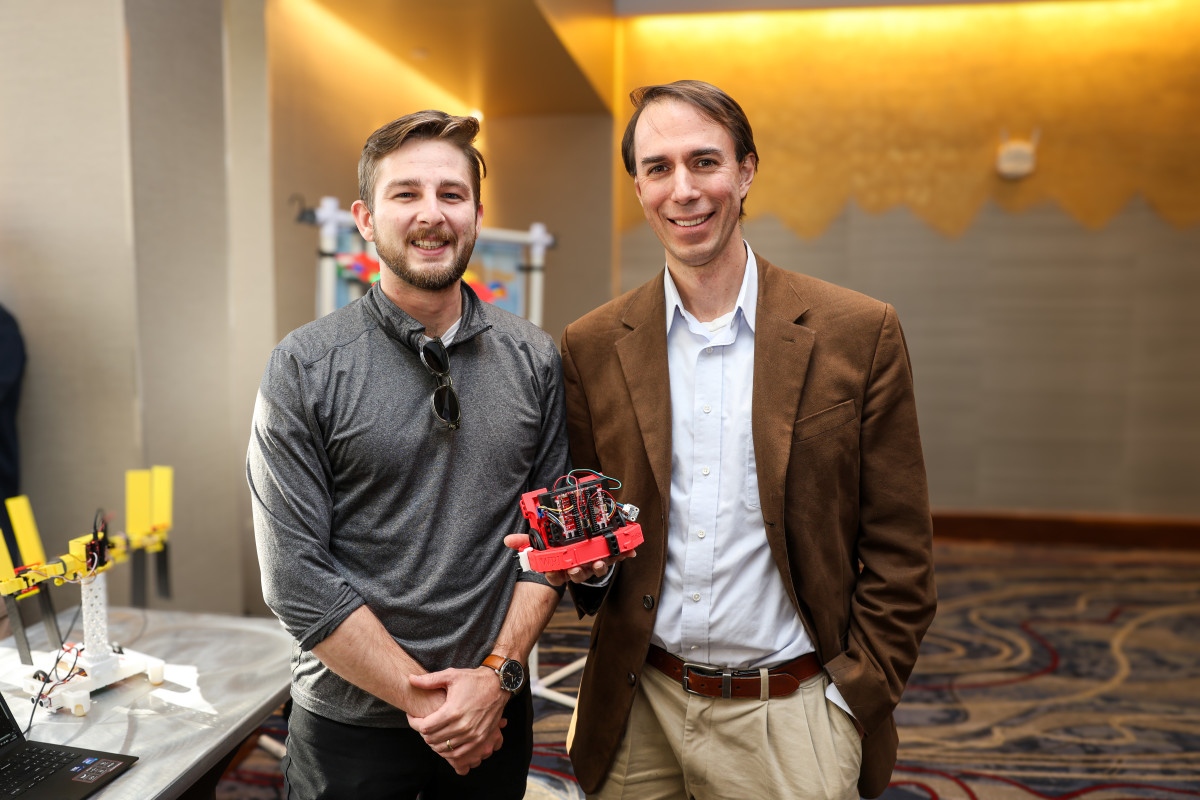
Jonathan Jaramillo, lecturer, left, and David Schneider, director of systems M.Eng. programs and XRP Consortium advisory board chair organized the XRP robot demonstration.
“This will be an incredible opportunity for Cornell Systems Engineering to make a significant impact,” he said.
A highlight of the summit was the presentation of the Distinguished Systems Engineer Award to Jeff Loren ’75 for his “exemplary leadership, enduring contributions to the systems engineering discipline, and his lifelong commitment to advancing the values and impact of Cornell Engineering.” During a career spanning more than 45 years that included flight testing and systems engineering at Boeing, technical management policy and guidance expertise for the U.S. Air Force and other Pentagon offices, and corporate thought leadership at the Science Applications International Corporation, Loren also served for more than 30 years on the Cornell Engineering Alumni Association board.
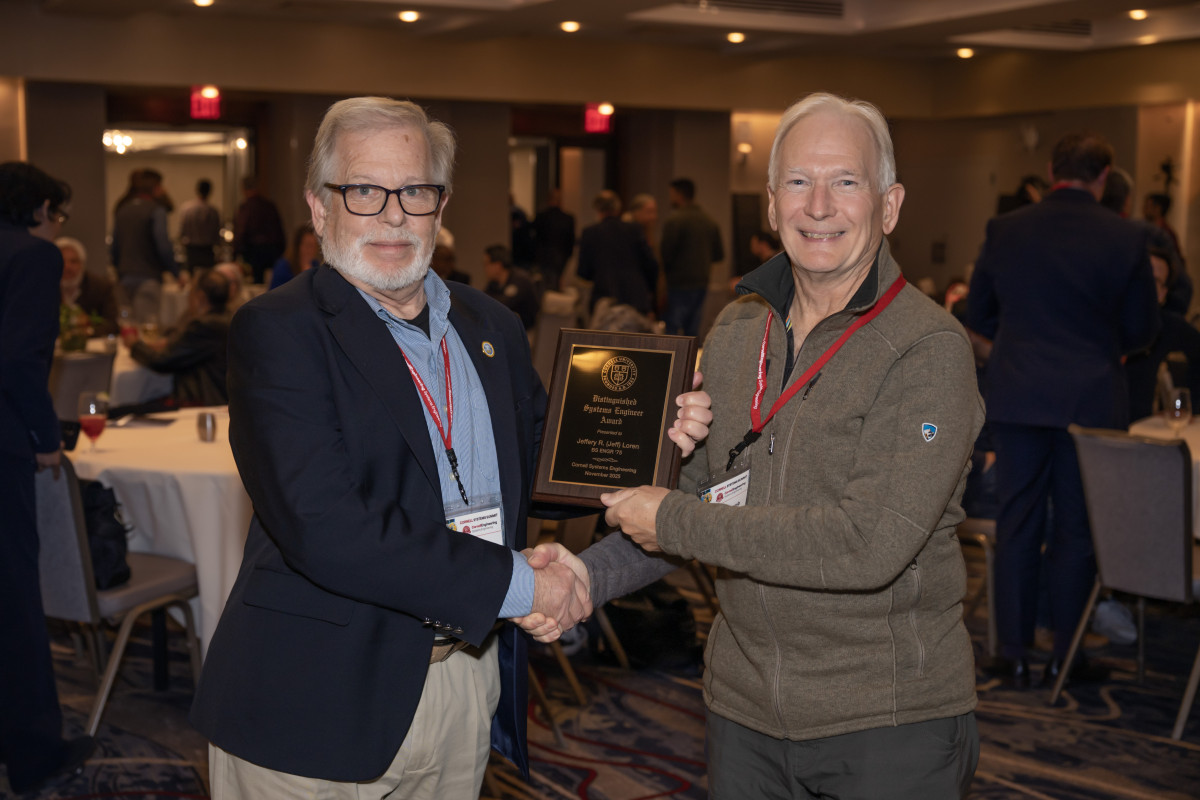
Jeff Loren ’75, left, received the Distinguished Systems Engineer Award from Clifford Whitcomb, executive director and director of graduate studies for Systems Engineering.
“I’m honored to receive this award, and humbled by the term ‘distinguished,’” Loren said, “It has been exciting to observe the growth of the Systems Engineering program since 2000, as well as the evolution of both core and departmental curricula and the continuing expansion of interdisciplinary programs across the college.”
Loren also thanked his colleagues in academia, industry, government and professional associations for their teaching, leadership, mentorship, wisdom and camaraderie.
“I’m more grateful than I can adequately express,” he added, “and I’m very much looking forward to what may come next.”
Media Contact
Get Cornell news delivered right to your inbox.
Subscribe