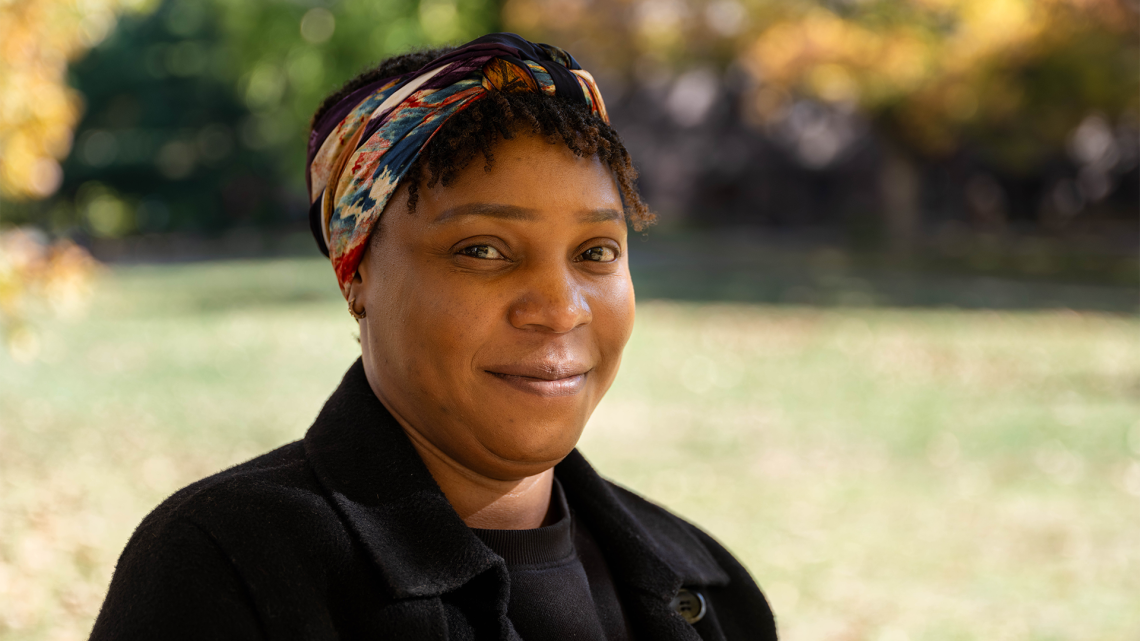
Shiela Muganyi, community research leader at the Zimbabwe Homeless People's Federation and member of Slum Dwellers International–Zimbabwe, visited AAP to share information about the importance of settlement upgrading with Architecture Assistant Professor Felix Heisel's Informal Futures studio.
News directly from Cornell's colleges and centers
Informal settlements generate collective empowerment through locally led action
By AAP
Further strengthening their ongoing collaboration with Slum Dwellers International (SDI), which has affiliates in more than 30 countries across Africa, Asia, and Latin America, the Cornell Mui Ho Center for Cities at the College of Architecture, Art, and Planning (Cornell AAP) hosted Shiela Muganyi from SDI–Zimbabwe this semester. Her visit included supporting the Informal Futures studio with Architecture Assistant Professor Felix Heisel as well as leading seminars, giving lectures, and meeting with AAP students and faculty. Muganyi shares her perspective on the impact of SDI's work, including the organization's successes and challenges, as well as the value of sharing resources across settlements, cities, and communities to increase access to basic amenities and improve living standards.
Could you describe where you grew up and what some of the biggest challenges you faced were?
I grew up in an informal settlement called Dzivarasekwa in Harare, Zimbabwe, where there is a lack of access to basic services such as water, sanitation, education, and housing. We rented one and a half rooms in a property that did not belong to us. When I was young, my mom had a stroke, and then my dad decided to leave us. My mom was bedridden, so I had the responsibility of taking care of her doctor's check-up every month. I had to drop out of school after my father, our family's only sole provider, left us. With no one else to support us, we couldn't afford my or my siblings' school fees, and I had to learn how to do hair so we could survive. I needed to provide food and pay school fees for my three younger siblings. It was very difficult, heading the household as a child.
What is your current role with Slum Dwellers International, and how did you come to work with them?
At Dzivarasekwa, some of my mom's friends said it was not fit for a sick person to be staying in such a situation and told her about Slum Dwellers International (SDI). My mom was very interested, but she could not walk or attend the organization's weekly meetings, so I went in her place and was the youngest person there. I grew to love the environment. I became a member of the saving scheme. They were very supportive and gave me a small amount of money to buy sweets and snacks to sell, to help generate more income while I was doing hair.
I started my journey with the Slum Dwellers International network as a community mobilizer. In SDI, we focus on community savings groups as the main way to organize and support urban poor communities. Through these savings groups, we supported communities in coming together, strengthening their collective voice, and engaging meaningfully with local authorities.
In Zimbabwe, this approach led to the establishment of city funds that support community-led upgrading. One of the first projects was the Harare Slum Upgrading Finance Facility, a collaboration between the Zimbabwe Homeless People's Federation, Dialogue on Shelter, and the City of Harare. I was among the pioneering loan officers for this initiative and also trained others as the model scaled up to other cities.
Over time, I also became interested in data collection, enumeration, and mapping. I ended up leading SDI's regional data collection team in Harare, and then the national Zimbabwe enumeration team. I was particularly interested in community research and understanding the issues faced by different types of informal settlements, as I was also part of an informal settlement myself. I was keen to know their experiences and also to learn about solutions. We ended up having settlement exchanges, city-to-city exchanges, and learned from each other to improve our settlements. Currently, I'm also doing a lot of research on climate change vulnerability assessments.
Continue reading on the College of Architecture, Art, and Planning website.
Media Contact
Get Cornell news delivered right to your inbox.
Subscribe
