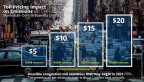
Congestion pricing improved air quality in NYC and suburbs
By David Nutt, Cornell Chronicle
Since New York City introduced congestion pricing in January 2025, the state has heralded significant reductions in traffic and rush hour delays, fewer crashes and noise complaints, and toll revenue projected to hit $500 million by the end of the year.
Now, Cornell researchers have tallied the environmental benefits. In the first six months of the program, air pollution – in the form of particulate matter 2.5 micrometers and smaller – dropped by 22% in the Congestion Relief Zone (CRZ), which encompasses all local streets and avenues at or below 60th Street in Manhattan. The team also reported declines across the city’s five boroughs and surrounding suburbs.
The findings were published Dec. 8 in npj Clean Air. The study’s co-lead authors are Timothy Fraser, assistant teaching professor in the Systems Engineering Program in Cornell Engineering, and postdoctoral researcher Yeonkyeong Gina Park, Ph.D. ’24.
Led by senior author Oliver Gao, the Howard Simpson 1942 Professor of Civil and Environmental Engineering at Cornell Engineering, the team based its analysis on real monitored data of air quality, traffic, neighborhood demographics and meteorology, all filtered through robust statistic modeling.
“Our overall conclusion is that congestion pricing in New York City, like many other cities in the world that have implemented it, helped not only improve traffic, but also helped reduce air pollutant concentration, improve air quality and should be good for public health,” said Gao, who is the director of Cornell’s Center for Transportation, Environment and Community Health.
The study follows a 2020 collaboration with the City College of New York to estimate the potential benefits for New York City for a range of different toll prices. For the new study, the researchers relied on daily data from 42 air quality monitors in the metropolitan area across 518 days, for a total of 17,758 observations. The pollutants being monitored, known as PM2.5, are particulates roughly 30 times smaller than a human hair.
The study found that, from January through June 2025, average daily maximum PM2.5 concentrations in Manhattan’s CRZ declined by 3.05 micrograms per cubic meter – a reduction of 22% compared to a projected average of 13.8 micrograms per cubic meter had congestion pricing not been implemented. During the same period, when the toll for passenger and small commercial vehicles at peak hours was $9, the overall volume of vehicles entering the CRZ decreased by about 11%.
The benefits didn’t end there. The study also noted average declines of 1.07 micrograms per cubic meter across the five boroughs and 0.70 micrograms per cubic meter in the broader geographic area.
For comparison, the Environmental Protection Agency recommends an annual average exposure of no more than 9 micrograms per cubic meter, while the World Health Organization’s recommendation is even lower at 5 micrograms per cubic meter.
“It’s really exciting to me that air quality improved throughout the entiremetro area,” said Fraser. “This tells us that congestion pricing didn’t simply relocate air pollution to the suburbs by rerouting traffic. Instead, folks are likely choosing cleaner transportation options altogether, like riding public transportation or scheduling deliveries at night. This thins traffic and limits how smog compounds when many cars are on the road.”
While Gao anticipated seeing a drop in pollution, he was surprised by the size of the decline – which was greater than what has been seen in other congestion pricing zones in Stockholm (5-15% between 2006 and 2010) and London (7% between 2019 and 2022).
“When I thought about that, it actually makes sense. Just look at how many people live in New York City compared to London and Stockholm,” he said. “As a result, you can see the impact of such a policy, the scope and scale, can be larger than what we observed in London and Stockholm.”
Gao’s group is now conducting system dynamic studies about how congestion pricing impacts driver behavior and the use of mass transit in New York City. And, just as they did for the Big Apple five years ago, the researchers are simulating the potential environmental benefits of congestion pricing in other cities, including Boston, Los Angeles and Chicago.
“Maybe in five years, those cities will catch up with their congestion pricing and cite our study,” he said. “This is how academic research can help inform the general public and, in turn, drive good policy.”
Co-authors include doctoral student Danni Lu, postdoctoral researcher Mohammad Tayarani and Haiyan Deng, senior lecturer in the Systems Engineering Program.
The research was partially supported by the Cornell Atkinson Center for Sustainability.
Media Contact
Get Cornell news delivered right to your inbox.
Subscribe