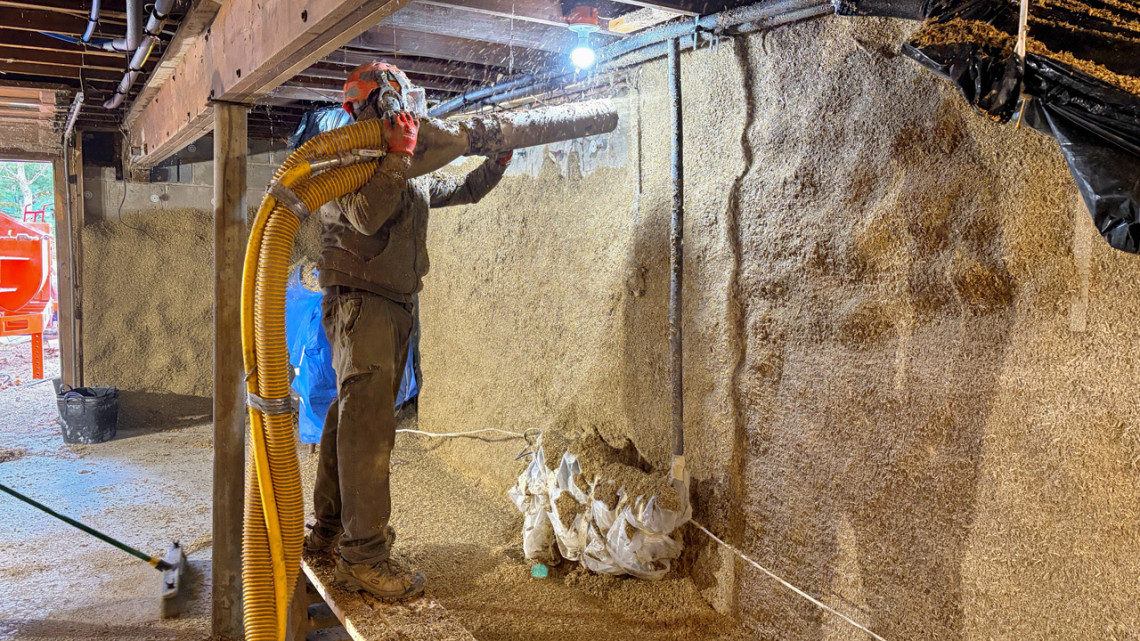
Builder Jeff Gagnon uses the Ereasy spray system - recently purchased by Cornell for community use - to insulate a basement in Ulster County with hemp lime, a composite of hemp hurd and lime binder.
‘Hemp house’ project kicks off new support for NYS hemp
By Caitlin Hayes, Cornell Chronicle
According to builder Jeff Gagnon, a space that’s been insulated with hemp materials stays warm in winter, cool in summer, emits no toxins and is as quiet as snow.
“It’s really apparent when you walk into the space – it feels similar to when there’s a fresh snowfall, that embracing quiet,” said Gagnon, a design builder at Rondout Natural Builders based in Ulster County, New York. “Like other natural building materials, hemp can really transform our relationship with our environments and how we live within them.”
In November, Gagnon was the first to use new equipment, purchased by Cornell, that sprays hemp lime – a composite of hemp hurd, processed from the stalks, and lime binder – onto or between walls as insulation. The system’s purchase launches a larger effort, funded by a $5 million investment from New York state, to build a hemp processing hub at Cornell, a “service center” where New York state businesses will be able to research, develop and prototype new hemp-based materials. The facilities and equipment will help farmers and businesses overcome barriers to the hemp industry’s growth in the state.
“The biggest need is investment in processing facilities,” said Larry Smart, professor of plant breeding and genetics in the School of Integrative Plant Science in the College of Agriculture and Life Sciences, and leader of Cornell’s hemp research and extension and hemp breeding program.
“The aim of this new project is to provide a facility with processing equipment that would be too specialized and expensive for a startup company to invest in,” he said. “We take that risk, acquire the equipment and have it ready to go for companies that want to develop new products or try a new process.”
The capital project will fund the construction of a code-compliant biomaterials processing building at the Cornell AgriTech campus in Geneva, New York, to house currently owned equipment and new processing equipment recommended by stakeholders in the industry, such as fiber cleaning equipment. The Ereasy hemp lime spray system, developed in France and licensed to Americhanvre in Pennsylvania, was the first piece purchased. It’s now housed at the Cornell Hudson Valley Research Lab and is available for loan to trained installers for their construction or renovation projects.
Cornell will also contract with Rensselaer Polytechnic Institute for the purchase of equipment that can take the raw materials processed at Cornell and turn them into usable building products.
The investment is creating momentum. Cornell Cooperative Extension (CCE) Ulster County, with funding from the county, held an at-capacity conference Dec. 9 that drew more than 90 stakeholders – from growers and community organizers to processors and investors – to discuss current research, best practices and opportunities, including the new equipment and capital projects, which are projected to be completed by early 2029.
For Gagnon, who used the new spray system to insulate a client’s basement in Ulster County, the investment and energy bring hope.
“This is a whole new approach to the built environment and to the materials we’re sourcing, and it’s going to take a lot of support,” he said. “Having Cornell as an ally, a hub for this regional supply network throughout the state, and the support from Ulster County – there are a lot of exciting prospects on the horizon as far as getting this bioeconomy moving.”
‘The story is shifting’
Industrial hemp, with its myriad uses, has huge potential: It can be used as a component in insulation, siding, flooring and other building materials; it can be woven into fabric or rope and pulped for paper products; and it makes for an excellent, high-protein additive for animal feed, among other uses. Distinguished from cannabis by its low concentrations of tetrahydrocannabinol (THC), hemp lacks the toxicity of many manufactured materials, stores carbon and grows well in New York state. Proponents imagine a bioeconomy that benefits New York farmers, creates manufacturing jobs and improves the safety and sustainability of the materials around us.
But it’s been a rough road for farmers and businesses working to establish a New York state industry. Many hemp growers entered the cannabidiol (CBD) market when it exploded in 2018 but then suffered two years later when that market crashed. The market changed again after New York state legalized recreational cannabis in 2021, with many switching to THC-producing varieties, but farmers and processors have struggled with regulatory uncertainty and permitting.
Cornell largely rode the wave with the industry, Smart said, initially working to develop cultivars for grain and fiber markets and helping improve the viability of the crop for New York. In 2018, researchers pivoted to help with CBD hemp – setting out to learn about the variety’s biology and production and passing on the knowledge through outreach and extension all over the state. Now, with fewer in the CBD market, and because cannabis remains illegal at the federal level, Cornell researchers have shifted focus again, developing cultivars and processes that would help stakeholders break into the building materials, textile fiber and animal feed markets.
Throughout it all, the potential for and grassroots interest in an industrial hemp market has remained.
“Up to this point, [taking on hemp] has been presented as a risk, so many have stayed away from it,” said Henry Gage, community organizer, senior project manager for the nonprofit Build Green Now and former president of the U.S. Hemp Builders Association. “But the story is shifting, this year in particular, and I think going into next year, that’s when you’re really going to see things start to happen.”
Gage sees Cornell’s new facility and equipment as a catalyst. With CCE specialists, he and his organization helped host a training in September to use the new Ereasy spray system; he plans more trainings in 2026 and expects interest from contractors across the state. Gage is also working to help communities manage hemp building projects and navigate barriers through a platform called Voices for Progress, which he launched at the CCE conference on Dec. 9.
“The things Cornell is doing are the things that the community is asking for, and there’s deep community appreciation,” Gage said. “Working with Cornell gives us the opportunity to develop a multidimensional strategy…a combination of community activism, which is what we bring, along with the science.”
With the new funding, Smart said he’s most excited for companies he’s seen struggle to get a foothold in New York state. He gave as an example Hempitecture, which was a Grow-NY winner in 2022 and has received support from the New York State Energy Research and Development Authority, but still faces hurdles. The company manufactures a hemp-based insulation, a direct replacement for pink fiberglass, but they currently make the product in Idaho, closer to their hemp supply, which is grown in Montana.
“Hopefully we can install the piece of equipment they need to develop this new insulation product, and that will give them the momentum to get more capital investment to build a full-scale processing and manufacturing facility here,” Smart said. “That’s what we want in the end – to build out new businesses and jobs in New York.”
Media Contact
Get Cornell news delivered right to your inbox.
Subscribe