Future restaurateurs sharpen their skills in remodeled food lab
By Holly Hartigan, Cornell Chronicle
River Aquino ’27 overturned a ramekin on a bed of finely sliced cucumber, lifting it to reveal a perfectly round stack of avocado, rice, vegetables, shrimp salad and seasonings, to applause from three fellow chef assistants. After this success, the group shifted to the fryer where chef instructor Christian Latimer taught them how to fire up a batch of truffle fries.
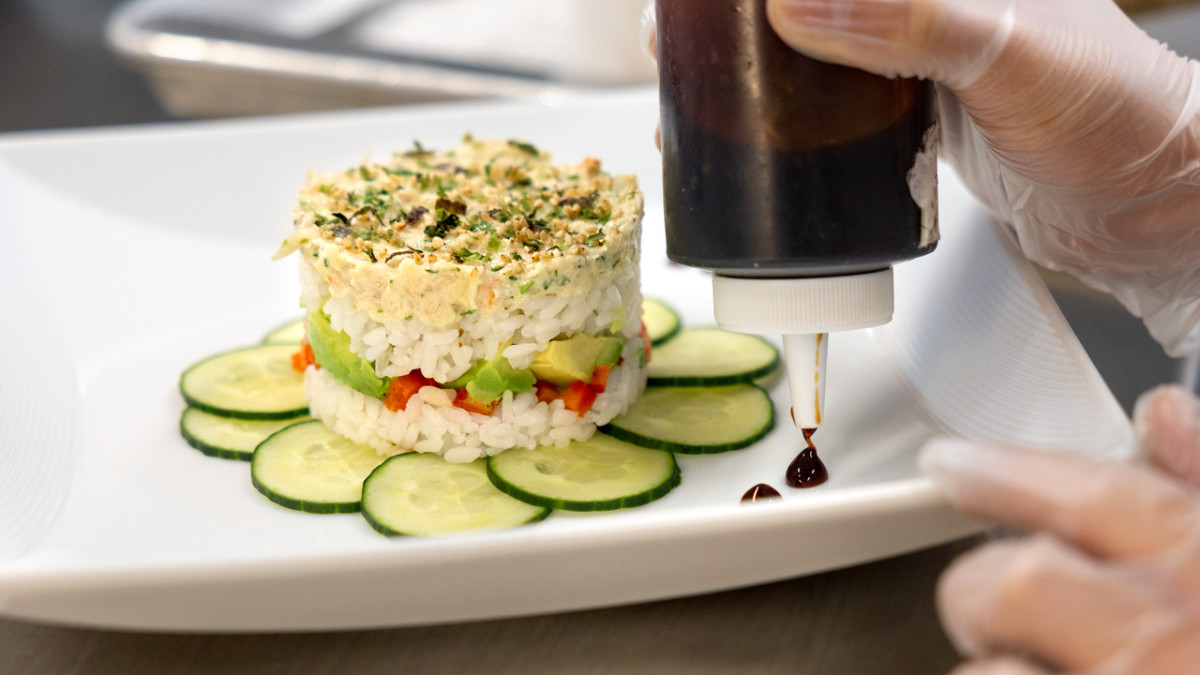
Chef assistants for the Restaurant Management course in the Cornell Peter and Stephanie Nolan School of Hotel Administration learned how to make a shrimp salad appetizer.
The students are chef assistants for this semester’s Restaurant Management class, a long-time pillar of the Cornell Peter and Stephanie Nolan School of Hotel Administration’s curriculum, and it was their first time cooking in the newly renovated Grailer Food Lab’s full-service kitchen.
“We can definitely tell that the kitchen here is built for efficiency,” said Isabelle Louis ’26. “It’s really nice to have a very efficient setup so that we can run a full-service restaurant while teaching and learning and having students understand how it works.”
The chef assistants, all hotel administration majors in the Nolan School in the Cornell SC Johnson College of Business, support the sophomores and juniors currently enrolled in the class as they learn all aspects of the food service business by running a real restaurant – Establishment – in Statler Hall.
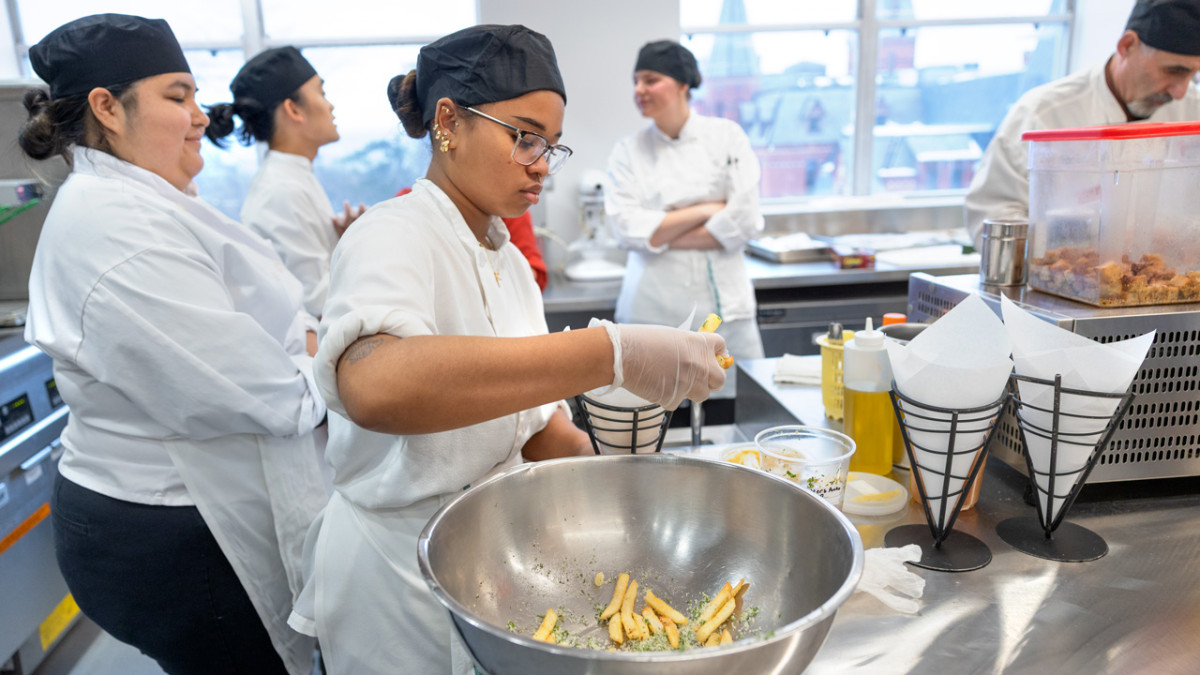
Chef assistant Nicole Beamon ’26, a hotel administration major in the Cornell Peter and Stephanie Nolan School of Hotel Administration, prepares an order of truffle fries in the new full-service kitchen space of the Grailer Food Lab.
The food lab recently reopened after two years of renovations. Its new floor plan divided the space into two: the full-service kitchen in the front and a teaching kitchen with 14 work stations in the back.
“The new layout of the lab is more conducive to learning,” said chef instructor Robert White, associate director of instructional support and lab operations in the Nolan School. “It’s much easier for us to teach in and make sure that everybody's getting the same information.”
A separate service kitchen will also make it easier to teach two classes at once and support clubs and special events like the student-run Hotel Ezra Cornell conference.
“It just looks bigger, even though it’s literally the same footprint,” said Heather Kolakowski ’00, senior lecturer in food and beverage management at the Nolan School.
The space is pioneering energy efficiency, too, going all electric and using induction technology for stoves, ovens and fryers. Induction heating uses a magnetic field to send alternating electric currents into a pan, heating the pan but not the burner, using less energy and cooking food faster than a gas flame.
“We don’t have any gas into the lab, which makes the environment that much better for us,” White said. “There’s no carbon monoxide, and there’s no residual heat from gas range tops.”
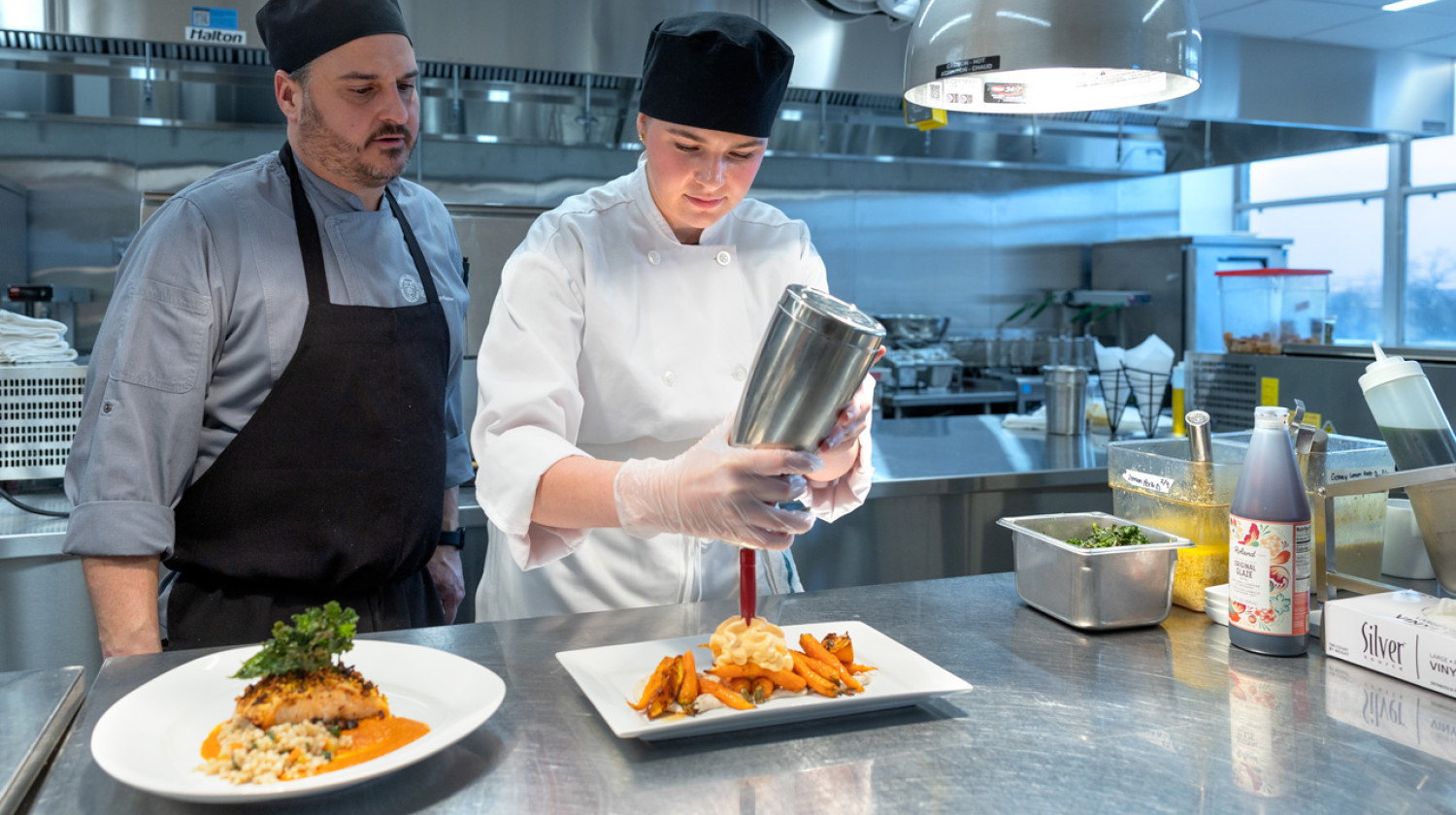
Chef instructor Christian Latimer (left) instructs Isabelle Louis ’26, a hotel administration major and chef assistant, how to add the finishing touch to the roasted carrots appetizer.
Learning to use induction will be a challenge, White said, but it also presents a great opportunity to decrease fossil fuel usage and learn to adapt.
“All of our recipes, everything that we do in there, is going to have to be modified to fit into an induction cooking environment,” White said.
As he started a couscous dish for the Restaurant Management class, Latimer demonstrated how a pot of water boiled in less than 90 seconds but reminded the chef assistants to keep the pot on the burner. Lifting and shaking a pot while cooking over a gas flame is second nature for some, but with induction that completely stops the heat transfer.
Commercial kitchens have not yet widely adopted induction technology due to cost, but it is likely the way of the future, White said.

The remodeled teaching kitchen inside the Grailer Food Lab has 14 student work stations, a chef instructor station at the far end and all-electric appliances.
“These students are getting trained on an all-electric kitchen. It’ll prepare them for what’s coming,” he said.
The lab was state-of-the-art when it was built in 1988 but badly needed updating, Kolakowski said.
“As an alum, I went to school in the old food labs,” she said. “This new environment is really exciting, and it looks phenomenal.”
Three alumni donors – Alan Rosen ’91, Susan (Guerin) Harrison ’83 and Alan Kanders ’87 – largely funded the renovation, along with an estate gift from C. Kenneth Grailer ’53.
“I think we positioned our lab to be one of the best in the country again,” White said. “I’m really proud of it.”
Media Contact
Get Cornell news delivered right to your inbox.
Subscribe