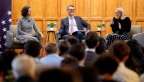
Global Hubs researchers probe war, how to keep peace
By Sheri Englund and Olivia Hall
With wars unfolding in far-flung places from Ukraine to the Horn of Africa, Cornell faculty are joining with international collaborators at Cornell Global Hubs to understand the organized violence of modern war – and find ways for nations to act together to keep the peace.
“We’re living through a transition period,” said Ruth Lawlor, assistant professor of history in the College of Arts and Sciences (A&S). “And we need scholars who study war and peace to help explain what is going on.”
Lawlor and Sabrina Karim, associate professor of government in A&S, both lead collaborations with Global Hubs colleagues in the United Kingdom that began with 2024 research seed grants from Global Cornell. The UK Hubs represent five partner institutions in a network of 26 universities worldwide.
Lawlor launched her project, “War and the State,” with colleagues at King’s College London (KCL) and University College London (UCL) to examine how war reflects and is shaped by the social structures and political and economic systems of the societies in conflict. She is collaborating with Jonathan Fennell, an expert on global dimensions of World War II at KCL, and with Nick Witham and colleagues at UCL, who bring expertise on liberal democracy and theories of the state to the project.
The researchers’ conversations in late 2023 launched a series of academic activities on the topic and ultimately led to an eight-point agenda that Lawlor describes as “a manifesto of sorts.” It outlines a new approach to war studies that an expanding network of scholars is adopting.
This innovative methodology focuses on war as a conflict not just between armies but between societies. It incorporates new research on civil-military relations, recognizing that the economic and social structures of warring nations – from race and gender hierarchies to divisions of labor and concepts of citizenship – are a central factor in understanding changes in battlefield tactics, strategies, new war technologies and other aspects of conflict.
The manifesto emerged from a series of virtual meetings that culminated in a symposium at UCL in May 2024 on the history of war and state power. A second UK conference, in Cork, Ireland, will bring the group together again this May to discuss whether military theorist Carl von Clausewitz’s famous definition of war as “politics by other means” still holds.
Conversations across three continents generated similar momentum for Karim and her collaborators on “From War at Home to War Abroad: Understanding the Experiences of Post-Conflict Peacekeepers.”
With support from the Global Cornell award, Karim joined forces with Maggie Dwyer, an expert in African studies and international development at the University of Edinburgh, and collaborators from West Africa for a May 2024 workshop in Edinburgh.
“That workshop was instrumental in helping us figure out what the data were saying,” Karim said, “because we could, for the first time, compare the qualitative findings that Maggie had with my quantitative survey findings.”
The team’s joint analysis uncovered significant differences in how peacekeepers from Liberia and Sierra Leone experienced their deployments. Liberians were more likely to say their peacekeeping activities improved security in host countries but also reported feeling less safe during deployment. In contrast, Sierra Leonean peacekeepers felt safer but were less likely to say they had made a meaningful impact.
The researchers attributed these differences to variations in postwar security reform and the different types of peacekeeping missions. The scholars also identified gender as a factor in the returned peacekeepers’ reported outcomes: Men had more physical and mental health problems, while women were more likely to experience social stigma and financial challenges.
“Men suffered more health issues because they were more likely to see combat or insurgent violence,” Karim said. “Women had more issues with stigma upon return because they were perceived to have been unfaithful” in their romantic relationships.
Women experienced financial issues, she explained, both as solo heads of households and “because money sent home from the mission was not properly used when they were not there to oversee what happened to it.”
The researchers shared these findings in October 2024 in a public webinar aimed at policymakers and practitioners and in a policy brief outlining the range of difficulties faced by African peacekeepers returning home. The team also has a paper under review at the journal African Affairs.
Their recommendations for the United Nations Department of Peace Operations include measures to support returning peacekeepers’ mental health, from exit debriefs to trauma screening and post-deployment traveling counselors. The recommendations also include support for financial stability, through post-deployment funds for lower-income returnees, financial literacy classes and recognition of professional achievements written in a way that matches domestic job requirements.
“At a time when the future of U.N. peacekeeping is being debated, our research shows how countries that once received peace operations can become contributors elsewhere,” Karim said. “This is because they have direct expertise on how to resolve conflicts, having experienced conflict themselves.”
Lawlor and Karim are steering committee members and core faculty of the Reppy Institute for Peace and Conflict Studies, part of the Einaudi Center for International Studies.
Sheri Englund is senior associate director of communications. Olivia M. Hall is a freelance writer for Global Cornell.
Media Contact
Get Cornell news delivered right to your inbox.
Subscribe