Local volunteer powers rural resilience with student support
By Susan Kelley, Cornell Chronicle
Since Beth Harrington moved to Caroline, New York in 1974, she’s served her community as a nurse, an EMT, a paramedic and a firefighter. Now 80, she’s been the president of the Slaterville Volunteer Fire Company for 30 years.
Her latest volunteer effort is addressing a key need in Caroline, with the help of three Cornell graduate students. The small rural town, about 15 minutes from the Ithaca campus, has limited internet and cell-phone coverage. Many older adults, who make up about 18% of the community, have no way of receiving information or help during emergencies like power outages.
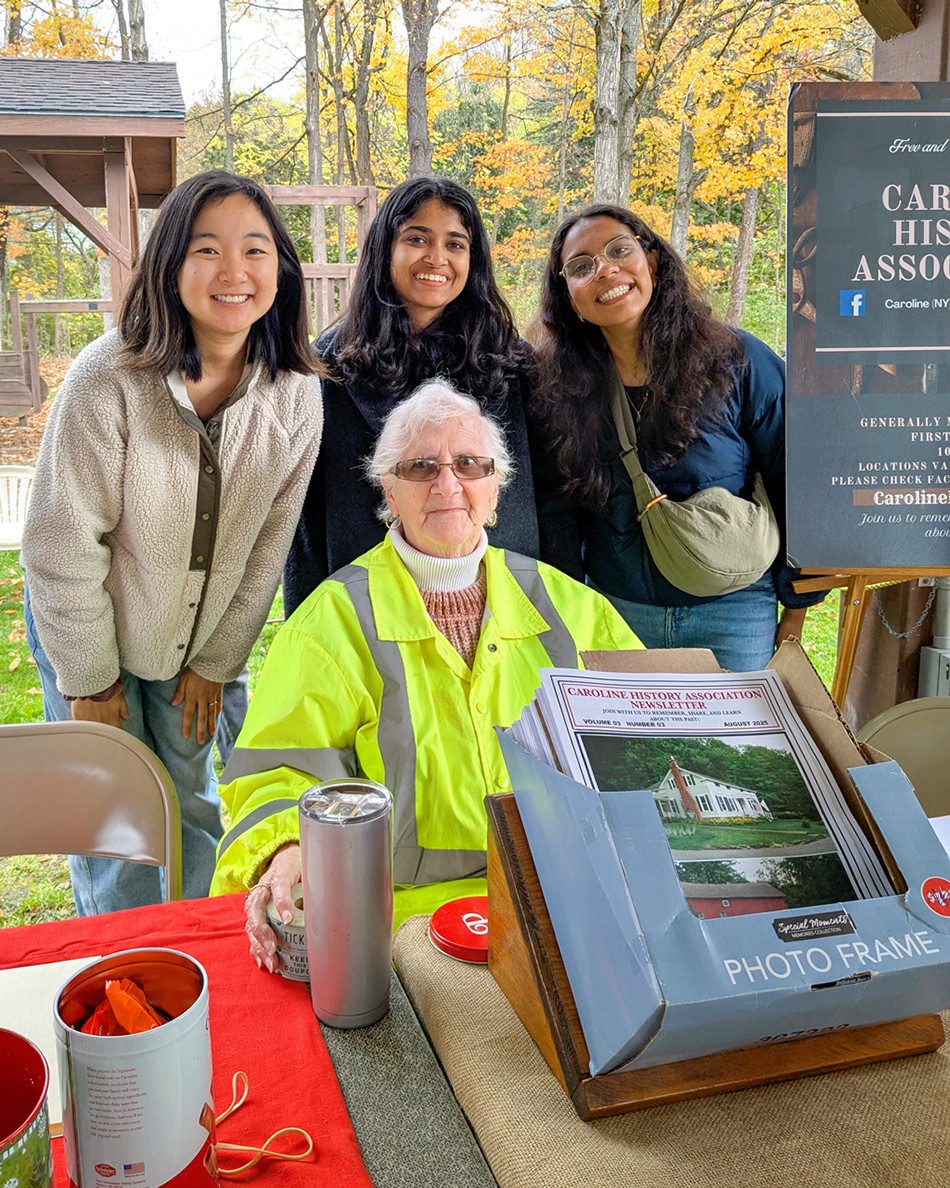
At center, Beth Harrington, president of the Slaterville Volunteer Fire Company in the Town of Caroline, visits with Cornell master’s degree students (left to right) Hannah Chow Russell ’19, Shreya Rangaraj and Kritika Vidyashankar.
So Harrington created an emergency preparedness working group to address the problem, with support of the students who helped shape plans and put them into action. The students developed a survey identifying residents’ most pressing concerns, which in turn led to a report and resource brochure aimed at helping the community make the most of its existing strengths.
On Feb. 5, Cornell will recognize Harrington’s work with the Debra S. Newman ’02 Cornell Tradition Community Recognition Award, which honors local residents who have demonstrated a strong commitment to service and/or leadership in community service.
“She is a voice for those whose needs are often hidden. She is proactive, moving quickly to make change happen, knowing who to talk with to get things done,” Hannah Chow Russell ’19, a master’s student in global development, wrote in Harrington’s nomination letter. “For decades, she has been creatively utilizing the Fire Department for diverse functions: hosting a caregiver respite program, a social dining program and community working groups.”
Caroline once had many multigenerational farm families, but the town’s demographics have become more transient in recent years. Nonetheless, Harrington and her neighbors have maintained community ties to make Caroline better prepared for emergencies than other rural towns, said Mildred Warner, M.S. ’85, Ph.D. ’97, professor of global development in the College of Agriculture and Life Sciences’ Ashley School of Global Development and the Environment. “They stood out as already thinking about their plan, thinking about moving forward,” she said. “In my view, they’re ahead of the game compared to all the other municipalities in the county.”
Student support
In spring 2025, Harrington reached out to Warner to ask if her students could help the working group figure out how to produce resilience in a rural context. “I had the question,” Harrington said. “I didn’t have any answers.”
She had already worked with Warner, students and Tompkins County on a separate countywide age-friendly planning project.
“I knew from working with Mildred and seeing the projects that her students had come up with, that they do a tremendous amount of research, that they were creative,” Harrington said. “Planning, to me, took on a much broader aspect than designing a building; planning included that sense of community.”
In the course, “Economic and Community Development Workshop: Age-Friendly Planning” in the College of Architecture, Art and Planning (AAP), students worked on a range of planning projects with an aging society in mind, Warner said.
Age-friendly planning can help everyone in a society, she said. For example, planning that assists elders with mobility or transportation issues also helps teens who can’t yet drive and families with small children. “We can all ride the ‘aging train.’ Demographic aging is coming, and the aging train is something women can ride, children can ride, families can ride,” said Warner, who is also a professor of city and regional planning in AAP.
The Caroline student team included Chow Russell and Shreya Rangaraj and Kritika Vidyashankar, who are both studying city and regional planning.
“The thing that helped us make a lot of progress is that Beth had a concrete vision for what she wanted,” Chow Russell said. “So it was easy for us to slot into that structure that they already had.”
The working group had created a survey to assess Caroline elders’ concerns about emergencies. It originally consisted of 50 questions, ranging from pet evacuations to vulnerable farm equipment.
But the students noticed the group kept saying their No. 1 one concern was a lack of communication, due to limited internet access and cell phone coverage and frequent power outages. “That was something I didn’t expect to be so top of mind for everyone, and that determined the approach we took,” Chow Russell said. “If they were really concerned about best communication methods in an emergency, we needed to design the survey around that, first and foremost.”
With the group’s guidance, the students whittled the survey down to five questions, which they distributed at the 2025 Brooktondale Apple Fest and online.
When they analyzed the 60 responses, they discovered Caroline residents were most worried about power outages; without generators, houses can drop to below-freezing temperatures. Residents were also concerned about falling at home and water scarcity.
The biggest surprise: 83% of respondents said they’d be willing to help their neighbors in an emergency – by transporting others, phoning or visiting, lending generators and helping with elder and child care.
“That said to me we were on the right track,” Harrington said, because it showed they could leverage community ties during emergencies. “If everyone thought about their neighbor to the left and the right, you’d have the whole area covered.”
The students compiled a list of resources and created a resource brochure residents could consult in a pinch. It includes emergency numbers to call in case of flooding or snow storms, churches, food pantries and heating and cooling centers. The information now also lives on the Brooktondale Community Center’s website. “Before, all this information was scattered. It lived in people’s email inboxes or in people’s heads, and it wasn’t all in one place for easy access,” Chow Russell said.
Last, the students compiled a report that offers other communities a roadmap to boost emergency preparedness using local resources.
Harrington was impressed. “It succinctly put into words what we were trying to do, what we have accomplished and what we might do to enhance it,” she said.
The project taught Chow Russell the power of a participatory approach. “Definitely there was sensitivity that our group took to go in, saying ‘We’re here to learn. We’re not here to prescribe. You are the experts, and we’re just here to support something you’re already working on,’” she said.
She is continuing to work with the Caroline working group as an independent research project in the spring semester. She has already helped launch the first gathering of emergency volunteers, who will meet Feb. 7 at the Slaterville Fire House. She invited the volunteers, set the agenda and is helping to organize the gathering.
Harrington is funding it, and other aspects of the effort, with the Newman Award’s $1,000 prize. She hopes the working group can expand the emergency volunteer concept to other parts of Caroline, she said.
“If you help one person or two people or three people who are your neighbors,” Harrington said, “then you’ve done what you need to do.”
Media Contact
Get Cornell news delivered right to your inbox.
Subscribe