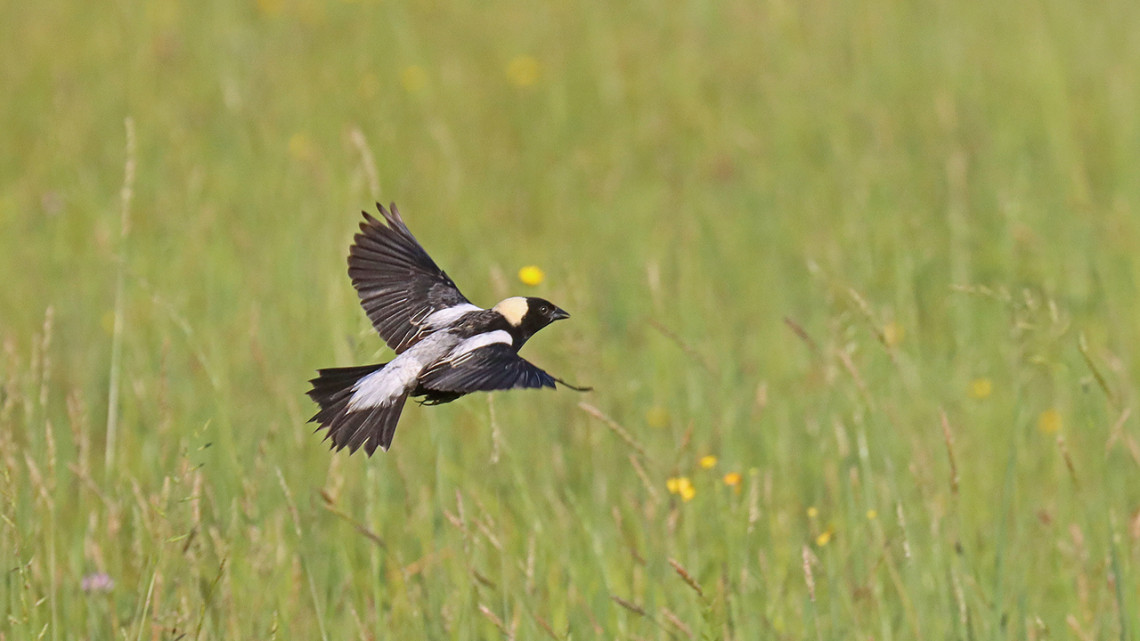
Smoke from Canadian wildfires in 2023 had a particularly silencing effect on the bobolink – an imperiled, highly social species that depends on grassland habitats.
Wildfire smoke silences grassland birds in NYS
By Caitlin Hayes, Cornell Chronicle
On a hazy day in June 2023, doctoral students Trifosa Simamora and Timothy Boycott noticed that the birds at their field site had gone quiet.
Now in a study published Feb. 19 in Biological Conservation, they show that the culprit was smoke from that summer’s record-breaking Canadian wildfires. The smoke dampened the songs and vocalizations of multiple species, with a particularly negative effect on already imperiled grassland birds and birds with ranges specific to the eastern U.S. The reduced communication came at an important time in the birds’ breeding cycle, when vocalizations attract mates and establish territories.
“Grassland birds are declining the most out of any group of birds, so it’s very important to understand the threats they face,” said Simamora, co-first author and current Ph.D. candidate. “This study provides a baseline, so in the future, when there may be more fires, we can have a better sense of how these events are impacting the species.”
The research, funded by the New York State Department of Environmental Conservation (NYSDEC), adds urgency to efforts to protect grassland species and their habitats. The team found that the bobolink – an imperiled, highly social species that depends on grassland habitats – showed the sharpest drop in communication.
“By understanding cumulative stressors, wildlife managers can better prioritize conservation efforts for grassland birds in the state,” said senior author Steven Grodsky, assistant professor in the Ashley School of Global Development and the Environment in the College of Agriculture and Life Sciences (CALS).
Researchers collected the data at 45 sites using passive, autonomous recorders from the Cornell Lab of Ornithology’s K. Lisa Yang Center for Conservation Bioacoustics. The team controlled for variables – such as rain, temperature, breeding stage – that also impact vocalizations. Species residing exclusively in grasslands and species with ranges restricted to the eastern U.S. were most impacted.
Researchers recorded a bobolink (in the foreground) and other birds at the Finger Lakes National Forest.
“There are grassland species in New York state that are not used to wildfire smoke,” Simamora said. “Part of the novelty of this research is that we’re looking at species that have not evolved to adapt to intense smoke, where the exposure is currently quite rare. But we’re showing that these negative impacts can happen in the future, as even more fires occur because of climate change.”
The researchers noted that the smoke from wildfires studied here differs in intensity from that of prescribed fire, which is known to be a beneficial management practice for grassland birds. And during a subsequent but less intense smoke event in July 2023, the researchers found that many of the species resumed vocalizations, which raises several questions for future research.
“We saw stronger declines in the first event, but they were at different points in the breeding season with different levels of smoke – so we don’t know if there’s a threshold response or if the responses had more to do with the point in the breeding season,” said Boycott, co-first author and current Ph.D. candidate. “There’s plenty more work to do.”
The study is an offshoot of a larger project investigating imperiled grassland birds and their interactions with solar energy development, which tends to occur on flat and open grasslands and agricultural lands.
“We’re studying these species because they’re in decline, and we’re looking at a potential threats – like solar development – but it’s also about understanding the existing suite of threats they are facing,” Boycott said. “This smoke exposure is another novel threat we’ve discovered along the way.”
The overall research program, including this study, helps inform NYSDEC’s conservation management.
“The next step will be to figure out where this novel stressor fits amongst all the other stressors, and to continue to fine tune our best management practices for conserving these species,” Boycott said.
To Simamora, that conservation is deeply meaningful. She described visiting grassland field sites in the Finger Lakes National Forest on summer mornings at 4 or 5 a.m., with mist moving in.
“It’s so beautiful and gives me peace and makes me feel connected to nature,” she said. “I hope that this type of habitat will stay like this for the future generations to enjoy, and that the birds can come back and breed again – and that we can welcome them here. We hope the paper garners more attention for these grassland birds.”
Connor M. Wood, research associate at the Cornell Lab of Ornithology, is a co-author. Grodsky is also assistant unit leader of the U.S. Geological Survey New York Cooperative Fish and Wildlife Research Unit, housed in CALS, and a faculty fellow at the Cornell Atkinson Center for Sustainability.
Funding for the study came from NYSDEC.
Media Contact
Get Cornell news delivered right to your inbox.
Subscribe