News directly from Cornell's colleges and centers
Cornell Atkinson: Financing the future of agriculture
By Krisy Gashler
The Dust Bowl of the 1930s stemmed from a catastrophic combination of economic and climate disasters, which led poor farmers in the south central U.S. to till up marginal land and forgo regenerative practices that protect long-term soil health. Recognizing the crisis, government agencies responded, supported by scientists, non-profit organizations and private actors. Among other things, they established federal crop insurance, guaranteeing farmers some financial stability in case of natural disaster, and devised incentives to encourage practices that improved soil and ecological health.
Almost 100 years later, farmers face different challenges: consolidation of smaller family farms into fewer, larger farms; policies that threaten growers’ ability to access necessary labor; tariffs jeopardizing markets and undercutting profits; and climate change increasing the frequency and severity of major weather events.
But the answers are similar, according to Miguel Gómez, faculty director for the Cornell Atkinson Center for Sustainability: collaboration in good faith between public, private and non-profit sectors; high-quality, scientific research that supports public policies and corporate practices; and recognition that short-term profits can only be sustained by long-term investment in our natural resources.
“Even though the challenges are many, farmers are super smart people and the agricultural sector is resilient,” said Gómez, who is also the Robert G. Tobin Professor of Applied Economics and Management in the Dyson School of Applied Economics and Management. “I am hopeful that we will be able to address and overcome these challenges, as we have overcome others in the past.”
To respond to these challenges, Cornell Atkinson is collaborating with public, private, NGO, and fellow academic partners to develop research, training and partnerships that will help finance the future of U.S. agriculture. These efforts include a new research collaborative focused on agricultural finance and insurance, which is offering grants to U.S.-based land-grant universities and industry partners to discover and disseminate finance and insurance solutions for farmers and ranchers. And a new executive leadership program for sustainable agriculture professionals – which began in February 2026 – is bringing together 29 professionals from financial and agricultural organizations to build connections and develop strategies to drive sustainable agriculture.
Finance and Insurance Research Collaborative
Climate change is already impacting farmers and decreasing agricultural yields. A report from Cornell Atkinson, Environmental Defense Fund (EDF) and Kansas State University tracked 39 years of data from Kansas farms and found that for every 1 degree Celsius of warming, yields of major crops like corn, soybeans and wheat fall by 16% to 20%, and net farm income drops 66%.
In response to this crisis, food giants like Cargill, PepsiCo and Walmart have developed plans to support farmers who seek to adopt regenerative practices that will sequester carbon, protect soil quality, reduce water use or improve biodiversity. The U.S. Department of Agriculture in December 2025 announced its own strategy to encourage regenerative practices.
The hard part is connecting the dots between organizations that want to scale regenerative agriculture, research that fleshes out the practices and policies that are truly effective, and farmers who need the right financing to adopt new practices, said Alan Martinez, lead for climate and nature finance on Cornell Atkinson’s Strategic Partnerships team. Cornell Atkinson, EDF and the Foundation for Food & Agriculture Research (FFAR) have launched their new Resilient Agriculture Finance and Insurance Research Collaborative to connect some of those dots.
“Across the country, the challenges differ. In the west, you have issues of water scarcity. In California, there are risks associated with wildfire. In the Northeast, we’re concerned about things like reducing nutrient pollution into waterways to prevent algal blooms and negative biodiversity impacts,” Martinez said. “By bringing together not just researchers at Cornell but from across the country, alongside public and private partners who can make use of that research, we aim to create a critical mass of people focused on these issues and quickly advance new financial strategies to support regenerative agriculture.”

Hosted at Cornell in Washington's Wolpe Center, EDF, FFAR and Cornell Atkinson brought together researchers and leaders from the finance and insurance sectors to explore opportunities through the newly launched Resilient Agriculture Finance and Insurance Research Collaborative. From left: Maggie Monast (EDF); Vincent Gauthier (EDF); Alan Martinez (Cornell Atkinson); Mai Lan Hoang (EDF); Olivia Shoemaker (FFAR); Allison Thomson (FFAR); Gillian Woodward (FFAR); and Sarah Zoubek (FFAR).
Key priority themes that research teams will address include: financing the transition to resilient practices; aligning resilient practices with risk and insurance outcomes; and valuing resilience in farmland and mortgage markets. This collaboration builds on the success of ongoing work: Cornell and EDF are already partnering with a major agricultural lending institution on a long-term study to assess how soil health practices like reducing tillage or planting cover crops impact long-term land values. The project, led by Vincent Gauthier, senior manager of climate-smart agriculture at EDF, and Ariel Ortiz-Bobea, associate professor of applied economics and policy, will ultimately be used to create frameworks that farm lenders could apply when issuing mortgages to support growers who use regenerative practices.
Farmers have always understood the value of conservation practices that protect soil health, but adopting them often involves risk, additional expense, and short-term loss, said Allison Thomson, scientific program director for FFAR.
“However, the farmers who adopt these practices have more resilience to continue producing crops over the long term,” Thomson said. “What we really need to shift into a higher gear of transition is to build these practices, and fair valuation of these practices, into the financial products that farmers are already familiar with. This is why working with lenders and insurance companies from the outset is so important.”
Strengthening sustainability leaders
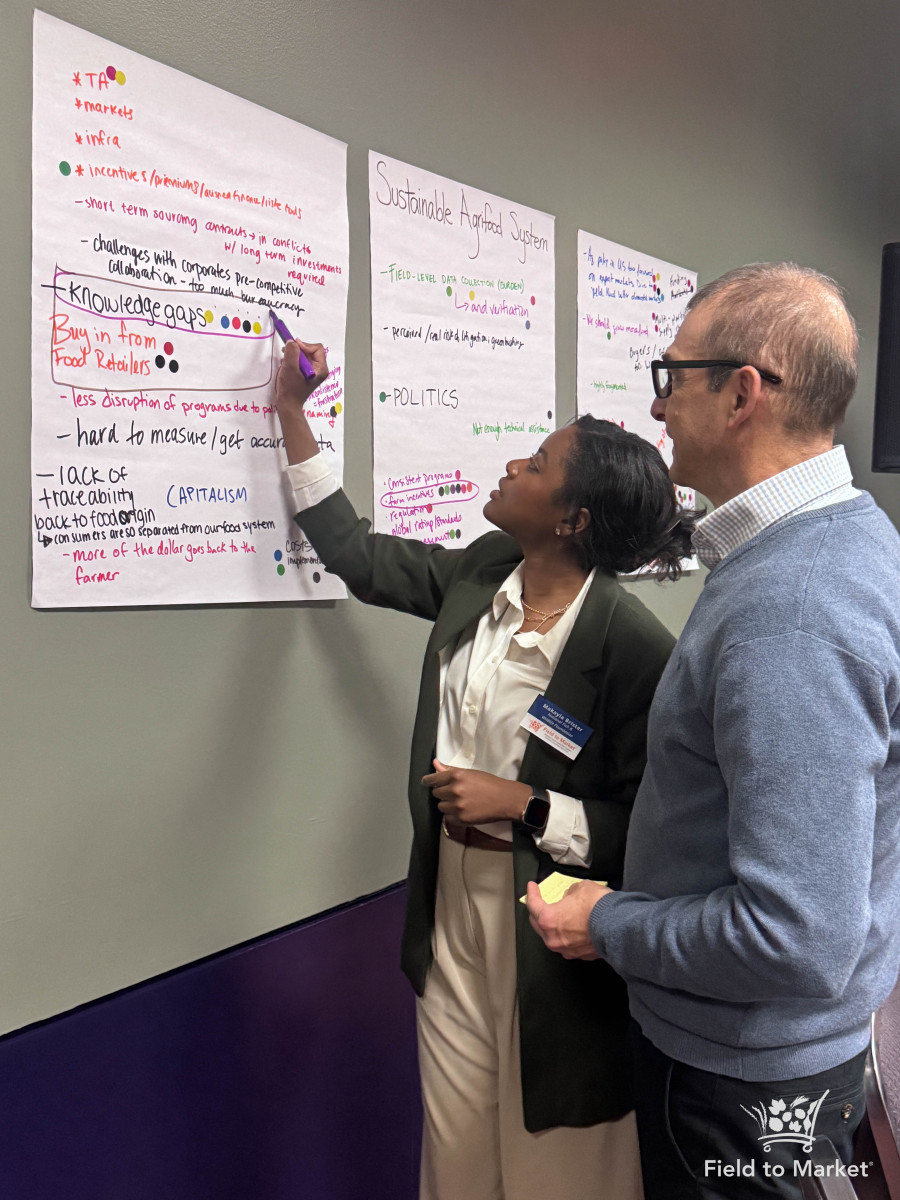
The 2026 cohort of the Resilient Futures Leadership Program gathers for module one focused on global, national and farmers perspectives at the Commodity Classic in San Antonio. From left: Makayla Brister (NFWF) and Miguel Gómez (Cornell Atkinson)
Another crucial way to connect research and finance to sustainable impact is by training the leaders who are capable of making agriculture and the food, fiber and fuel supply chains more sustainable. That's the primary goal of the Resilient Futures Leadership Program, a collaboration between Cornell Atkinson and the non-profit Field to Market, Gómez said. The six-month program launched in January 2026 and includes virtual meetings and in-person programs in agriculture, finance and sustainability, and in-person modules at the Commodity Classic (the largest, farmer-led conference in the U.S.), at Cornell’s Ithaca campus, and at the Cornell Tech campus in New York City. Students will learn about agricultural economics, global and U.S. policy landscapes, financial mechanisms and case studies, and on-farm implementation realities – with visits to Cornell and private farms.
The first cohort of 29 students includes mid-to-senior level professionals in agriculture and finance, including employees of Nestlé Purina, Bayer, Cobank, the agricultural technology company Indigo Ag, and the non-profit Intertribal Agriculture Council, Martinez said. Field to Market is leading the program with academic leadership from Cornell Atkinson and delivery support from eCornell.
“A key outcome of this program is developing a holistic, systems-level vision for a sustainable farming sector – one that aligns incentives and creates value for every stakeholder in the supply chain,” Gómez said. “I don’t have all the answers – I will learn in this program. By bringing together 29 executives who represent diverse segments of the food and fiber supply chain, the program creates a dynamic environment that naturally fosters learning, connection-building and the kind of dialogue needed to tackle complex challenges.”
Krisy Gashler is a writer for the Cornell Atkinson Center for Sustainability.
Media Contact
Get Cornell news delivered right to your inbox.
Subscribe