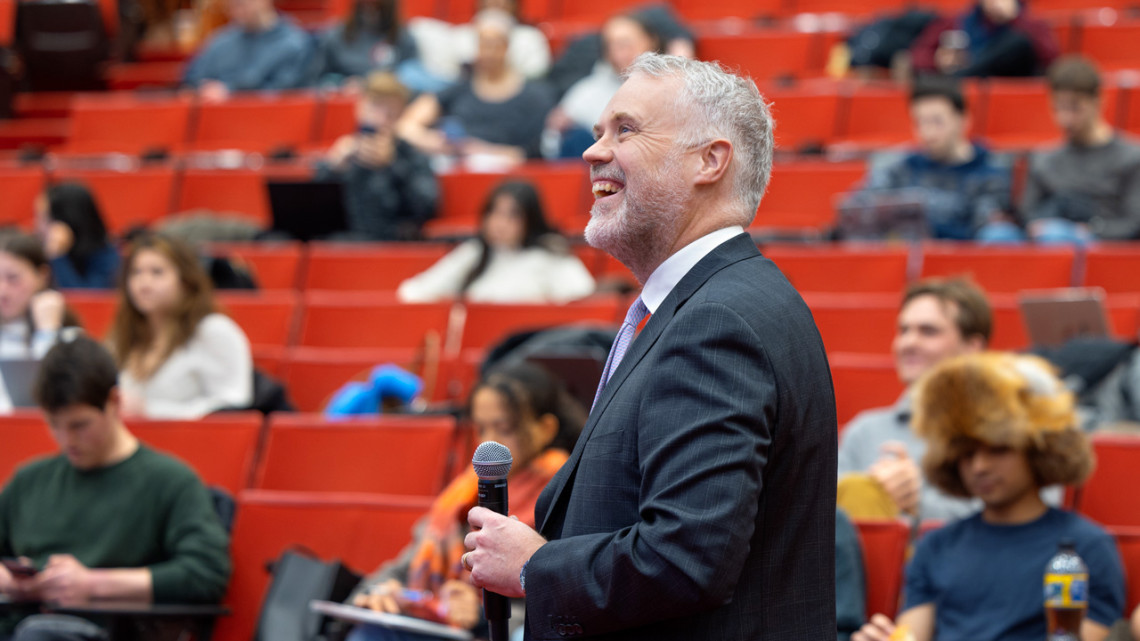
Peter John Loewen, the Harold Tanner Dean of Arts and Sciences, leads his government class, Disagreement.
Course introduces students to constructive disagreement
By Kathy Hovis
At the end of every one of his Wednesday evening classes, Peter John Loewen, the Harold Tanner Dean of Arts and Sciences, asks students two questions: How many of you changed your mind about this topic? How many of you are less certain about your opinions after listening to this disagreement?
Many hands flit up after each question, and Loewen said his own opinions have shifted a bit as well. The class, Disagreement (GOVT 1109), brings speakers together each week for a discussion about one of today’s most contentious issues: immigration and family size, for example; or the merits of democracy, capitalism and progressivism. Students prepare for the discussions with related readings, and writing assignments include a final project requiring them to disagree with a classmate and reflect on the process.
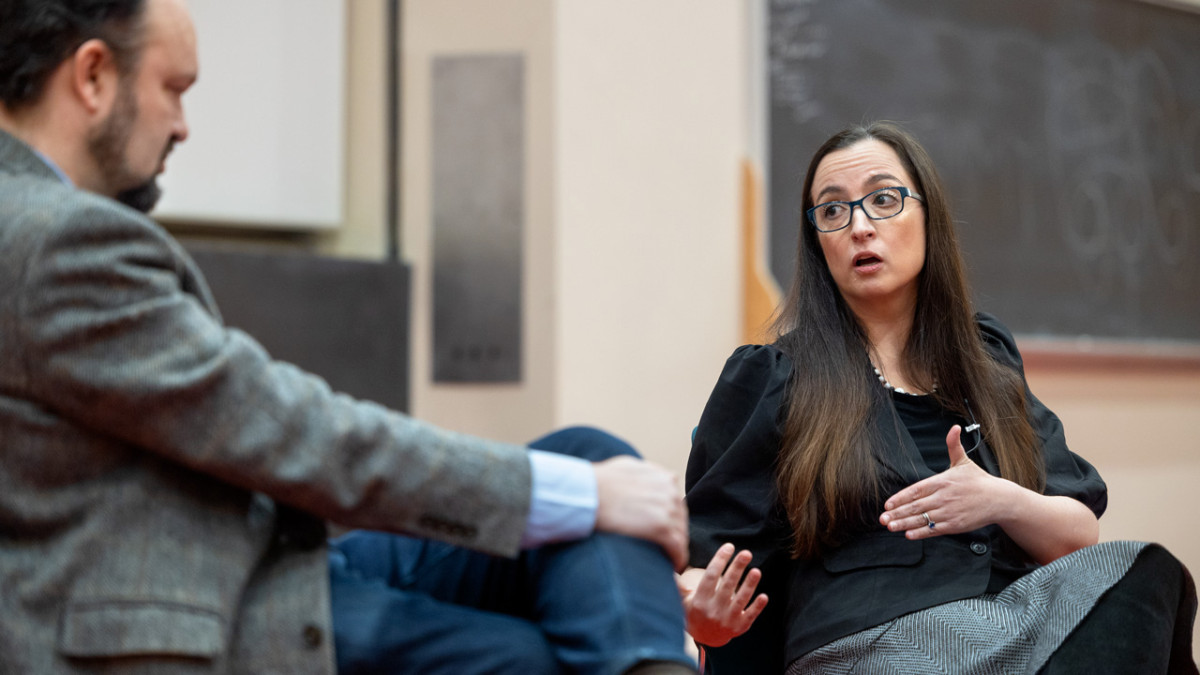
Kate Manne, right, professor of philosophy, debates with New York Times columnist Ross Douthat on the issue of declining fertility rates as part of the Disagreement course.
The new class, developed by Loewen along with Davide Napoli, Klarman postdoctoral fellow in government, meets a deep need, Loewen said, for students to be able to confront and move through disagreements at work, at home, in their communities and in society.
“For many people, one of the greatest experiences they have at the university is exploring what they believe and coming to understand that others believe differently and see the world through different lenses,” Loewen said. “So, at a time when society is very polarized, when disagreement seems fraught and difficult, we shouldn’t run away from it, but take seriously our responsibility of introducing students to constructive disagreement.”
Evan Liberman ’26, a government and French major in A&S, took the class to prepare for disagreements he’ll inevitably encounter during his career.
“People are very shy [in work environments] to express disagreement and they struggle to do so in a way that comes off as respectful,” he said. “In this class, I learned from the techniques the speakers used to disagree respectfully and have the opposing party understand that you really do mean [well].”
Marco Martini ’27, a student in the ILR School and an Air Force cadet in Cornell’s ROTC, said he signed up for the class because he hopes to be an intelligence officer. “I believe disagreement in the intelligence community is critically important,” he said. “You need to have people in the room who can talk with each other.”
One disagreement featured author and professor Michael Eric Dyson of Vanderbilt University and Musa al-Gharbi of Stony Brook University, to discuss progressivism; another put Ross Douthat, conservative columnist for The New York Times, and Kate Manne, professor of philosophy in A&S and author of the book “Down Girl,” in conversation about falling birth rates.
“The way that the things we value in human society are passed down – the culture, the beliefs, the worldview – is through our children” Douthat said during that discussion, supporting the need for an increased U.S. birth rate. “Societies that don’t have children disappear in a more rapid way.”
Manne’s argument centered around a lack of support for girls and women, especially their reproductive choices. “Dobbs and previous anti-choice policies have made it more difficult and dangerous to have a baby in the U.S.,” she said. “People are underserved, there’s a lack of postpartum care, there’s no affordable child care. People are suffering, women are dying, pregnancy is a dangerous condition.”
Each week, the 120 students in the class also meet in 14 smaller discussion sections led by faculty in humanities, social sciences and sciences. The class, which will also be offered in fall 2026, is open to students from any college, any year and any major. The spring 2026 class included students from five of Cornell’s schools and colleges, and all current undergraduate class years.
“Our professors are experts at seeing issues from multiple viewpoints and can demonstrate to students that when you learn to think critically and clearly and comprehensively, then you’re able to look at issues from multiple perspectives,” Loewen said.
In a discussion section after the disagreement on immigration, Shirley Samuels, the Thomas and Dorothy Litwin Professor of American Studies and Picket Family Chair in the Department of Literatures in English (A&S), asked students what they knew about past U.S. immigration policies such as the 1798 Alien Enemies Act, the 1882 Chinese Exclusion Act and the National Origins Formula, established in 1921 to limit immigration.
She then invited students to write out questions they wished the debaters would have addressed. Among their questions: What do you think about the tactics ICE is using to increase deportations? What are changes you’d like to see in U.S. immigration policy? How is immigration beneficial or harmful to the U.S. economy? Students then spent the rest of the class period sharing their own views.

A student poses a question at Disagreement class.
“You tend to be friends with people who agree with you, so this class offers an avenue to have these kinds of disagreements,” said Courtney Molina ’29, a psychology major in A&S. “I’m a very opinionated and passionate person and I want a better avenue to learn how to manage that without getting overly emotional.”
Eman Siddiqui ’26, a classics and government major in A&S, thought the class would help her to be “a better communicator, a better arguer,” she said. “I appreciated the style of the debates and was able to tell what kind of messaging is more effective for people. I also appreciated how speakers were encouraging us to not take things at surface value but to consider the context and scale your arguments appropriately.”
Loewen ended the course with a session seeking feedback from students about topics and speakers to include in future semesters.
“This class makes me feel like a student again. Seeing people who have thought a lot about things disagree about them, it has challenged my own views,” Loewen said. “One of the missions of the College of Arts and Sciences is to create humans who are ready to go into the world more tolerant, more pluralistic, more curious about other people. We need to make our students ready, and even eager, to wrestle with uncertainty.”
Kathy Hovis is a writer for the College of Arts and Sciences.
Media Contact
Get Cornell news delivered right to your inbox.
Subscribe