RBG’s influences featured in ‘Fashioning Justice’ exhibit
By Tom Fleischman, Cornell Chronicle
Cornell graduate. Pioneering attorney and Supreme Court justice. Mother, grandmother, pop culture icon.
Ruth Bader Ginsburg ’54 – a.k.a. RBG – was an influencer before it was even a profession, advocating for women’s equality. Her personal style, and the substance behind it, will be on display in the Human Ecology Building in an exhibit, “Fashioning Justice: Ruth Bader Ginsburg ’54 and the Power of Presence.”

One theme of the exhibit will be “The Politics of Lace,” and its ascension from accessory to a feature often worn by Ginsburg.
The exhibit – a collaboration between the Cornell Jeb E. Brooks School of Public Policy and the College of Human Ecology – will run March 16 to May 1, from 8 a.m. to 5 p.m. daily, in the Rachel Hope Doran ’19 and Terrace Level Display Cases in the Human Ecology Building. A celebration event on April 14 will feature remarks by Ginsburg’s granddaughter, Clara Spera, an attorney at Hecker Fink LLP who has worked on her grandmother’s defining issue, reproductive rights, with the National Women’s Law Center.
The exhibit will feature accessories, on loan from family members, from Ginsburg’s personal wardrobe, including her signature lacy judicial collars (among them her distinctive “Dissent” collars) along with gloves, COVID masks, handbags, jewelry and scarves. Cornellian yearbooks and a Class of 1954 Freshman Desk Book, from Cornell University Library, will also be displayed.
Pieces from the Cornell Fashion + Textile Collection (CF+TC) expand the narrative, with examples of fashion and justice influenced by Ginsburg’s legal legacy.
“This is a really exciting opportunity to talk about the intersections of fashion, law, freedom of expression, and clothing as symbolic speech” said exhibit curator Denise Green, Lau Family Associate Professor and director of graduate studies in the Department of Human Centered Design, in the College of Human Ecology (CHE).
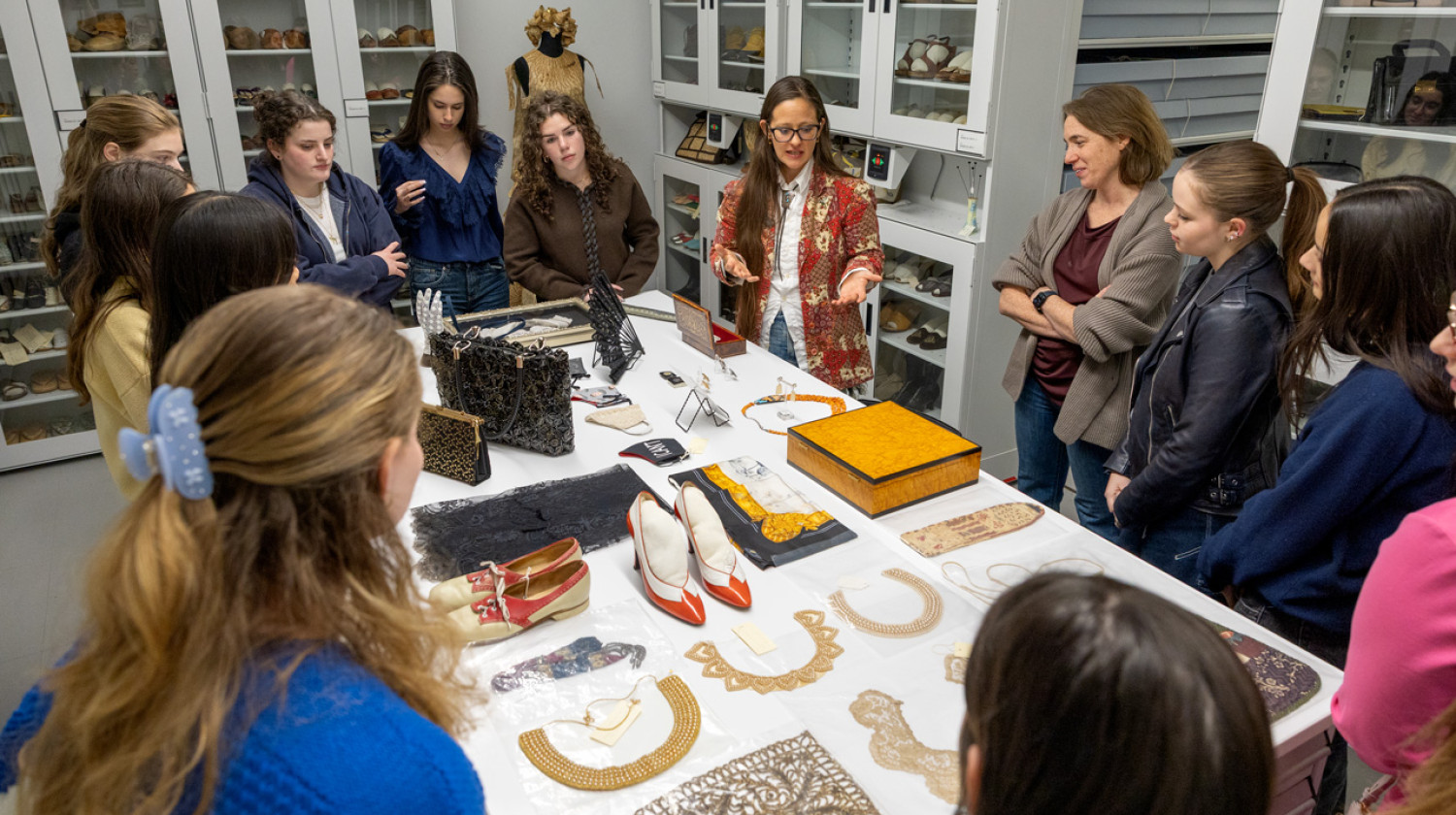
Denise Green shows students around the Cornell Fashion + Textile Collection and highlights artifacts on loan from the family of Ruth Bader Ginsburg ’54.
“Women have used fashion, historically and in the present day, as both voice and strategy to seek justice, navigate inequalities, and challenge some of the assumptions about how authority is defined and regulated through appearance,” said Green, director of the CF+TC.
Ginsburg, a College of Arts and Sciences alumna who died at age 87 in 2020, popularized lacy judicial collars alongside Justice Sandra Day O’Connor, the first female Supreme Court justice. Over time, Ginsburg’s collars developed more precise meanings and could signal whether she had written a majority opinion or, more famously, when she was dissenting.
“The judicial robe is itself a symbolic garment intended to convey authority, impartiality and uniformity,” Green said. “But because the judicial robe was designed for a man’s body, it left space at the neckline for a collar and tie, allowing for individual expression to peek through.”
The court’s only two female justices seized the opportunity.
“There was something both witty and bold in the way that they exaggerated this already-obvious difference with lace and other materials associated with femininity,” Green said.
One theme of the exhibit will be “The Politics of Lace,” and its ascension from accessory to a feature, Green said, with “symbolic meaning. It has often been dismissed as a delicate, decorative, frilly add-on, but lace represents labor, skill accumulated over generations, and economies made possible by women’s work.”
Other themes include “Carrying Rights: Handbags, Pockets, and Professional Dress”; “Campus Constraints: Fashion and Life at Cornell, 1950-1954”; “Clothing as Care: Connecting Family, Community, and Nation”; and “Signaling Dissent.”
The exhibit will run March 16 to May 1, from 8 a.m. to 5 p.m. daily, in the Rachel Hope Doran ’19 and Terrace Level Display Cases in the Human Ecology Building.
Students in this semester’s Learning Where You Live (LWYL) course, “Fashioning Justice: RBG and the Arts,” taught in Ginsburg Hall, are each researching and writing a label for an artifact being displayed at the exhibition. The students will also create an original artwork relating to the intersection of fashion and justice and RBG’s legacy, which will be displayed in the nearby Jill Stuart Gallery as a companion show.
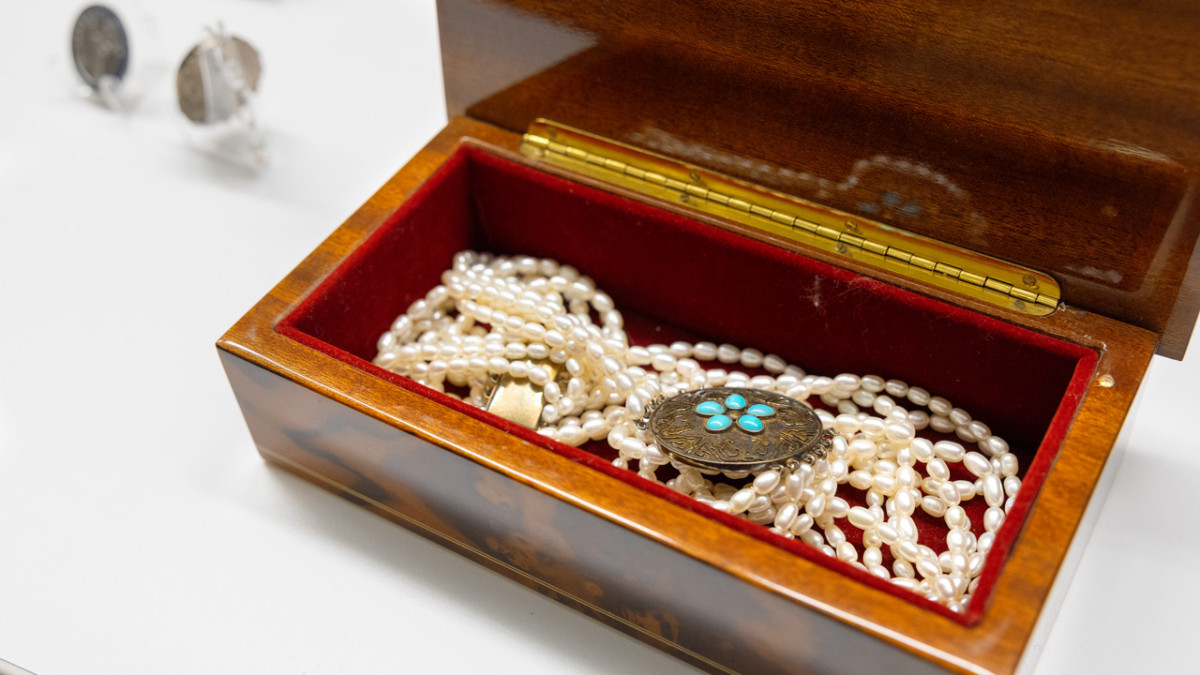
A jewelry box containing some of Ginsburg’s pieces.
“Beyond learning about her landmark cases, the course also explores how fashion and law are more connected than most people realize,” said Samantha Alberts, M.A. ’24, a doctoral student in fiber science and apparel design. “Ruth Bader Ginsburg showed up every day to a room full of men who did not always agree with her, and she made her presence known through what she wore. Her collars, her gloves, her purses were never just accessories. They were statements.”
“The students all do recognize RBG, not only for her judicial work but also as an icon of social justice and civil rights,” said Kristen Underhill, professor at Cornell Law School and faculty-in-residence at Ginsburg Hall. Underhill and Green are co-teaching the LWYL course.
In addition to remarks from Spera, the April 14 event will feature a screening of the 15-minute short film, “Making the Case: A Supreme Court Justice and Her Bags,” with filmmaker Jennifer Callahan. The event will take place from 5-7 p.m. in Room G155 of Martha Van Rensselaer Hall; those wishing to attend can RSVP here.
Both the exhibit and the event were made possible by a gift to the Brooks School from Jeff ’79 and Christie Weiss P’11 and ’14.
Media Contact
Get Cornell news delivered right to your inbox.
Subscribe