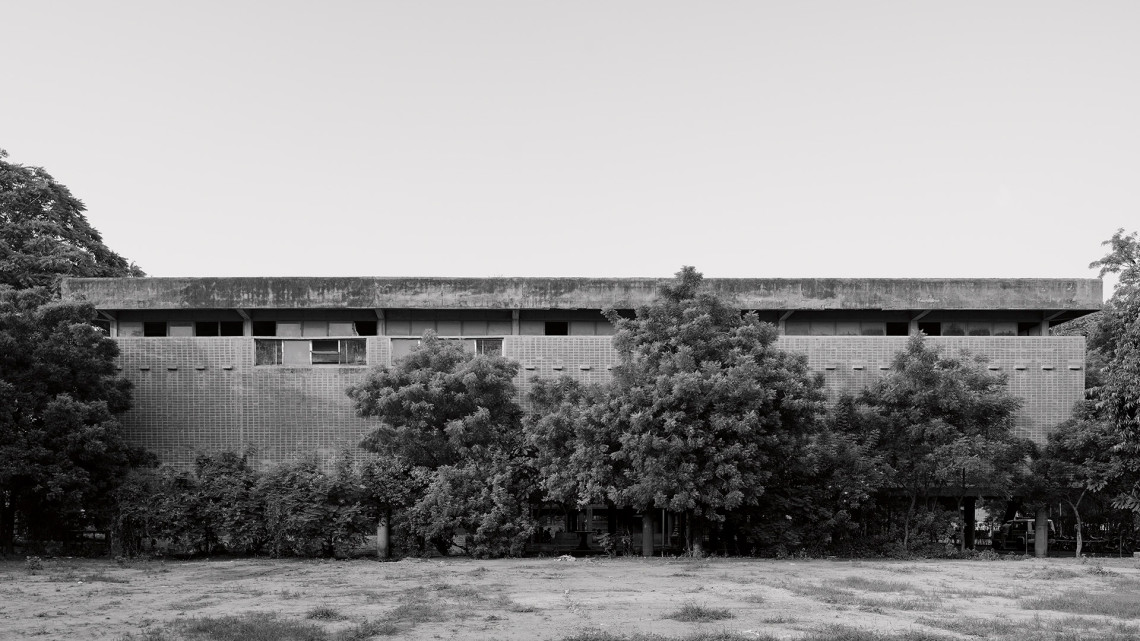
Sanskar Kendra, south facade.
News directly from Cornell's colleges and centers
Building and Unbuilding the City Museum: From Le Corbusier to Ahmedabad
By AAP
When it was designed and built just years following India's independence, Le Corbusier's Sanskar Kendra in Ahmedabad was intended as a new cultural space. Currently closed, the campus has fallen into disrepair and questions surround its purpose and place in the city's contemporary life. From what began as an architecture studio offered by Associate Professor Lily Chi and Sarosh Anklesaria (M.Arch. II '08), a visiting critic on campus in 2018, this volume of essays emerges for a deeper look at the history and present-day questions surrounding this lesser-known slice of early Modernist architecture.
Molly Sheridan: Why did you and your coeditor decide to focus on this particular building for this essay collection and select these contributors?
Lily Chi: The City Museum was the site that Sarosh and I had selected for the M.Arch.’s 2018 Expanded Practices Studio. The first of three museums built by Le Corbusier, the museum and the Sanskar Kendra (People’s Cultural Center) were conceived just four years after India’s independence. Great ambition and optimism went into both commission and design. Both client and architect believed that architecture had a role to play in the cultivation of new civic sensibilities — that new cultural programs and new spatial, material, and social formations could contribute to new imaginations of self, community, and nation. And yet, by 2018 there was but a crumbling building in an unkempt void behind high walls. The City Museum barely registers amongst the renowned projects built in the first two decades of the new nation: Gira Sarabhai's Calico Museum, the Mill Owners’ Association (Le Corbusier), the National Institute of Design (Gautam and Gira Sarabhai), Louis Kahn’s India Institute of Management, Charles Correa’s Gandhi Ashram Museum and Sardar Patel Stadium, CEPT school of architecture (B.V. Doshi) — even the Sarabhai and Shodhan villas are better known. Tensions and ambiguities in both commission and project led to a stillborn "endless museum" and an abandoned multi-programmed urban center, but for B.V. Doshi’s later built Tagore Hall auditorium, built later in the site.
Since 2018, with economic and political developments led by another prime minister with nation-building ambitions, a whole new scale of contradictions have arisen around Sanskar Kendra. The same terms that described the project ambitions in 1954 today mark its unsuitability for contemporary India. We regularly use terms like the public, culture,modern/modernism, or form as if they are universal and static in meaning, but they are laden with agendas, values, and assumptions. The book develops questions we had framed along these lines for the students. Fortunately for the studio, complex, vibrant, creative Ahmedabad makes these questions vivid, compelling, and unavoidable.
Continue reading on the College of Architecture, Art, and Planning website.
Media Contact
Get Cornell news delivered right to your inbox.
Subscribe