Classical art historian Annetta Alexandridis dies at 58
By Kate Blackwood
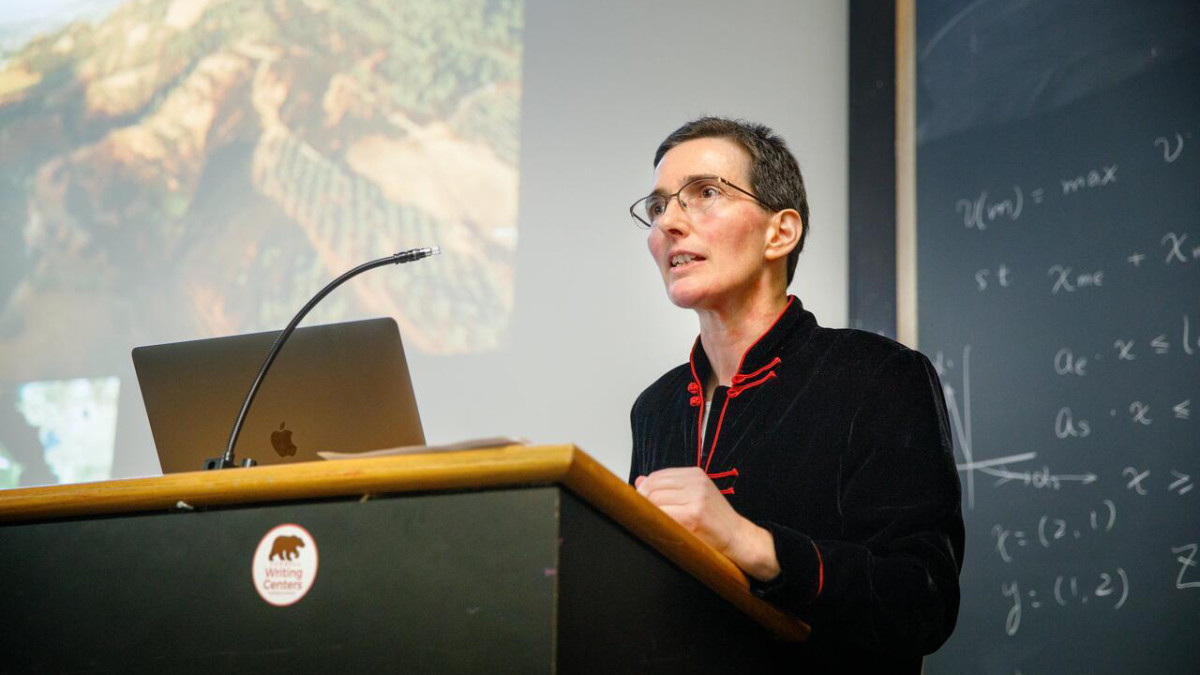
Annetta Alexandridis, a classical archaeologist known for her hands-on approach to research and teaching, died April 13 in New York City. She was 58.
An associate professor of history of art and visual studies in the College of Arts and Sciences (A&S), Alexandridis studied the art of ancient Greece and Rome with a particular interest in gender studies, animal studies and the media of archaeology.
Annetta Alexandridis
“We remember Annetta as a passionate and accomplished scholar of classical archaeology, and beyond that a true citizen of the world – fluent in more languages than seemed possible, a gifted pianist, widely read and deeply learned in art, history and literature,” said Benjamin Anderson, associate professor of history of art and classics (A&S).
Alexandridis was an associate director of the long-running Harvard-Cornell Exploration of Ancient Sardis, Türkiye. She studied the city’s Roman funerary culture and was conducting a survey of all its cemeteries in collaboration with Susanne Ebbinghaus, curator of ancient art at the Harvard Art Museums, and Leyla Uğurer, doctoral student in history of art.
More local to Cornell, Alexandridis co-curated Cornell’s coin collection and the Cornell Plaster Cast Collection. The casts displayed prominently in the Groos Family Atrium of Klarman Hall and other locations across campus, as well as those in storage, were under her purview, together with co-curator Verity Platt, professor of classics and history of art (A&S).
“Annetta worked heroically throughout her time at Cornell to rescue, document, restore and display the Cornell cast collection,” Platt said. “She brought a unique pair of eyes to the field of classical art history, always encouraging her colleagues and students to look closely and to think rigorously but compassionately.”
Annetta Alexandridis was born in 1968 in Frankfurt, Germany, and grew up in Heidelberg.
She studied French language and music at the Sorbonne in Paris, 1986-87, and in the following years studied classical archaeology, ancient history and art history at the Ecole du Louvre in Paris, the University of Perugia and the University of Munich, where she completed her doctoral studies in 1997.
Alexandridis taught at the University of Rostock in Germany and worked at the Collection of Classical Antiquities and Pergamon Museum in Berlin, among the world’s most important collections of classical art, before joining the faculty at Cornell in 2006.
Alexandridis was knowledgeable across several disciplines, said Iftikhar Dadi, the John H. Burris Professor of History of Art and chair of the Department of History of Art (A&S).
“She was deeply committed to social justice in both academia and the broader society,” Dadi said. “Her vibrant and uplifting presence, her genuine enthusiasm for supporting colleagues and students, and her love for scholarship were truly infectious.”
Dedicated to her students at all levels, Alexandridis had a genuine joy and passion for teaching and advising, said Danielle Vander Horst, a doctoral student and undergraduate coordinator in the Department of History of Art and Visual Studies in A&S.
“She was genuinely excited by her students’ ideas and thoughts, and she put so much time, effort and care into how she approached not only her classes but meetings with students and how she crafted her feedback,” said Vander Horst. “She felt very strongly that she was training not just students but future colleagues.”
In 2023, Alexandridis co-edited an influential book rethinking the history of plaster casts, “Destroy the Copy – Plaster Cast Collections in the 19th-20th Centuries.”
In 2004, she authored the book “Die Frauen des Römischen Kaiserhauses,” a study of how women in Roman Imperial Families were represented in public, and the same year she co-authored “Archäologie der Photographie,” exploring the tensions between documentary and aesthetic value of archaeological photographs. She co-edited a multilingual conference volume in 2008 on the transgression of species boundaries in Greco-Roman antiquity, “Mensch und Tier in der Antike,” and contributed many scholarly articles to the field.
Alexandridis served on the editorial board of the open access journal ARTS and was president of the Finger Lakes chapter of the Archaeological Institute of America from 2010-19. She was a fellow at Cornell’s Society for the Humanities (2015-16) and a junior fellow at Harvard University’s Center for Hellenic Studies (2005-06). She was teaching two courses and advising graduate students during the spring 2026 semester.
She is survived by her husband, Michael Morris.
Kate Blackwood is a writer for the College of Arts and Sciences.
Media Contact
Get Cornell news delivered right to your inbox.
Subscribe