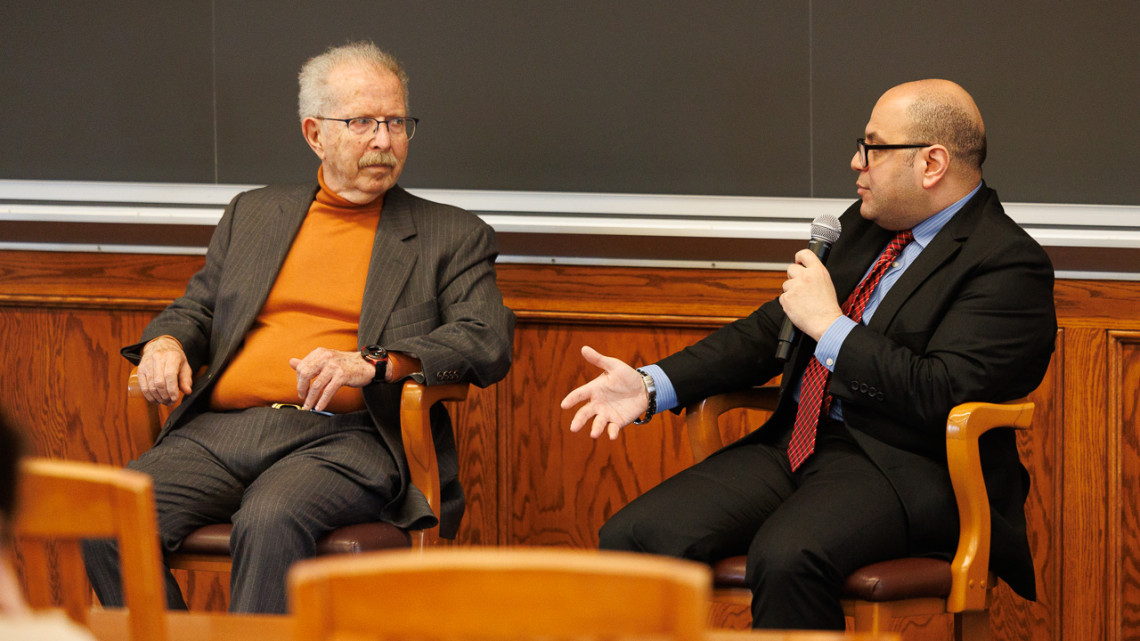
At right, Mohamed ‘Arafa, adjunct professor of law, talks with Menachem Z. Rosensaft, adjunct professor of law, about “The Urgency of Jewish-Muslim Dialogue” April 14 in Myron Taylor Hall at Cornell Law School.
Legal scholars advocate for sustained Jewish-Muslim dialogue
By Susan Kelley, Cornell Chronicle
Serious, sustained dialogue, in which both sides are heard and acknowledged, is urgent and necessary to address the long and growing list of conflicts involving Muslims and Jews around the world, according to two adjunct professors of law at Cornell Law School.
Mohamed ‘Arafa and Menachem Z. Rosensaft demonstrated that point at “The Urgency of Jewish-Muslim Dialogue,” a discussion held April 14 in Myron Taylor Hall. Jens David Ohlin, the Allan R. Tessler Dean and professor of law at Cornell Law School, facilitated the event.
Dialogue is necessary “not tomorrow, not when things calm down, but now, precisely because emotions are high, because wounds are open and because misunderstandings are deepened,” ‘Arafa said.
Rosensaft agreed. “When we are looking at dialogue today, we need to look at it in a much broader context than just the stereotypes” that reduce the intertwined complexities of Jewish and Muslim history to simplistic, damaging generalizations, he said.

Audience members attend the discussion “The Urgency of Jewish-Muslim Dialogue” April 14 in Myron Taylor Hall at Cornell Law School.
Dialogue is often the first casualty in conflict and can feel like a betrayal to one’s own side, ‘Arafa said. “But history teaches us something different. It is in a moment of rupture that dialogue becomes most necessary, not less.”
Jewish and Muslim communities have been profoundly intertwined and have co-existed for centuries, with shared lives and mutual influence in Spain, the Ottoman Empire and North Africa including Jordan, Lebanon, Egypt among many others. “This history matters because it reminds us that coexistence is not an abstract idea. It is something that has existed and therefore something that can be re-imagined,” ‘Arafa said.
Now narratives of separation and a crisis of perception overshadows that shared memory. Communities see each other through lenses of suspicion, anger and dehumanization, which risk expanding into simplified, dangerous generalizations, he said. That is where dialogue can be “a moral and intellectual assistant,” he said.
Dialogue neither erases differences, nor pretends that disagreements do not exist, he said. It must be honest, allowing for grief and anger, he said. Dialogue must be reciprocal, sustained, extend beyond elites to include families, students and communities, and be committed to human dignity, ‘Arafa said.
Both Islamic and Jewish legal traditions can help, with rich resources for thinking about pluralism and human rights in the face of conflict, he said.
We often think of a dialogue as idealistic, secondary to political or military engagement, he said. But without dialogue, mistrust deepens, narrative hardens and the space for coexistence shrinks. “With dialogue, even imperfect, difficult dialogue, we create the possibility of seeing each other, not as abstractions, but as human beings,” he said.
To create any future that includes justice, accountability and coexistence, Jewish-Muslim dialog is not optional, ‘Arafa said. “It is urgent, it is necessary, and it is in many ways one of the most important responsibilities we share.”
Rosensaft said he agreed with everything ‘Arafa said, and they share a friendly, easy sense of dialogue.
“The problem becomes, what of others?” he said.
Rosensaft recounted how, in December 1988, he was one of five American Jews who spent two days in Stockholm talking with a senior delegation of the Palestine Liberation Organization about kick-starting a then-very dead peace process. “We spent two days talking – not agreeing – but talking,” he said.
It resulted in the PLO’s historic acceptance of Israel’s existence in the region. That eventually led to the Oslo Accord in 1993 – the first formal recognition between Israel and the PLO, followed by the famous handshake between the PLO’s Yasser Arafat and Israel’s Yitzhak Rabin on the White House lawn.
The initial talks were a process of de-demonization, Rosensaft said. “Once you demonize somebody else, there’s nothing to talk about, and there’s no one to talk with.”
Although Jews lived in the Middle East more than 1,000 years before Islam came into being, they, like many present-day Palestinians, have a long history of displacement, he said. In 1948, an estimated 700,000 Arabs left from or were forced to leave from what is now Israel. During the same period, 850,000 Jews were expelled from Arab and North African countries, with about 650,000 of them ending up in Israel.
Both Jews and Muslims must acknowledge their respective painful experience of forced expulsion and relocation, he said. “What we need to do is build on it … with an understanding that the pain of the other is real, that the grievances of the other side are real,” Rosensaft said. “It is not, ‘I’m right, you’re wrong,’ but it’s ‘What can we do now?’”
People are being killed on both sides, and the radicals on both sides want to maintain that state of affairs; that’s a recipe for disaster, he said. We need to find a way to bring people together to understand one another. “Maybe, just maybe, you end up with a new generation of leadership that’s going to say, OK, let’s try something different.”
With Ohlin facilitating, Rosensaft and ‘Arafa also discussed creative diplomatic spaces where dialogue might occur, how the legal traditions of Islam and Judaism could contribute to productive dialogue, and what role universities could play. A Q&A with the audience followed.
Media Contact
Get Cornell news delivered right to your inbox.
Subscribe