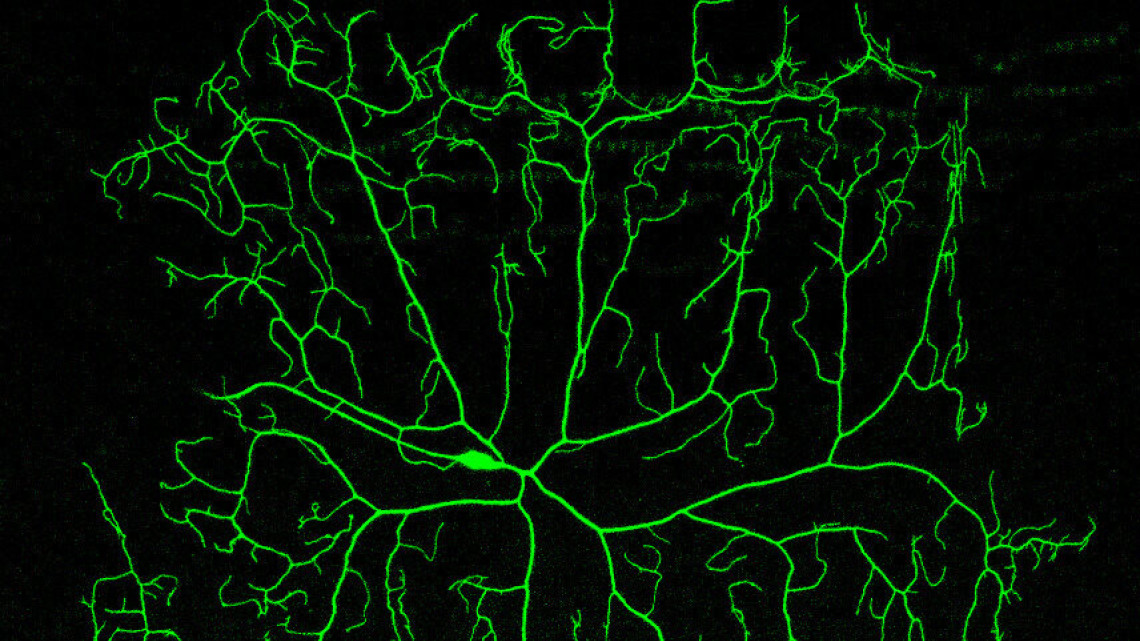
A single Drosophila larval sensory neuron labeled by the MAGIC technique
News directly from Cornell's colleges and centers
New genetic toolkit enables genome-wide analysis
By Henry C. Smith
Researchers at Cornell University have developed a powerful new genetic toolkit that allows scientists to study how genes function at the level of individual cells, an advance that could accelerate discoveries in development, neuroscience and disease.
The system builds on MAGIC (Mosaic Analysis by gRNA-Induced Crossing-over), a method originally created by the labs of Chun Han, associate professor in the Department of Molecular Biology and Genetics in the College of Agriculture and Life Sciences (CALS) and the Weill Institute for Cell and Molecular Biology. MAGIC uses CRISPR gene editing to generate individual mutant cells within otherwise normal tissue, enabling precise comparisons within a living organism.
In the new study, graduate researcher Yifan Shen expanded the approach into a genome-wide toolkit for Drosophila melanogaster, creating resources that work across all chromosomes and allow researchers to study genes that were previously difficult, or impossible, to analyze at single-cell resolution.
“It saves at least a couple months for studying a single mutation compared to traditional methods,” Han said. “If someone wants to screen hundreds or thousands of mutations, the time saved will be years or more.”
Traditional mosaic analysis often requires researchers to spend weeks or months recombining genetic elements before experiments can begin. By contrast, the expanded MAGIC system works directly with existing genetic stocks, significantly lowering technical barriers while relying on standard laboratory equipment.
The toolkit also introduces improved fluorescent markers that make mutant cells brighter and easier to track under a microscope. In earlier versions, visualizing fine cellular structures could be challenging.
“Our final design beautifully illuminated the whole neurons, down to the finest branches,” Han said. “This was a huge help for analyzing dendrite morphology of individual neurons.”
With genome-wide coverage, the system opens the door to large-scale genetic screens at single-cell resolution. Researchers can now pair MAGIC with existing resources such as Drosophila deficiency libraries to systematically scan the genome for genes involved in key biological processes.
“Many fundamental biological processes are still poorly understood due to the previous inability to screen all genes at the individual cell level,” Han said. “The combination of deficiency libraries and the MAGIC kit greatly accelerate the gene discovery process.”
The researchers also demonstrated that the system works in hybrid animals derived from different Drosophila species, an application that had been difficult or impossible with previous tools.
“This technique should allow researchers to ask some very interesting questions about speciation in ways impossible before,” Han said.
In addition, the team overcame longstanding technical challenges associated with the fruit fly’s fourth chromosome, a region that has historically been difficult to study. The new toolkit enables more reliable analysis of genes on that chromosome, potentially revealing previously overlooked biological functions.
To maximize accessibility, the researchers have made the toolkit broadly available through community repositories, allowing other labs to adopt the system without specialized training.
“We have benefited so much from the supportive Drosophila community,” Han said. “If other labs can now use our system to study their most important questions in ways not possible before, we feel that we have reached our goals.”
In 2021, Han's laboratory, in conjunction with the laboratory of Mariana Wolfner, Distinguished Professor of Molecular Biology and Genetics and Stephen H. Weiss Presidential Fellow in CALS, first developed the MAGIC toolkit. The new study was funded by the National Institutes of Health, and the Weill Institute for Cell and Molecular Biology. All fly stocks generated in this research have been deposited to the Bloomington Drosophila Stock Center, and the molecular tools are available through Addgene, ensuring broad access for the research community.
Henry C. Smith is communications specialist for Biological Systems at Cornell Research and Innovation.
Media Contact
Get Cornell news delivered right to your inbox.
Subscribe