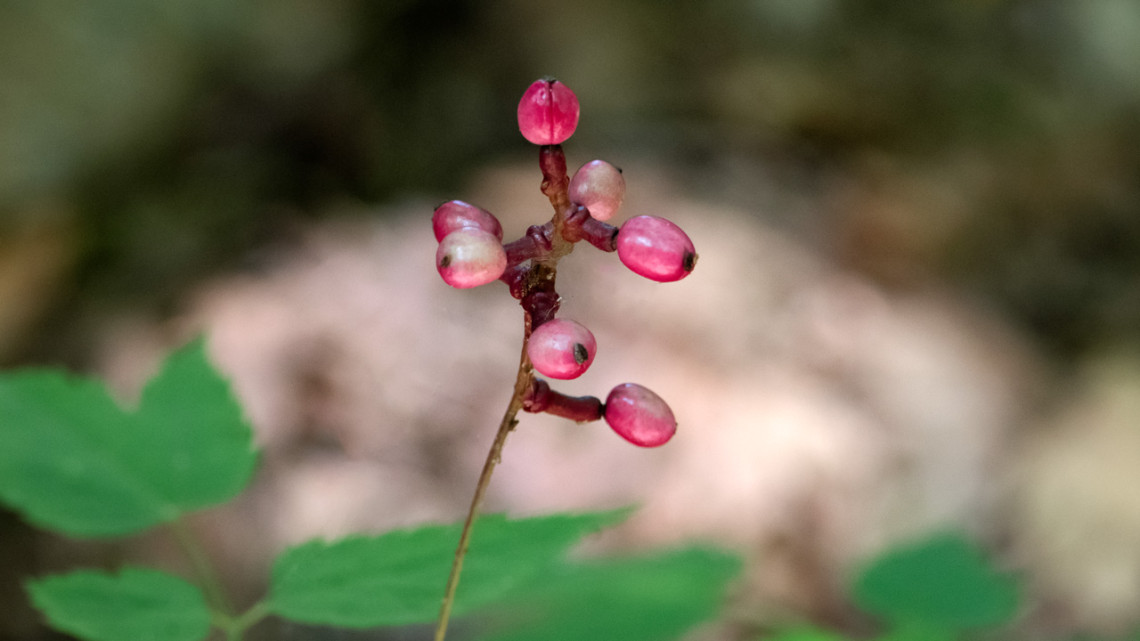
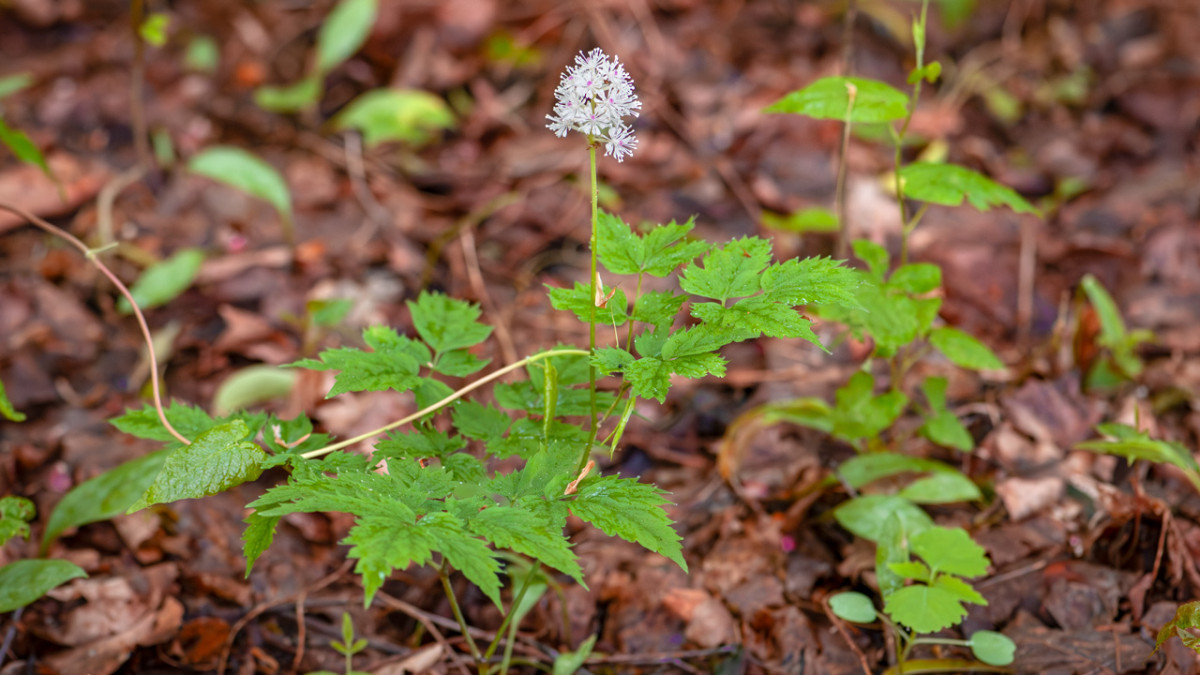
Pink berries differentiate Actaea rhodostigma from the white- and red-berried baneberry species.
Ph.D. student finds new flower in Finger Lakes forests
By Holly Hartigan, Cornell Chronicle
Justin Scholten ’22 knows the plants growing on the forest floor around the Finger Lakes. There’s the white baneberry, Actaea pachypoda. And the red baneberry, Actaea rubra. Both about 30-70 centimeters tall, herbaceous and extremely toxic to humans.
But in 2023 as he hiked through Summer Hill State Forest, less than 30 miles northeast of Ithaca, he noticed an oddity: a pink baneberry.
A doctoral student in the field of plant biology, Scholten at first assumed the plant was a hybrid of the red and white species. However, after searching the local forests for two years and identifying several more populations, spending a growing season documenting the plants’ physical characteristics and performing genetic testing, Scholten confirmed that the pink-berried plant is its own distinct species – Actaea rhodostigma – the first new flowering plant species identified in New York in nearly a decade.
Doctoral student Justin Scholten '22 identified populations of the pink baneberry in forests near Ithaca.
He and his co-authors – Arianna Sprenger ’26, a plant sciences major in the College of Agriculture and Life Sciences (CALS), and Chelsea Specht, the Barbara McClintock Professor of Plant Biology and associate director for faculty development and engagement in the School of Integrative Plant Science (CALS) – published their findings March 23 in The Journal of the Torrey Botanical Society.
“This region of the Northeast has been pretty extensively sampled,” Scholten said, “so it was surprising that this hadn’t been documented before.”
Actaea rhodostigma likely eluded detection because its defining characteristics appear for only a short time during flowering and fruiting. During their fieldwork, Scholten and Sprenger observed the new species has pink to purple stigmas, sepals with a pink apex, a citrus-forward fragrance and a unique mix of insect pollinators that differentiate it from other species.
They studied populations in multiple sites in Cayuga and Tompkins counties, including in Danby State Forest, about 10 miles south of Ithaca. At some sites, they hiked as many as 4 miles into the forest, following streams and other landmarks to study populations off the trail.
“It was a lot of work, especially in those two or three weeks when they were flowering,” Scholten said. “It was basically a full-time job collecting the data.”
Scholten said he suspects A. rhodostigma has a larger range than they studied, and he has already seen reports of the plant as far north as Ontario and as far east as Vermont on the iNaturalist network, where citizen scientists around the world identify and report plants, animals, birds and insects. He hopes to see more A. rhodostigma populations identified, as the plants flower in the second and third weeks of May.
Even well-trod areas can yield new discoveries, Specht said. She teaches her students to keep their eyes open for them.
“A lot of times people think to find a new species, you’ve got to go to the tropics,” she said. “It turns out there are new species in our own backyard that have yet to be discovered.”
Many species are disappearing due to climate change and habitat destruction, Specht said, so understanding what plants make up an ecosystem is crucial to protecting it.
“We may be losing species that we don’t even know exist,” she said, “and that can be really dangerous when we’re thinking about ecosystem resilience and what it takes to have a sustainable environment. Unless you really know what species you have in the wild, it’s hard to predict and promote biodiverse systems that are sustainable.”
Media Contact
Get Cornell news delivered right to your inbox.
Subscribe