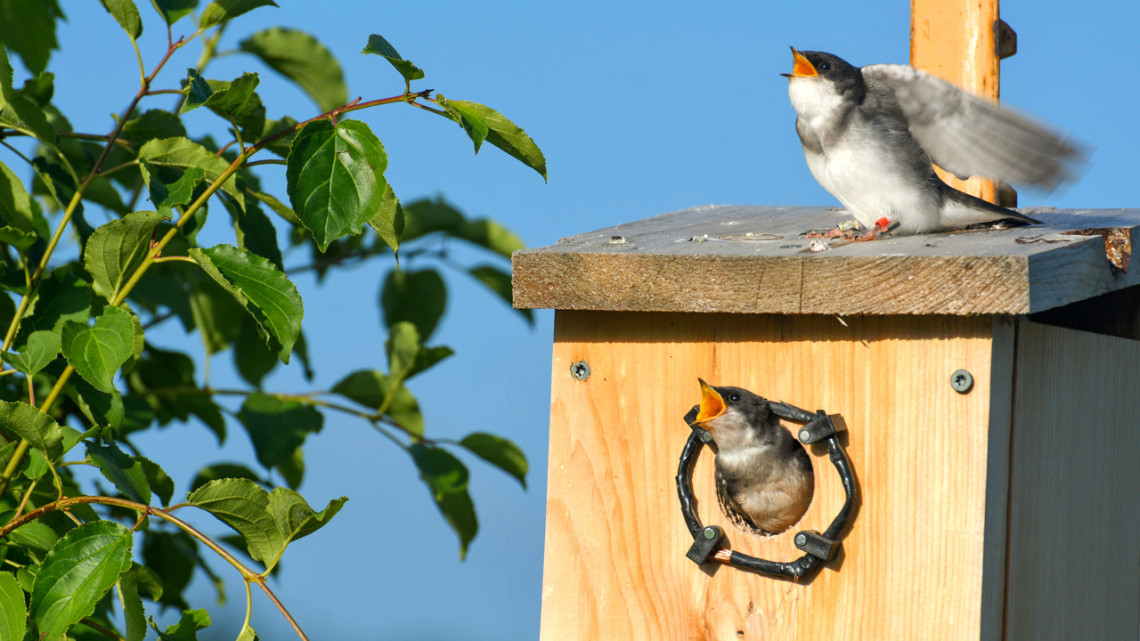
Young tree swallows beg for food from a parent who is foraging nearby.
Spring cold snaps harm nesting tree swallows, but some show resilience
By Krishna Ramanujan, Cornell Chronicle
Warming temperatures from climate change cause tree swallows to nest up to two weeks earlier than they did in the 1970s, but early spring cold snaps can hinder nestlings’ growth and survival, according to a new study that incorporates a four-decade Cornell dataset on the birds.
While previous papers examining the survival of nestlings during early spring cold snaps provided population-level insights, this paper focused on whether individual birds differ behaviorally during such cold spells, which in turn, has revealed dynamics that help explain why nestlings might struggle when temperatures fluctuate. The study also investigates whether some adult birds are more resilient to the sudden cold.
Details on how adults may alter their behaviors during cold snaps, such as how efficiently they can source food for themselves and their young and how long they incubate nests, have strong implications for nestling well-being and survival.
“A lot of early climate change literature focused on how animals respond to increases in average temperatures, but these short-term fluctuations in temperature could actually be as important, or maybe even more important, than exposure to average temperature changes,” said Conor Taff, a research associate in the Department of Ecology and Evolutionary Biology in the College of Agriculture and Life Sciences (CALS) and co-leader of the long-term Cornell Tree Swallow Research Project.
Taff is first author of the study published April 3 in Current Biology.
Tree swallows belong to a guild of birds that only eat flying insects. This guild is suffering steep declines, which many suspect are in part due to the changing climate. Though tree swallows themselves are still abundant, they have declined markedly in parts of their range, such as in southeastern Canada.
Scientists have noticed mass mortalities of tree swallow nestlings during years with cold snaps during the breeding season. Since the birds eat flying insects, breeding season occurs when temperatures warm, leaves begin to unfurl, and insects begin to appear.
“Climate change, somewhat paradoxically, might increase exposure to cold snaps, because the birds breed earlier in warmer springs when the temperature is more variable,” Taff said.
Examining the long-term data – which includes some 150-200 nests per year in Tompkins County – Taff and colleagues noticed that a few days in a row of cold temperatures during breeding season significantly affected the weight of adults, nestling growth, nestling survival and whether adults returned to a nesting area the following year, as they normally would.
The data includes those from automated behavioral tracking systems employed over the last 11 years that record the activities of individual birds. Technology consisted of a fake egg fitted with a thermometer that recorded when and for how long parents incubate their nests, and a tag with a microchip attached to adults coupled with an antenna around the nest box entrance hole. “Every time the birds go in or out, it records their identity and a time stamp, and we can collect feeding behavior from that,” Taff said.
The data revealed clear patterns for how long parents incubate eggs and how often they feed nestlings when the temperatures drop.
“In cold temperatures, we see a steady decline in feeding rates, which helps explain decreases in growth rate and nestling survival,” Taff said. “Presumably that’s largely driven by the fact that there are very few flying insects at cold temperatures, so the birds are having to travel much further to go to particular places to feed.”
When they spend more time away from the nest, they, in turn, incubate their eggs less, and if it gets too cold, embryos stop developing, he said. Also, once eggs hatch, parents feed their nestlings less when they must travel for food when it’s cold. These factors explain weight loss for adults and decreased nestling growth and survival.
The researchers also estimated the resilience of the parents and whether it impacted the likelihood of nestling survival. “For parents that are more robust to cold temperature changes, their nestlings are more likely to grow larger and survive under those challenging conditions,” Taff said.
The results suggest there could be implications for tree swallow evolution, though the researchers could only speculate based on the data. However, the variation in birds’ responses to cold snaps could potentially create an increased ability to persist in subsequent generations, Taff said.
“There was some evidence that chicks that were incubated at cold temperatures tended to be more resilient to those temperatures when they were feeding as adults,” Taff said.
Maren Vitousek, associate professor of ecology and evolutionary biology in CALS, and co-leader of the Cornell Tree Swallow Research Project, is the paper’s senior author.
The study was funded by the Defense Advanced Research Projects Agency, the USDA and the National Science Foundation.
Media Contact
Get Cornell news delivered right to your inbox.
Subscribe