Student-built methane sensor aids mangrove restoration efforts
By Krisy Gashler
In fall of 2024, a team of students and faculty met to launch a project: creating a device that could measure methane from water bodies, a valuable tool in the fight against climate change.
The kind of methane sensor device they needed didn’t yet exist. Their task – to help communities and researchers measure methane emissions accurately and protect their water bodies – required something low-cost, rugged and portable. It would need to be deployed anywhere in the world, robust to wind and rain, run off a light battery, and contain a chamber that can fill with gases and then efficiently clear those gases to enable new measurements.
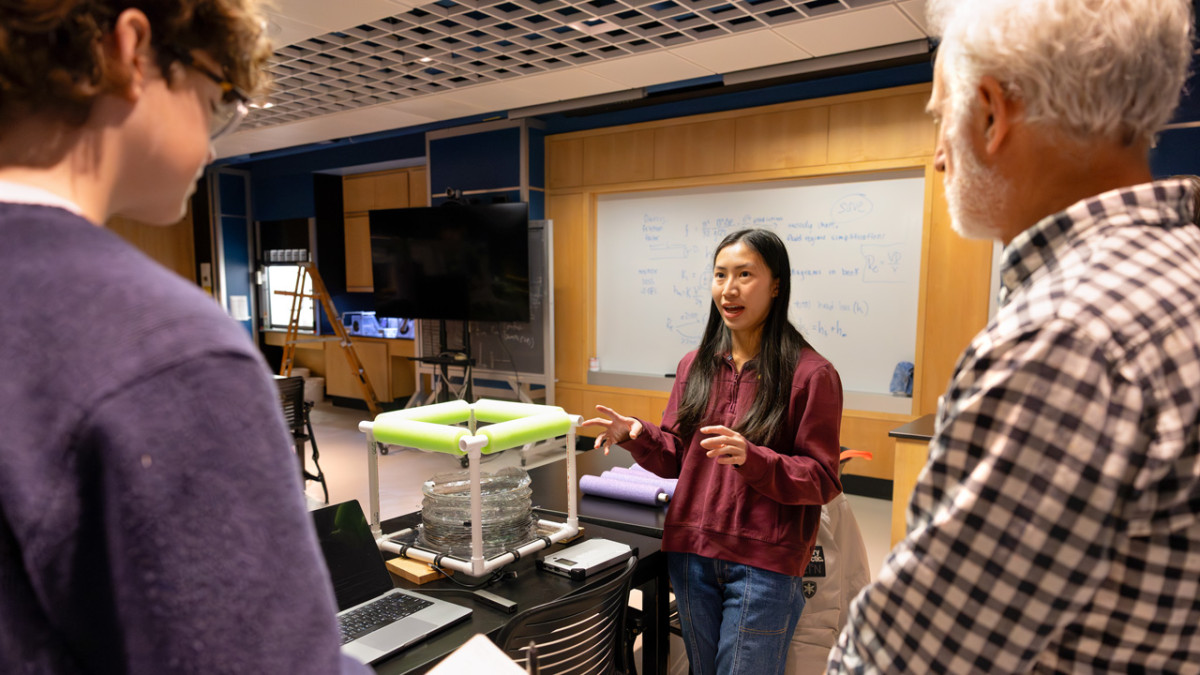
On campus, students and researchers prepare to deploy the “Cornell Flux Chamber” in Colombia’s mangrove ecosystems, capturing methane emissions in a dynamic tidal landscape.
“The real-world application of this was really motivating for me,” said Grace Lo ’24, M.Eng. ’25, who is now a computer engineer for IBM. “Knowing that people are going to actually put this out in a lake or out in a real mangrove forest inspired me to make this the best device I could produce within the time limit and the supplies I had. That challenges you in a way you don’t get just by doing projects isolated in a lab.”
Sixteen months later, in partnership with the Cornell Atkinson Center for Sustainability and Environmental Defense Fund (EDF), these sensors were deployed in Colombia for the first time, informing global greenhouse gas assessments and reforestation of mangroves – ecosystems that can store up to four times more carbon per hectare than tropical rainforests. In the future, the student-built methane sensor device could be used to study emissions from lakes, wetlands, dairy farm manure lagoons, abandoned gas wells and many other sources.
“As we have growing wealth inequality, we’re seeing more and more pressure on coasts from mining, lumber, tourism and development,” said Todd Cowen, one of three faculty members in Duffield Engineering and the College of Agriculture and Life Sciences who worked with the students in a partnership facilitated by Cornell Atkinson.
“That puts mangroves in a very vulnerable position because mangroves are frontline coastal defense. They dissipate wave energy and offer wind breaks for inland indigenous communities. The wood from mangrove trees is used to make homes in those communities. And mangroves are incredible for carbon storage,” Cowen said. “So as mangroves are destroyed, there is both carbon being released, and carbon not being sequestered.”
Protecting Colombian mangroves
Mangroves thrive in the warm, brackish water along equatorial coastlines, where their spider-like exposed roots prevent erosion and protect against storm surges and rising sea levels. They also offer refuge for a wide diversity of sea creatures, anchoring ecosystems and creating a critical food source for Indigenous populations.
However, over the past 50 years, global coverage of mangrove forests has fallen 38-52%, primarily because of human activities like coastal development, agriculture, shrimp aquaculture and salt production.
Mangroves create such a supportive environment for fish and other aquatic species because roots grow closely together, overlapping and reducing wave forces. However, when people cut channels through the mangroves for transportation or to access natural resources, it “completely modifies the dynamics,” said Johann Delgado, a doctoral candidate and research fellow in Cowen’s lab.
“When you create an artificial channel in the mangroves, water velocities increase a lot, which erodes sediments. And the sediments are a very critical part of capturing the carbon in the ecosystem,” said Delgado, who is also a Coastal Solutions Fellow in the Cornell Lab of Ornithology. “When you think about the small fish that rely on these mangrove ecosystems or the small mangrove propagules trying to establish, a channel like this is like having a highway in the middle of your house.”
The ocean forces around Punta Soldado Island, where the research took place, were incredible, said Brooke Beers, a High Meadows Fellow with the ocean sciences team at EDF.
“The tidal environment between high and low tides was so extreme, which meant a lot of flux in methane and CO2,” Beers said. “Our biggest task in Colombia was getting the flux chambers up and running and seeing how they would work in a pretty hostile environment, because this was their first real field trial.”
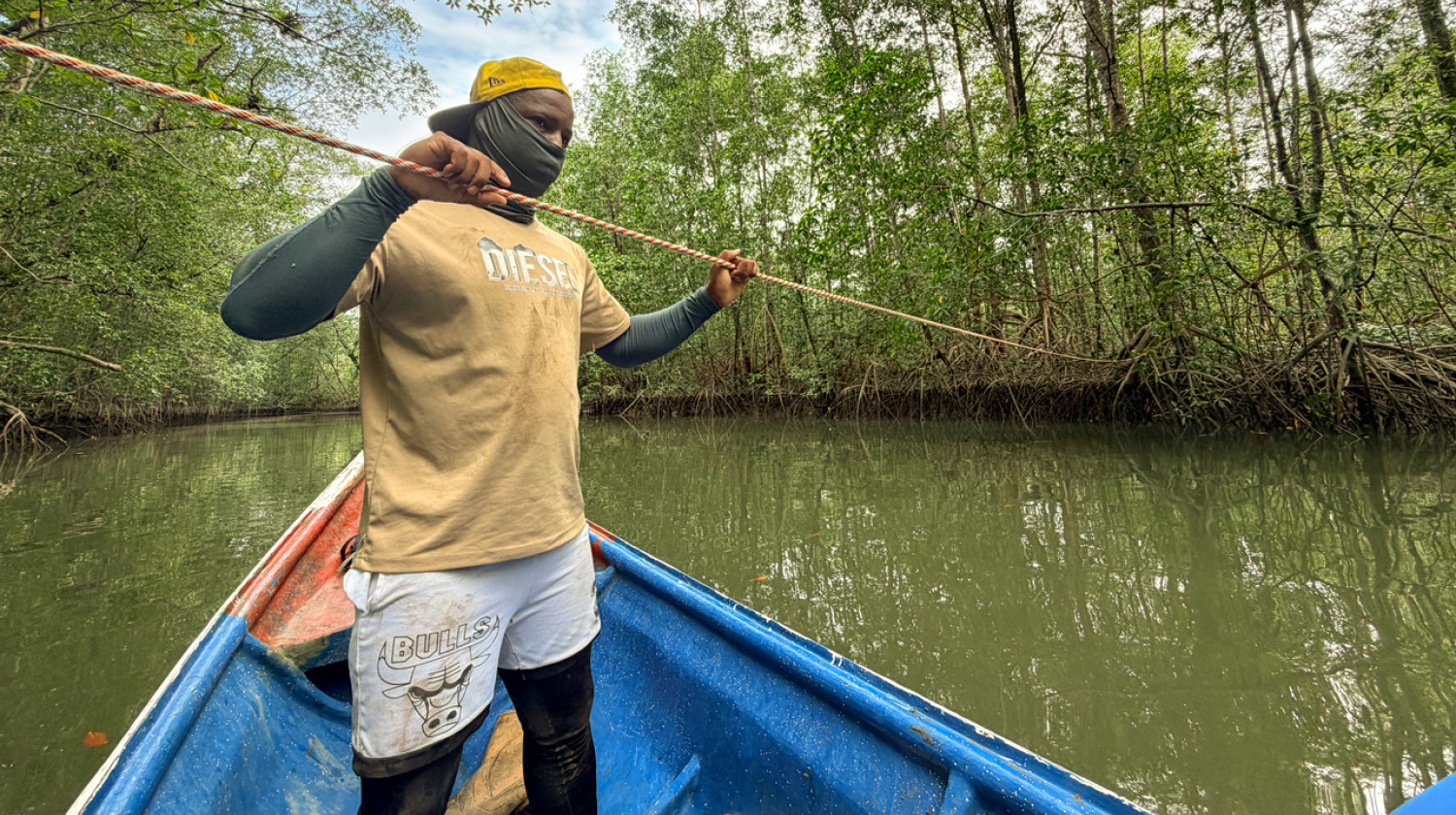
Community members and researchers work together to position monitoring equipment in challenging coastal conditions.
Student engineers enable research
Back in Ithaca, the students worked with Hunter Adams, assistant teaching professor of electrical and computer engineering in Duffield Engineering, to develop a working prototype. Then, they tested the technology locally with insights from Cowen; Meredith Holgerson, associate professor of ecology and evolutionary biology in CALS; and Matt Reid, associate professor of civil and environmental engineering in Duffield Engineering.
Methane sensors are commercially available, but the big challenge has been engineering chambers that are deployable in aquatic environments, and don’t require constant supervision, Holgerson said. She and her lab had experimented with some strategies, but they were cumbersome.
“We’ve had a sensor in an upside down bucket and a battery floating next to it in a cooler. It was not an ideal setup,” Holgerson said. “We can analyze methane emissions all day, but we are not experts in electronics or engineering.”

For communities like Punta Soldado, Colombia, mangrove ecosystems underpin local livelihoods – supporting fisheries, protecting coastlines, and sustaining daily life along the water’s edge.
Other, similar devices have been made with rigid-walled chambers and high-power fans to blow out gases between measurements. Those fans are a big power draw on their battery systems. The big breakthrough the engineering students made was realizing that the chamber could be made of light plastic, and the airing out could be done by raising and lowering the chamber and letting the wind take care of it, at significantly lower power cost. The students’ device – the Cornell Flux Chamber – uses a laptop battery that runs for 90 hours and weighs only 714 grams. Inspired by space technology and off-the-grid solutions, they added a small solar panel that enables continuous in-field recharging, Adams said.
“I love working with colleagues in other departments because it generates a very realistic, professionally relevant experience for the engineering students,” said Adams, who advises undergraduate and master’s students as they complete practical, independent projects. “It’s also an eye-opening experience for students about potential career possibilities. It sometimes doesn’t occur to electrical engineers that if they’re interested in earth science or biology, that they could go contribute meaningfully to those disciplines.”
These devices are made exclusively with simple materials available at any hardware store and only cost about $300, Adams said. That affordability and adaptability was important to the research team, because so many people and organizations are interested in measuring methane – enterprising citizen scientists could even construct one of these devices to test for oil or gas leaks in their neighborhood, Holgerson said.
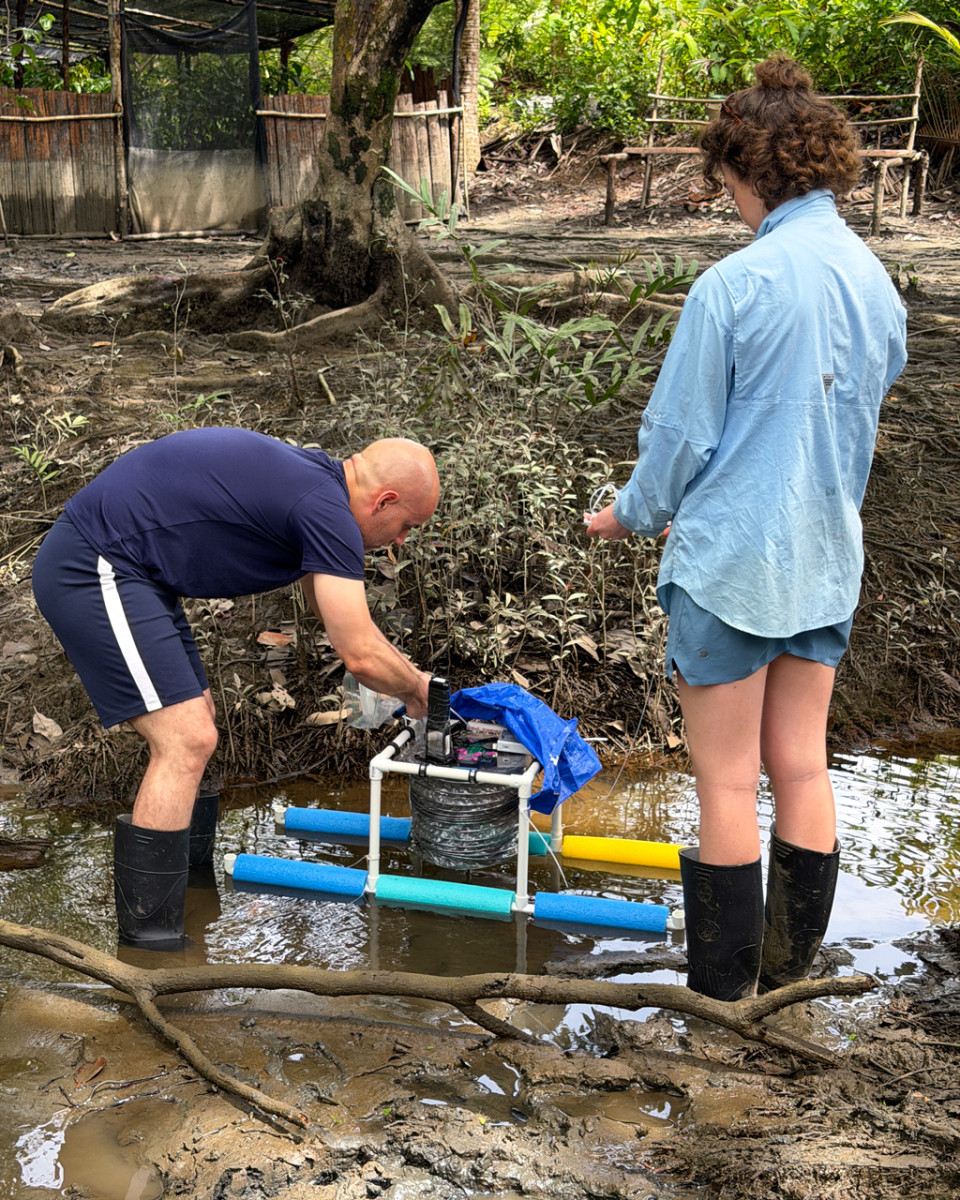
Researchers position monitoring equipment.
“One of the biggest challenges we face in estimating aquatic methane budgets at the global scale is that we’re working from relatively small sample sizes and extrapolating around the globe,” Holgerson said. “If we can make taking measurements more cost effective, we’ll have more measurements from a wider variety of locations and ecosystem types. That will enable us to make better management recommendations and better predictions of how systems will change in the face of climate change.”
Community powers solutions/Solutions power community
Delgado has spent the last eight years developing relationships and gathering data from Punta Soldado Island, part of Buenaventura Bay, Colombia. In January, Cornell, EDF researchers and community partners set up seven cameras and five methane sensors to gather data on hydrodynamics and methane emissions at three different sites: one small channel, one large channel, and an area that is naturally repopulating.
“It wouldn’t have been possible to gather the data we did without the community members who are so adept at navigating the terrain and the tides,” Delgado said.
“This project is a real collaboration with the community. They were the ones steering the boats, climbing the trees to set cameras, discussing with us what kind of data would actually benefit them.”
Next steps for the researchers are to evaluate all the data they collected in hopes of understanding what factors promote mangrove health, so they can recommend best practices for mangrove restoration in Punta Solado and throughout equatorial communities. In the long term, the Cornell Flux Chamber will empower these communities and others around the globe to affordably measure and collect their own emissions data, thereby contributing to climate change mitigation on the local scale.
The student methane sensor development was supported by the Cornell Atkinson Center for Sustainability. The Colombian mangrove research was supported through the collaborative research partnership between EDF and the Cornell Atkinson Center for Sustainability supported by the David and Patricia Atkinson Foundation.
Krisy Gashler is a writer for the Cornell Atkinson Center for Sustainability.
Media Contact
Get Cornell news delivered right to your inbox.
Subscribe