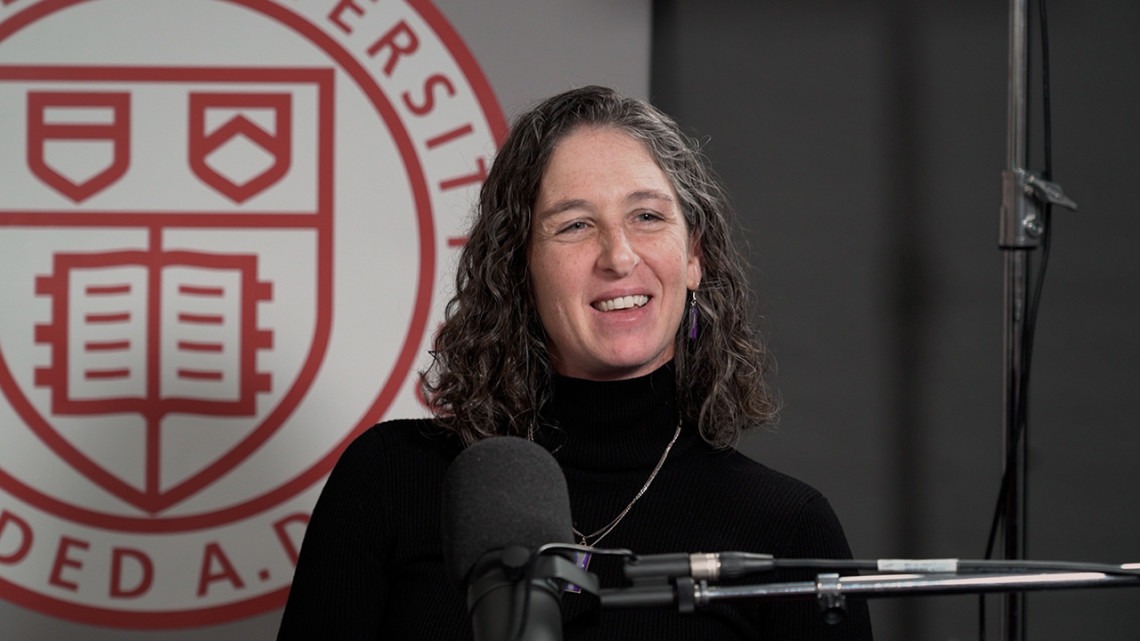
Dr. Elisha Frye, D.V.M. ’10, associate professor of practice, explains how Cornell’s Animal Health Diagnostic Center works at the front lines of detecting and preventing diseases that can jump between animals and humans.
What can individuals do to prevent the next pandemic?
By Laura Reiley, Cornell Chronicle
In this week’s episode of Research Matters, Elisha Frye, D.V.M. ’10, explains how Cornell’s Animal Health Diagnostic Center works at the front lines of detecting and preventing diseases that can jump between animals and humans.
The conversation between Cornell Chronicle Staff Writer Laura Reiley and Frye, an associate professor of practice in the College of Veterinary Medicine, explores how veterinarians, labs and policymakers collaborate to identify emerging threats, respond quickly to outbreaks and apply the “One Health” approach to protect both public health and food systems.
It also looks at how climate change and new technologies are reshaping disease surveillance – and what individuals can do to help stop outbreaks before they start.
Read the transcript:
Elisha Frye: 00:00
During COVID, a lot of people got dogs and so then there was like an upswing in purchasing of pets and so a lot of people had puppies and and then now we've got maybe not as many animals leaving shelters because a lot of folks got a dog a couple years ago.
Laura Reiley: 00:12
And then we thought, "Oh my god, what did I do?" Right? I did that. I did it. I mean, love them, but yeah. Hi, I'm Laura Reiley and this is Research Matters, a show about Cornell researchers who are tackling some of the world's toughest problems and finding solutions that make a real difference in our everyday lives. Today we're joined by Dr. Elisha Frye, associate professor of practice in the department of population medicine and diagnostic sciences at the College of Veterinary Medicine. We're going to talk about how diagnostic labs, field veterinarians, researchers, and policy makers join forces to build resilient systems that protect animal health, reduce disease spillover into humans, and support sustainable farming. Welcome. So good to have you here.
Elisha Frye: 00:55
Thank you.
Laura Reiley: 01:01
All right, so first thing, I would love to hear a little bit about what the Animal Health Diagnostic Center does.
Elisha Frye: 01:01
Sure. So the New York State Veterinary Diagnostic Lab is housed at the College of Veterinary Medicine within Cornell University and we are a commercial lab and we accept samples from veterinarians that they collect from their animal patients.
Laura Reiley: 01:18
Across all species?
Elisha Frye: 01:18
All species. We are funded partially by the New York State Department of Agriculture. And so one of our main missions is to support animal agriculture. And in New York there's a lot of dairy cows. So, we do get a lot of samples from veterinarians taking care of dairy cows. We also get samples from beef cows. There's a big horse industry in in New York State. There's a lot of different uh types of horses that are ridden for different reasons. There's race horses and there's pleasure horses. We also get samples from sheep and goat, pigs, of course, cats and dogs. And we get samples from New York State, but also from across the country and also from across the world. And we do do testing on wildlife. So we test for the DEC, the New York State Department of Environmental Conservation. So we have a nice smattering of different populations and species of animals from birds to mammals.
Laura Reiley: 02:09
So for wild animals, what kinds of things would you be testing for?
Elisha Frye: 02:16
So we, we test deer for chronic wasting disease. We test —
Laura Reiley: 02:16
So would that be a hunter? How would that? What's the process for that?
Elisha Frye: 02:27
In some cases, someone might report like I found a dead deer in my backyard. Or I found 20 dead birds. That seems weird, you know. So something that is atypical might prompt the DEC to want to test. There is some hunter harvested testing of deer samples during hunting season. And so there's even we have a a fish PhD who you know if there's large die off of fish in the state, he'll go and investigate why the fish died. We have a poultry veterinarian who specializes just in poultry. And and then there's my group which is four veterinarians and we are more on the domestic mammals. So we we field calls from veterinarians about sick domestic animals.
Laura Reiley: 03:01
What kinds of things for so for a cat or a dog, what would they be testing for?
Elisha Frye: 03:05
Routine screening, like if you just want to make sure that your your cat has normal blood work, that the kidneys are functioning and the liver is functioning, we can just do normal blood work on the cat. If a dog has a urinary tract infection, we can test the urine and see if there's something in the urine. That kind of testing.
Laura Reiley: 03:23
Why is this important? Why is it important to test domesticated animals? I think we probably all know because we love our cats and dogs, but but or you know bovine you know sampling or even wild animals. Why, why is that an important thing to do?
Elisha Frye: 03:40
I think it's very multiaceted, but one of the main goals is to monitor for certain diseases that might be of alarm. Like there are certain diseases that we don't have in the country because if we did they would um be bad for our food supply. And so we're we're constantly monitoring to make sure that these diseases don't appear.
Laura Reiley: 03:49
Would would be a disease that we're trying to keep out?
Elisha Frye: 03:55
The obvious one for me is foot and mouth disease. And folks might remember that from England in the early 2000s.
Laura Reiley: 03:60
Mad cow. Is that —
Elisha Frye: 04:04
Mad cow is a different one. Those are two different viruses that we don't have in the US.
Laura Reiley: 04:08
I feel like I often have foot in mouth disease, you know, personally.
Elisha Frye: 04:08
You, you might have hand foot and mouth disease, so that's different. I remember when my kids were little like everyone's saying foot and mouth, but they it's a different it's a different thing. But yeah, so foot and mouth disease is a virus that just affects cattle. It doesn't affect humans.
Laura Reiley: 04:19
So do you have to report to the CDC and then they're tracking nationally? Where does the information go?
Elisha Frye: 04:25
That's a good question. So our lab reports to the USDA. So we are in a network of laboratories, they're called NAHLN Laboratories and so there's like 60 of them in the US and if we detect something that we need to report to the USDA, we actually send that sample to them. And so then they can track all of the diseases more centralized. So it's really important that we have this funneling of the NAHLN labs to the USDA so they can track, like, if we get a virus from New York and then we get another virus from Georgia are they the same or have they changed at all? So it's really important —
Laura Reiley: 04:55
Like genetically is there shift? So do you have to work then with like state epidemiologists or like how how does it integrate so that we have a national picture?
Elisha Frye: 05:06
Sure. We work really closely... So there's state veterinarians. There's like different state veterinarians. Some are doing public health and some are doing more animal related stuff and so yeah we work with all those folks and the states also work with the USDA veterinarians so it's a big network.
Laura Reiley: 05:25
All right, so zoonotic is a word that we heard many, many times in the recent past and I don't think everyone is crystal clear on what that is.
Elisha Frye: 05:31
So zoonotic just means a disease that's transmitted from an animal to a human or from a human to an animal. So that's what zoonotic means.
Laura Reiley: 05:37
And is there is that one of the chief things that you're concerned about or that you're tracking some of this stuff to kind of be aware of?
Elisha Frye: 05:49
So we don't test human samples, but I I am really fascinated by diseases that jump species, including from humans to animals and animals to humans. I think that's really interesting, but my my lane is kind of the animal component of it.
Laura Reiley: 06:03
OK, so are there, to go back to that though, are there certain species that tend to jump or certain, certain viruses that tend to jump species or what are those?
Elisha Frye: 06:10
Yeah, I think for that , avian influenza is kind of the low-hanging fruit. That's the one that seems to jump species.
Laura Reiley: 06:19
OK. So avian flu is definitely something that everyone has been kind of on everyone's minds. You know it's in headlines all the time. So, I guess my first question specifically about avian flu is... it's a it's a virus that exists in wild bird populations and they're fine. How does it get from those wild bird populations into domesticated bird populations, turkeys, laying hens. How does that happen?
Elisha Frye: 06:46
The aquatic birds are the reservoir. That's where the virus hangs out and it doesn't make them sick. And then there's these big migratory bird patterns every year where they come, you know, from Eurasia and then they fly through North America and then they can bring the virus to domestic birds. Sometimes a wild animal might eat a wild bird and that wild animal could get the virus that way. A wild bird could, you know, fly into an area where there's domestic poultry and their droppings could spread the virus. So, so something like that could occur and that's kind of how these viruses are spread between species.
Laura Reiley: 07:19
Interesting. Well, so I know turkeys are really susceptible and like Minnesota is a big turkey state. And they often are indoor-outdoor, you know, kind of their so it seems like it's harder to protect them entirely from migratory birds that fly over. But someone said to me that climate change is causing small shifts in migratory bird patterns and that may be contributing to avian flu. Is that anything you've heard?
Elisha Frye: 07:50
I guess I'm not really... Like the migratory patterns, I know that there's four flyways across the US. And then every like around January we that's when they they start to migrate. So we start to worry about a new influenza or more influenza coming during the the migratory season. I don't know. I don't know much about like climate change impacting those flyways, but I could, I could assume that that would be a reasonable concern.
Laura Reiley: 08:15
All right, so well, in terms of climate change, you deal with a lot of you know with cows, how is that putting pressure on cow populations or how is it making things harder for dairy folks or cattlemen?
Elisha Frye: 08:29
I always thought it's interesting that Florida is a huge dairy state because you think it's really hot in Florida and and the Holstein, which is the breed of cow that we have, the black and white cow that we're all familiar with, they like to be cold. They actually don't like to be hot. So, you know, heat stress is a legitimate concern for a cow. They're they're making tons of milk every day. It's like the equivalent of running a marathon. So, they we need to worry about heat abatement. We have to keep these cows cool. That's a, you know, factor that we have to take into account when we're caring for them. Also, there's a lot of movement of cattle these days. We have a lot of large farms and some of the farms they might milk the cows but they don't take care of the babies and so then those cows are being transported, the baby calves are being transported to a different state. So we can have like disease transmission but we can also have just the stress of movement impacting the health of the calves and then they're arriving at a different facility with a different, you know, management style so that they can take care of all these baby calves and then at some point those calves go back to the farm.
Laura Reiley: 09:21
So there's the cow-calf operation, the kind of middle section of that animal's life that, you know, is somewhere else and then they're finished somewhere or on a feed lot or whatever. So is that introducing additional... I don't know pressures in terms of, you know, bacterial problems or viral problems.
Elisha Frye: 09:40
Yeah, so you can have a bacteria in New York State and it travels with the calf to Kansas, right? And so now it's moved. So that bacteria has moved itself with the calf, you know, in the trailer and then it can maybe spread it to the other calves in Kansas, which might have come from Colorado. So we can have a lot of, like, mixing of of of pathogens when these animals are moved and then and then maybe it before the calf once it's bigger is going to go home. Then we've got like a new bug that it's gotten in Kansas that it's going to then bring back to New York. So there's a lot of animal movement.
Laura Reiley: 10:10
It feels like the it's like the kids going to preschool for the first time so that everyone gets sick all the time. Well, you know, I I don't think bees are in your in your, you know, your wheelhouse, but it seems like that's when bees are tracked to the almond fields or whatever, you know, orchards or whatever that often it's the commingling of all of these bees from all over the place that may cause some of the problems bees have had Varroa mites and colony collapse and all that. All right, well, so going back to to cows, what kinds of things are you testing for for New York State cows? What are the big problems that arise for cows in our state?
Elisha Frye: 10:52
Sure, so the things that get me excited are like when there's something terrible that happens like 10 cows die overnight and I we want to know what happened to those cows. So, we're doing —
Laura Reiley: 10:57
What's the likely suspect there?
Elisha Frye: 10:57
Elisha Frye: 11:02
So, when a lot of cows die, I always worry about a clostridial. You might have heard of black leg or like tetanus is another type of clostridial. And so there's a lot of clostridials. It's a bacteria that's kind of everywhere. And so that can kill a large number of cows really quickly. So a veterinarian might call me and say, you know, this farmer had a catastrophe and we need to figure out what the cause was. And so we'll talk about what, what the causes could be and what samples he needs to send us so that we can do the testing at the lab to get the diagnosis and help the farmer.
Laura Reiley: 11:31
So is there — what's the most unusual thing you've seen? And is there like a special, like, Bat Phone that you have to pick up when like some some kind of like cataclysmic finding has you know threatens a whole uh population?
Elisha Frye: 11:47
Yeah. Uh the most interesting.... I think, you know, when the bird flu jumped to the cattle, one of the veterinarians on the ground sent samples to our lab and so we were one of the first labs who found it in the milk and I don't think anybody thought that the bird flu was going to jump from wild birds into into cow milk.
Laura Reiley: 12:00
All right, so I know that people listening to this are going to are be are going to kind of like freak out, because, like, wait, what? I have to worry about...So, talk a little bit about just from a consumer perspective. Do you have to worry about cheese? Do you have to worry about milk? Do you have to worry about beef?
Elisha Frye: 12:15
Pasteurization kills the virus, so if you drink —
Laura Reiley: 12:15
Period.
Laura Reiley: 12:26
Elisha Frye: 12:26
So if you drink pasteurized milk products, then you are not going to get —
Laura Reiley: 12:20
So, is this yet another reason to not drink raw milk?
Elisha Frye: 12:32
This is yet another reason, in addition to a number of bacteria that can live in raw milk, now we've got a virus. Yeah. And the same for poultry products. So, you know, raw, raw diets are popular for feeding your pet, but there have been cats that have gotten avian influenza from eating raw poultry products.
Laura Reiley: 12:46
And is it do they die of it? What? Like what happens to a cat?
Elisha Frye: 12:51
Yeah, cats do diet of it. They can get neurologic. So basically their brain can swell and they can die. This also happens to wild carnivores. So there's been like wild animals that have also had this. Foxes and there's been actually a huge number of different species of wildlife affected by avian flu. But the kitty cats, unfortunately, they — it it affects their brain. The virus goes to the brain and then and then they can succumb.
Laura Reiley: 13:13
Wow. All right. So I, Cornell talks a lot about One Health, I think that's kind of one of its big missions or like Atkinson, there are a lot of researchers who are working on this kind of idea of One Health that kind of humans, animals, environment, all, it's all linked so from, from your perspective, from the daily work that you do like how do all those things come together? How do human behaviors change animal, you know, zoonotic possibilities or you know animal health overall?
Elisha Frye: 13:44
Yeah, I think at the lab we're kind of, I feel like it's my job to stay up to date on what's going on. What are veterinarians seeing? What are their, you know, what are their clients, which are the pet owners coming to them about? And so just being aware of all of those things and knowing what's up and coming is important for me to then be able to look for diseases. During during Covid, a lot of people got dogs and so then there was like an upswing in purchasing of pets and so a lot of people had puppies and and then now we've got maybe not as many animals leaving shelters because a lot of folks got a dog a couple years ago —
Laura Reiley: 14:17
And then we thought, "Oh my God, what did I do?" Right? I did that. I did it. I mean, love love them, but yeah.
Elisha Frye: 14:22
Right? And then maybe these dogs didn't get, like, the social interactions uh that they typically would have if everybody was hanging out more. And so now we've got dogs that maybe have behavioral issues, which I don't really have to deal with, but there are other veterinarians who specialize in behavior. And so then you've got like these kind of, yeah repercussions from bigger events in society that impact all aspects of veterinary medicine.
Laura Reiley: 14:39
So, I imagine that technology has affected your world, and that there are new tool like diagnostic tools that you're using and and that have made things swifter or probably made communicating with other people faster. What, what kinds of things do you use? Like what are the tools?
Elisha Frye: 14:56
Yeah, I think just, cell phones and being able to take a really nice picture of an animal or a video even of an animal when you're out examining it or in the field and then sending that to the diagnostic lab and then we can look at that and it will help us hone in what we think might be happening with the animal. There's also newer diagnostic techniques. Um, sequencing is kind of the up-an-coming thing, which is when we can just look at the entire, you know, sample and see what's in it. You know, in the olden days it was we had to grow everything on a culture plate, right? And so now we've, we've advanced beyond that and we can use a lot of technology to get um deeper into samples and to get more answers. Sometimes too many, right? Like maybe we'll find something that actually isn't significant, right? And so then we have —
Laura Reiley: 15:37
Well, it's like human, human diagnoses, right? Sometimes you have the pituitary tumor, but you're not going to die of that, you know? I mean, right?
Elisha Frye: 15:46
Or even some viruses that don't cause disease, but then it's there and so then we're like, hm, you know, and so we have to look into that.
Laura Reiley: 15:50
So is there an area that you are especially concerned about in terms of, you know, a vulnerability in our system?
Elisha Frye: 16:05
You know, I think during the government shutdown, I was impacted because these monthly meetings that we'd have with the USDA didn't happen and so that loss of information, you know, I might find out about something on the news that we would usually talk about in these monthly meetings but then without the monthly meetings we don't get to have like a scientific discussion about that or I don't get to find out from the source, source. So I think um these structures that we have to kind of safeguard the human health and the animal health are really important and when we have government shutdowns we we we miss out on all of that.
Laura Reiley: 16:32
No, that sounds terrifying. OK. And uh I I we're getting close to the end but I would love to give a little bit more information for consumers, kind of how to be how to be a more how to be savvier about things like animal diseases. I mean we've talked we said a little bit about raw milk. We said a little bit about raw um animal food or pet food. Anything else that people should um that that they can do to just be a little safer in their daily practices?
Elisha Frye: 17:02
Even the most basic thing like just rinsing your vegetables. I think people always think, like, bacteria come from meat products, but actually there have been contaminations of like the lettuce like everyone remembers the lettuce that happened a few years ago. So we, right, so we can so just you know doing those basic things, handwashing, you know, preparing your food properly, cooking things to the right temperature, that will safeguard you yourself against getting something from, from food um and unfortunately all bacteria's around us, right? It's part of the world, we need it, um but we also need...some of them are going to make us sick so I think just some basic um things like that can go a long way.
Laura Reiley: 17:34
I guess I wanted to ask one final question. So we're getting better at predicting and stopping outbreaks. Are there... do we have systems in place kind of uh in the event of a big outbreak of something or a zoonotic, you know, an unexpected, you know, what are — what are the tools that we've developed to disseminate information and, you know, how does, how does Cornell participate in that or how does your your lab work to participate?
Elisha Frye: 17:59
Yeah, I think having that robust system where we're, we're, um, sending samples to the USDA then they would make the decision on how to control the thing. So I see my role as like I'm, I'm seeking the information and, and finding the things but I, I don't make any of the policies, which I you know so that's kind of my area. For some of the diseases, you know, there's stockpiles of vaccines but then some of if, if we have a disease we don't know about, right, then we're less prepared, right?
Laura Reiley: 18:31
All right, well, has been wonderful. You have been listening to Research Matters from Cornell University I'm Laura Reiley. If you like this episode, subscribe wherever you get your podcasts and share it with a friend who loves facts as much as you do. Thanks for listening and remember, when research meets purpose, we move closer to a healthier, fairer world. Elisha, thank you so much.
Media Contact
Get Cornell news delivered right to your inbox.
Subscribe