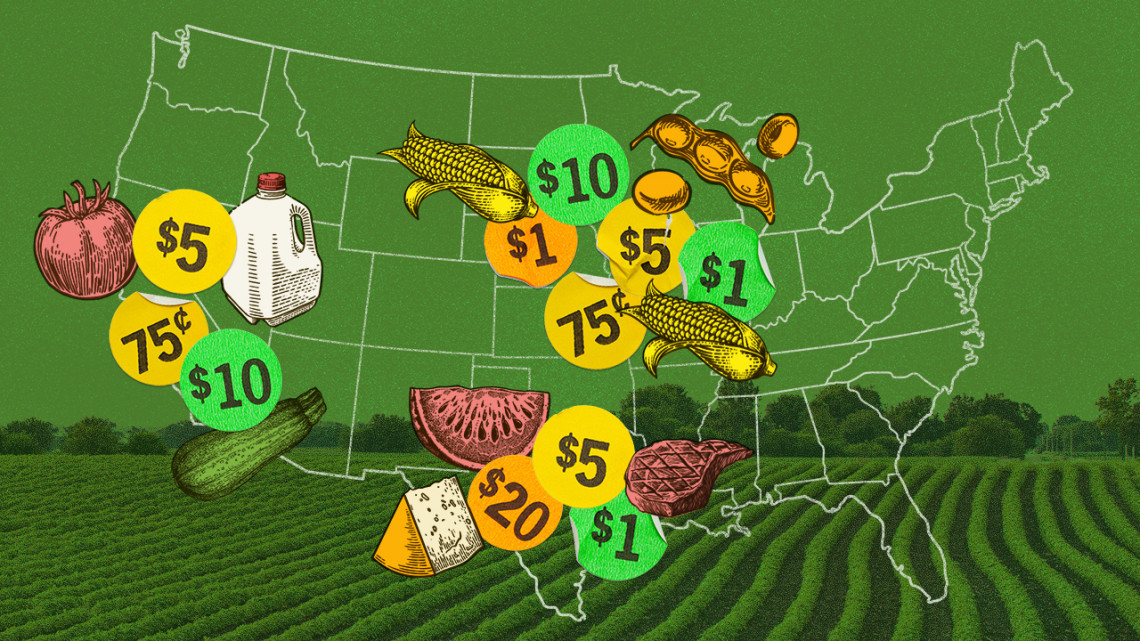
Why trade wars land harder in some states
By Laura Reiley, Cornell Chronicle
The current trade war doesn’t affect American states evenly. New research by Wendong Zhang and collaborators from Ohio State University finds that the risks from escalating tariffs with Canada and Mexico, the United States’ closest agricultural partners, fall along geographic lines, exposing some states to steep losses while leaving others relatively unscathed.
At the center of the analysis is a simple but often overlooked fact: The American food system is deeply regional. Using detailed freight data that tracks where goods are produced, shipped and consumed, the researchers map how agricultural trade flows across state borders and international lines. The result, published in April in Choices, a publication of the Agriculture and Applied Economics Association, is a portrait of a national economy that behaves less like a single market than a patchwork of highly specialized local systems, each with its own vulnerabilities.
“What makes this analysis distinctive is that we move beyond national trade aggregates and trace where goods are actually produced, shipped and consumed at the state level,” said Zhang, associate professor in the Charles H. Dyson School of Applied Economics and Management, part of the Cornell SC Johnson College of Business. “The United States doesn’t have one agricultural trade exposure – it has 50 different ones.”
Consider the Midwest, where vast fields of soybeans and corn feed a global export machine. States like Illinois and Iowa are heavily dependent on foreign buyers for export-oriented crops. When tariffs rise and trading partners retaliate, those states are among the first to feel the shock – as happened with soybeans during the 2018 U.S.-China trade war, a pattern the new analysis suggests could repeat itself with North American partners.
By contrast, parts of the Northeast appear more insulated. With less reliance on export-oriented agriculture, these states are less exposed to foreign retaliation. But that doesn’t mean they’re immune.
“There’s a tendency to think about tariffs as something that happens at the border and stays there. But the supply chain doesn’t stop at the port,” Zhang said. “When the cost of imported fertilizer or livestock feed rises, farmers absorb that first. When processors face higher input costs, they pass it along. Eventually, the consumer in a New York grocery store is paying more for something that traces back to a trade dispute in Washington – even if New York itself exports very little.”
The Trump administration’s 2025 tariff actions – imposing a broad 10% levy on imports, with higher duties on some countries – have already set these dynamics in motion. Canada responded with tariffs on roughly $30 billion in American goods, including dairy and poultry, while other countries signaled similar moves. Even the threat of such measures has begun to reshape trade flows, as buyers look elsewhere and producers scramble to adapt.
What makes the current moment especially precarious, Zhang and his collaborators said, is the tight integration of North American agriculture under the United States-Mexico-Canada Agreement (USMCA). Supply chains that once crossed borders seamlessly – such as livestock, feed and fresh produce – now face frictions. According to the study, imports from Canada and Mexico could fall dramatically, squeezing industries that depend on foreign inputs while simultaneously cutting off export markets for American farmers.
The geographic divide is striking, Zhang said. Northern border states such as Michigan and North Dakota are closely tied to Canadian markets, particularly for processed foods and livestock products. Southern states, including Texas and Arizona, depend heavily on Mexico, especially for fruits and vegetables that stock American grocery stores year-round. In both cases, proximity breeds dependence – and vulnerability.
Some states occupy both sides of the divide. California and Texas, for instance, are simultaneously major exporters and importers of agricultural goods. For them, tariffs present a double-edged sword: protection from foreign competition in some sectors, and rising costs in others. A tariff that helps a domestic tomato grower might hurt a food processor reliant on imported ingredients, creating uneven effects even within a single state.
Zhang says the most consequential aspect of the current situation might be how deeply integrated North American agriculture has become under the USMCA.
“We’re not just talking about finished goods crossing borders – we’re talking about livestock, feed and fresh produce moving across those borders multiple times as part of a single supply chain,” he said.
The International Food Policy Research Institute has projected that U.S. agrifood imports from Mexico could fall by 46% and from Canada by 60% under current tariff scenarios. According to Zhang, that’s not a manageable disruption – it’s a structural shock to a system built on seamless integration.
Tariffs don’t stop at the border, the researchers said. When the cost of imported fertilizer rises, farmers pay more to grow crops. When processors face higher input costs, those expenses are passed along. Ultimately, consumers feel it in the form of higher prices, sometimes in places far removed from the original trade dispute.
There are, to be sure, buffers. Some agricultural products remain protected under existing trade agreements, softening the blow. But many others – including alcoholic beverages, specialty crops and processed foods – remain exposed, leaving room for significant disruption.
The broader lesson, the researchers said, is that trade policy, often debated in national terms, plays out locally. A tariff announced in Washington can reverberate through a soybean field in Iowa, a dairy farm in Wisconsin or a supermarket aisle in New York. And while some regions may gain temporary advantages, the overall system becomes more fragile.
In that sense, the study offers both a warning and a map: a reminder that the costs of trade conflict are unevenly distributed, and that understanding where they land may be as important as the policies themselves.
Media Contact
Adam Allington
Get Cornell news delivered right to your inbox.
Subscribe