News directly from Cornell's colleges and centers
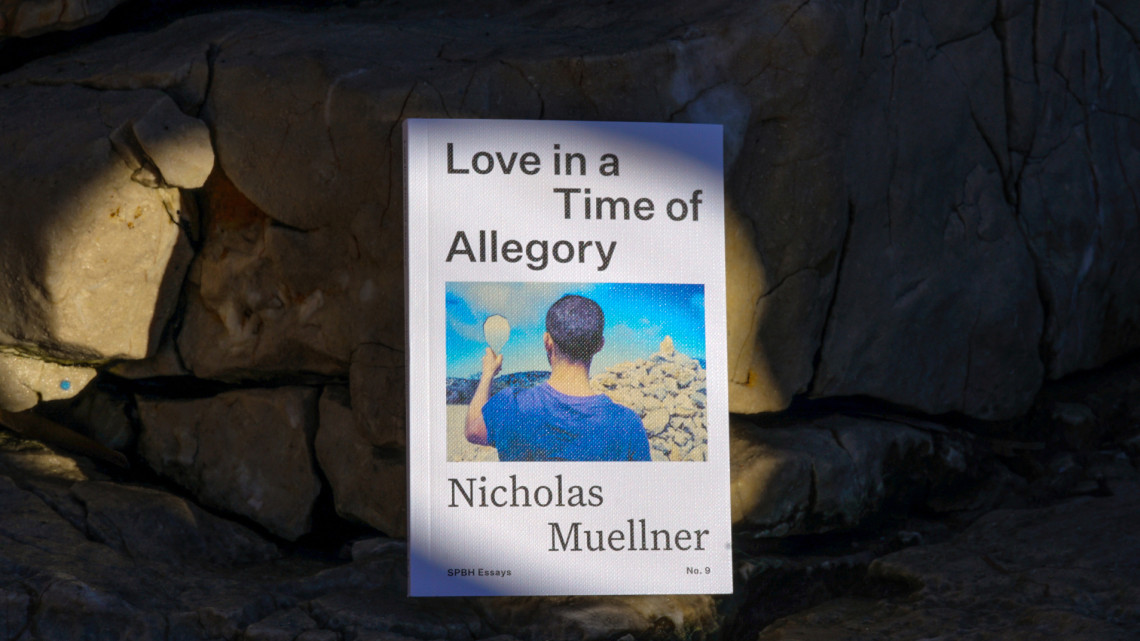
Announcing: Love in a Time of Allegory
By AAP
Across books and exhibitions, Nicholas Muellner, Art Senior Lecturer and Codirector of the M.F.A. in Image Text program and ITI Press, has placed visual media and the written word in dialogue to explore aspects of the human condition spanning the personal to the political. Yet in the opening pages of his latest publication Love in a Time of Allegory, he poses a startling confession for such an artist:
Adding more pictures to the world feels like making thin plastic bags that I know will end up in the ocean. But I have built my life around bag-making, so what else am I supposed to do? I no longer want or use these bags, but it’s all I know how to make.
In the pages that follow, Muellner does not set himself the charge of altering the world which brings him to this question, but rather investigates how to best interact and imagine from within it.
Molly Sheridan: The idea that imagination and social connection are being suffocated by the avalanche of crises and turmoil all around us is so resonant. Did exploring these ideas through text and images as you have in the book alter or expand your lines of thinking about this in any particular way? At the outset of the book, you note that the title came to you but that you didn't yet know what it meant, so I'm curious how this evolved for you.
Nicholas Muellner: The suffocation the book addresses comes not only from the crises all around us, but particularly from the avalanche of images and information that bury us in these crises. These events, in all their vast range of importance, and their images, in their indiscriminate excess, assault us without the time or context to situate and respond, and then are instantly replaced by more. My attempts to think my way through this onslaught, which I recount in the narrative of the book, starts by looking at 19th- and 20th-century histories of how events and social conditions were presented. This begins with a reconsideration of the realist tradition (as opposed to what I describe as “contemporary realism”), which I trace from its 19th-century literary and visual origins through to 1970s nightly news broadcasts. This helped me understand how much our common understanding of the present had been shattered by the digital revolution, but it did not provide a way forward. I then move further back in time — from Italian Renaissance painting and Indian Miniature painting to Giotto’s frescoes — in search of the formal tools of allegory, and how those forms or representations institute potentially useful forms of collective belief. But it is only through the trial and error of my own picture-making that I arrive at an understanding of the connections between love and the traditions of allegory. As I assert at the book’s beginning, I do not propose a solution to an overwhelming and complex global problem, but I do discover ways forward in image-making and thought that I can hope give solace and possibility to other image-makers, both in everyday life and in art.
Continue reading on the College of Architecture, Art, and Planning website.
Media Contact
Get Cornell news delivered right to your inbox.
Subscribe