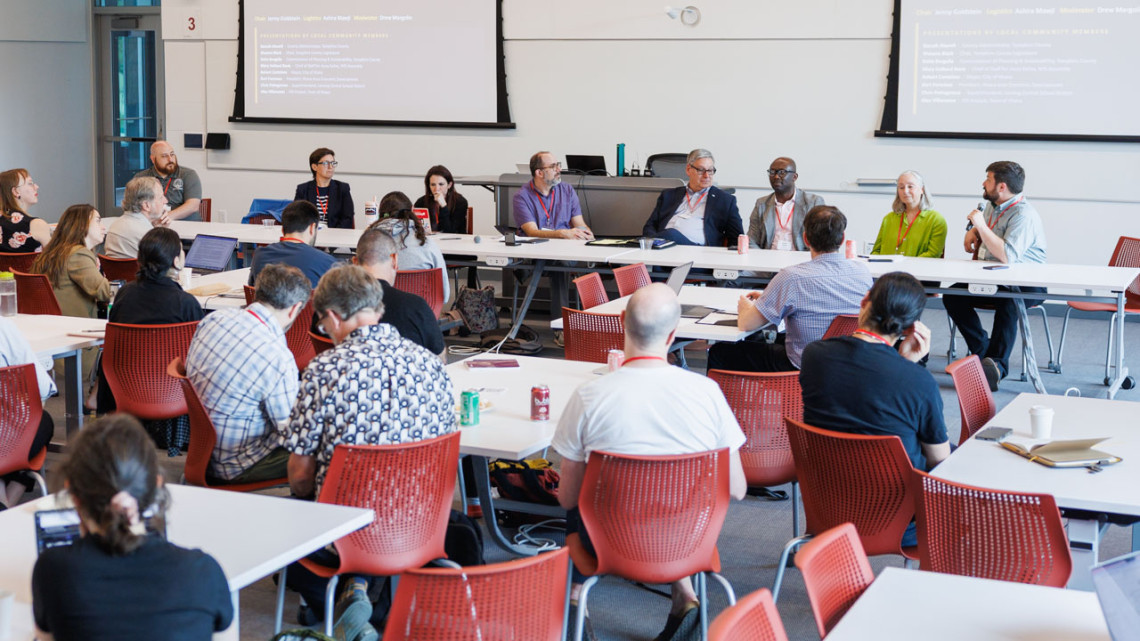
The community voices panel at the Community-Centered AI Thought Summit at Cornell.
News directly from Cornell's colleges and centers
Community leaders explore promise and risks of AI at Cornell summit
By Stephen D'Angelo
As artificial intelligence systems rapidly reshape schools, workplaces and public services, civic leaders from across New York state gathered at Cornell May 18-20 to explore both the promise and risks of this technological transformation.
During the “Community Voices” session of Cornell’s Community-Centered AI Thought Summit, a gathering of researchers, policymakers, technologists and local officials pondered fundamental questions: Who benefits from AI systems, who bears the costs, and who gets a voice in shaping them?
“AI is no longer a technology conversation,” said Mary Holland Bavis, chief of staff to New York State Assembly member Anna Kelles (D-125th District). “We’re talking about how this influences the environment, water, our communities, our health, and so I think that it’s great to be having these types of conversations because I think there’s still so much we don't know.”
For local governments in particular, the discussion often returned to how to integrate AI tools without eroding the human relationships at the center of public services.
Tompkins County Administrator Korsah Akumfi said agencies are already weighing how automation could free up administrative time while preserving direct support for residents.

Audience members participate in a Q&A session at the Community-Centered AI Thought Summit panel discussion.
“How do we use the tools that can take away the time that they’re spending on the paperwork to spend with those individuals to be able to help improve their health outcomes?” Akumfi said, referring to social service workers and other county staff.
Regarding economic impacts, speakers wondered whether communities are prepared for how AI could reshape local labor markets.
Kurt Foreman, president of Ithaca Area Economic Development, said there is growing sentiment that communities actively engaging with and training in AI may, in theory, create job opportunities rather than eliminate them.
“I have some friends around the country who feel less that AI is going to destroy jobs than if communities are engaging in it in a significant way and people are being equipped to know how to use it,” Foreman said.
Others were more cautious about what that transition could mean for long-term workforce stability.
Ithaca Mayor Robert Cantelmo questioned how communities would preserve workforce development opportunities as automation expands. “How do we make sure that we’re not eliminating jobs for future youths?” he said.
Also discussed were the environmental costs associated with AI infrastructure, particularly as local governments confront questions surrounding energy use, water consumption and land development tied to expanding data center construction.
“I spend half my career talking to people about turning the lights out and turning your heat down, and now it’s just like the gates are open,” said Katie Borgella, Tompkins County’s commissioner of planning and sustainability.
As the discussion closed, attention shifted to the role of public institutions and universities in shaping how AI is deployed. Several speakers said communities should not only adapt to the technology, but actively influence how it is designed, regulated and integrated into public life.
“Your role should be to help us in the public sector ensure that the distributional consequences of this technology do not massively worsen the lives of regular folks,” Cantelmo said.
Community‑Centered AI is part of Cornell Thought Summits, which are funded jointly by the Cornell AI Initiative and the Center for Data Science for Enterprise and Society to explore bold ideas, identify emerging research frontiers, and lay the groundwork for transformative, multi-institutional partnerships in data science and AI.
“Thought Summits create something rare: dedicated time for people across disciplines, institutions, and sectors to think together without the pressure of immediate deliverables,” said Jenny Goldstein, assistant professor at Cornell’s Ashley School of Global Development and the Environment, and principal investigator and co-organizer of the Thought Summit. “The decisions being made right now about AI will be very difficult to reverse, and the communities most affected are often the least equipped to influence them. Throughout this summit, we gained new collaborators, a shared research agenda, and the beginning of a methodology for community-centered AI research and advocacy that none of us could have produced alone.”
Additional sponsors and support of the Community-Centered AI summit included the Cornell Ann S. Bowers College of Computing and Information Science; the Cornell Center for Social Sciences; the Cornell Atkinson Center for Sustainability; and the Einhorn Center for Community Engagement.
Stephen D'Angelo is the communications manager for biological systems at Cornell Research and Innovation.
Media Contact
Get Cornell news delivered right to your inbox.
Subscribe