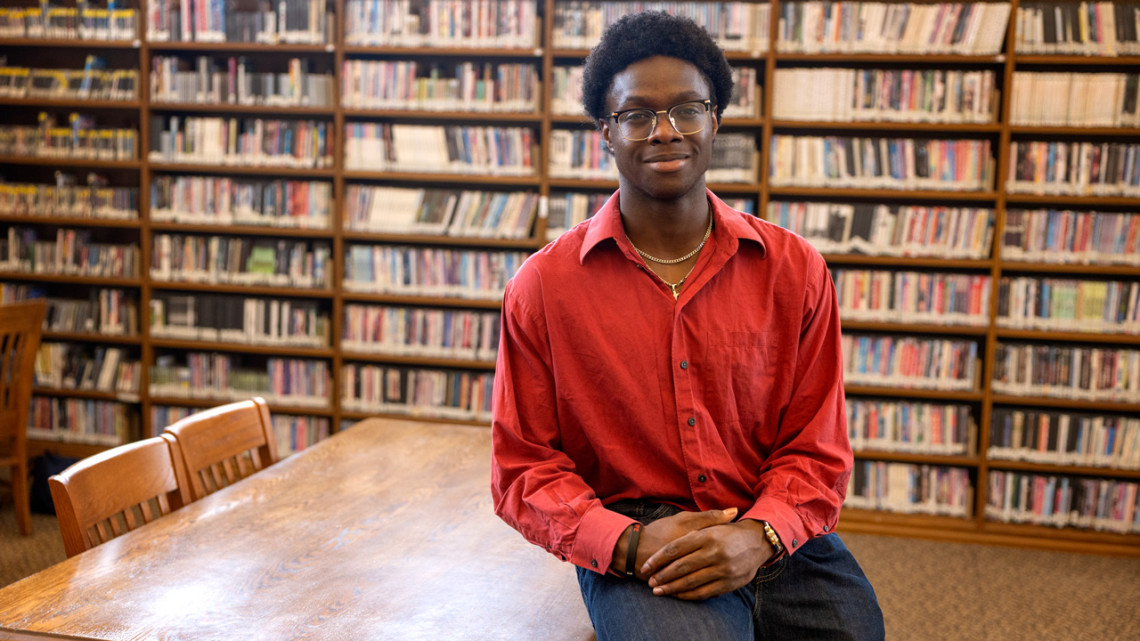
Josh Kwayke-Minott ’29 attended Ithaca High School, where the STEP program prepared him for a college work by visiting colleges, attending conferences and putting him together with tutors.
Cornell’s investment in local education anchors a broader economic story
By Laura Reiley, Cornell Chronicle
Josh Kwayke-Minott ’29 was going to have a hard time squeezing in this interview. Final exams were around the corner, there were track and field events to finish up, plus miscellaneous extracurricular responsibilities, like jazz saxophone with the After Six Band or work with his autonomous underwater vehicle team.
Nonetheless, he found the time. That’s part of what he’s learned as a Cornell freshman – time management. But for Kwayke-Minott, his pre-college preparation was just as vital.
“There were a lot of opportunities as a student in Ithaca City School District,” Kwayke-Minott said. “I got a lot of help with academic resources. And with Cornell STEP, the directors put a lot of time and effort into making it a different program that stood out from the rest.”
The Science and Technology Entry Program (STEP), which is funded by the New York State Education Department and hosted by Cornell’s Einhorn Center for Community Engagement, helps create new pathways to STEM careers for local students from communities often underrepresented in these fields.
It is an example of how, while Cornell and the Ithaca City School District are separate institutions with separate missions, they feed each other in profound ways.
“It was like having a family at school,” Kwayke-Minott said. “The director was always telling us about opportunities and focused on our college readiness. It gave me academic drive and inspiration for what I want to do later on.”
This year’s Local Economic Snapshot, produced annually by Cornell’s Office of Community Relations and the Division of Budget and Planning, captures the relationship between Cornell and local students in a single figure: $9.5 million in need-based scholarships and grants directed to Tompkins County students enrolled at Cornell.
The number reframes what a research university’s economic contribution to a small city can look like – not just payroll and purchasing, but a direct investment in the children who live here, said Kyle Kimball, vice president for university relations.
“Cornell’s leadership and campus community are committed to supporting our local and regional K-12 education partners and their students, evidenced by both scholarship and grant aid to admitted students, as well as significant investments of programmatic time and mentorship, faculty expertise, facility use and funding,” Kimball said.
The snapshot, which covers Cornell's fiscal year ending June 30, 2025, documents the university’s sustained role as the economic backbone of Tompkins County and the surrounding region. Cornell remains the area’s largest employer, with more than 11,000 full-time employees – plus 13,000 part-time, temporary and student workers – supported by a payroll of $1.36 billion. Its 25,816 students spent $452 million locally on rent, groceries, restaurants and services.
The numbers extend outward from there. Cornell spent $206 million purchasing goods and services from vendors in Tompkins and adjacent counties, and $115 million on construction to local and regional firms. University-hosted events – athletic competitions, family weekends, graduation, campus tours – generated 288,000 overnight stays in the city and region, with visitor spending estimated at a minimum of $46 million.
But it is the education and community investments that give this year's snapshot its particular texture.
In addition to STEP’s support of ICSD students, the federally funded Upward Bound program provides precollege support to 130 students in area rural districts, including Candor, Dryden, Elmira, Groton, Newfield and Spencer-Van Etten.
Cornell also made $11 million in contributions to governments, transit, education, housing and nonprofits. Within that figure, $1.7 million went specifically to K-12 education, childcare subsidies and development; $4 million supported public transit; $500,000 went toward affordable housing; and more than $300,000 was directed to area nonprofit and economic development organizations. Cornell also contributed $4.5 million in voluntary payments to the city and town of Ithaca.
The university's commitment to students extends to those in need currently on campus, too. Through the Community Work Study Program, Cornell provided $403,900 in wages to 182 students placed with 40 area nonprofit partners, a model that simultaneously supports students financially and strengthens the organizations the community depends on.
Cornell’s entrepreneurial ecosystem also generated substantial returns for the region. Combined capital raised in 2025 by companies in Rev: Ithaca Startup Works, the Center for Life Science Ventures and the Praxis Center for Venture Development reached $34 million. Across all three incubators, 53 member firms now support 377 total jobs, including 132 created in the past year alone.
Cornell paid $4.4 million in property taxes on Cornell-related properties last year, including $2.8 million in school taxes and $1.6 million in municipal taxes, ranking third in Tompkins County. The university also paid $6.2 million in municipal fees covering water, sewer, stormwater and other services.
“Cornell remains committed to building upon our local and regional educational partnerships as well as ensuring sustained economic impact to the region,”said Jennifer Tavares, director of community relations. “Continuing to build upon our local and regional partnerships and engaged learning initiatives is mutually beneficial and aligned with our public impact goals as a university.”
Media Contact
Get Cornell news delivered right to your inbox.
Subscribe