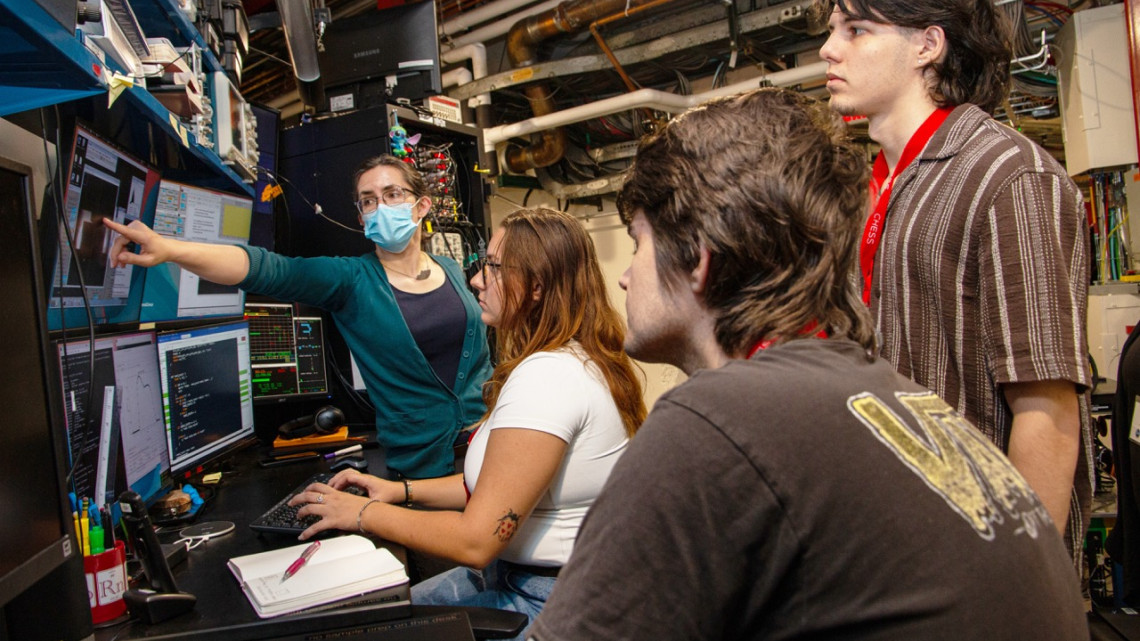
Attendees of the CHESS HEXT School learn how to operate an experiment at a CHESS beamline.
News directly from Cornell's colleges and centers
High-energy x-ray workshop trains next generation of synchrotron researchers
The Cornell High Energy Synchrotron Source (CHESS) will host its annual High Energy X-ray Techniques (HEXT) School next week, bringing graduate students and early-career researchers together for an intensive introduction to synchrotron science and high-energy x-ray research methods.
The school runs May 19th & 20th, 2026.
The school, which is designed to help train the next generation of synchrotron users and x-ray scientists, combines lectures from CHESS staff scientists with facility tours, beamline demonstrations, and instruction on writing successful proposals for beamtime at CHESS.
Participants will learn the fundamentals of synchrotron techniques including x-ray scattering, diffraction, imaging, spectroscopy, and crystallography, while gaining insight into how these tools are applied across materials science, chemistry, biology, energy research, and engineering.
“Our goal is to make synchrotron science approachable and practical for students from a wide range of scientific backgrounds,” said Chris Pollock, CHESS staff scientist and organizer of the school. “We want participants to leave with a strong understanding of the core techniques and the confidence to begin thinking about how these methods can support their own research.”
The school also includes hands-on beamline demonstrations where participants observe how synchrotron experiments are conducted, from sample preparation and data collection to data processing and interpretation.
Interest in this year’s HEXT school has been especially strong, with the in-person portion of the school now fully booked. Remote participation remains available for students and researchers interested in attending virtually.
CHESS, located at Cornell’s Wilson Synchrotron Laboratory, welcomes more than 1,000 users annually from Cornell and institutions around the world to conduct x-ray research using one of the nation’s premier synchrotron facilities.
Researchers interested in participating remotely can still register online.
Media Contact
Get Cornell news delivered right to your inbox.
Subscribe