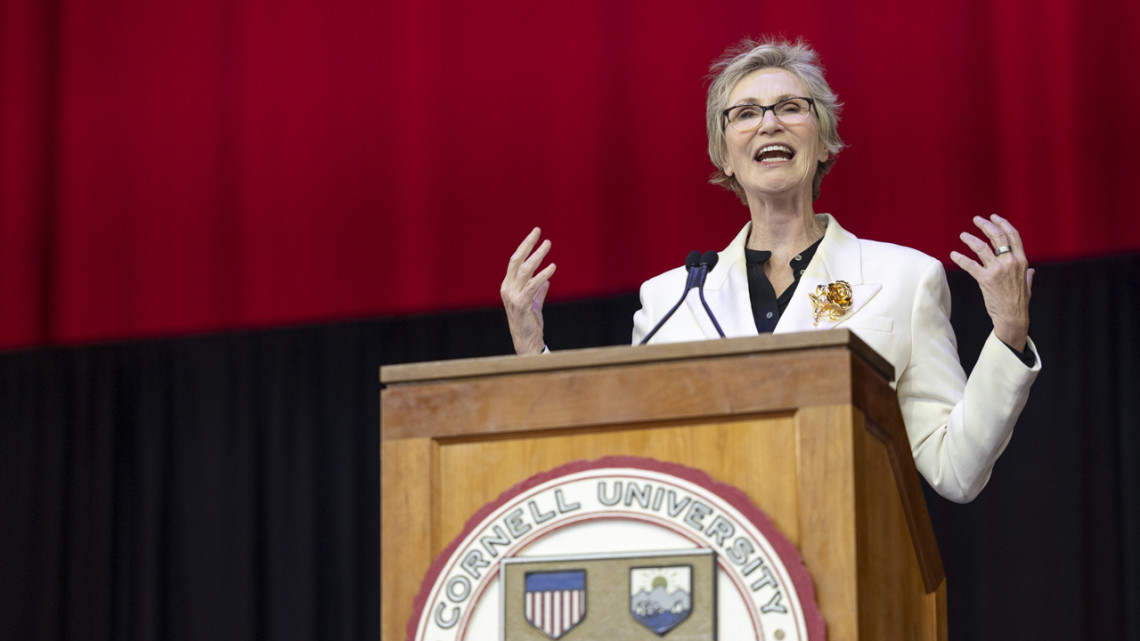
Award-winning actor and TV personality Jane Lynch, MFA ’84, delivers the Senior Convocation address on May 21 in Barton Hall.
Jane Lynch, MFA ’84, to Class of 2026: Shed your fear
By Tom Fleischman, Cornell Chronicle
As a student in Cornell’s master of fine arts program in the 1980s, Jane Lynch was walking across campus with some classmates talking about life after graduation.
“They all had such great hopes and seemed to have such solid ideas of where they were heading, had such confidence. And when it was my turn, I said, ‘I don’t see myself anywhere doing anything, because I’m paralyzed with fear,’” Lynch, MFA ‘84, said during her Senior Convocation address on May 21 in Barton Hall. “And there was silence, and I realized that I had said the quiet part out loud. I went into a fugue state the rest of that semester.”
She managed to overcome that fear – to the tune of a Golden Globe and five Emmy awards over her long acting career – and urged Cornell’s Class of 2026 to not succumb to their fears, either.

Taiko drum ensemble Yamatai gives a spirited performance during Senior Convocation.
“I have found, as an adult standing here before you,” she said, “that if you can get fear off your back, if you can just get out from underneath it, you unleash some awesome power, and you can live such a satisfying life.”
Lynch’s speech was the main event in a high-energy Convocation program that featured several student performance groups, including Taiko drum ensemble Yamatai and a cappella group The Hangovers; remarks from class members and Cornell administrators; a video featuring seniors looking back on their four years; and a rousing rendition of the alma mater to close.
“While I can’t tell you how to deal with the flurry of emotions that come with graduating, I do hope I can give voice to what you may be feeling and make you feel a little bit less alone as we all say our goodbyes,” said Chinaza Politis ‘26, an industrial and labor relations major and chair of the Convocation committee, before introducing Lynch.
“Each one of us has years of memories etched into the walls of this campus and carved into the desks at the stacks,” Politis said. “And as we start to pack up our things and say goodbye to our friends, it can’t help but feel a little bit sad. I mean, yes, Cornell is tough, but there’s something special about it that brought us all here and kept us all here.”
In her speech, Lynch said she was “riddled with phobias and doubt and uncertainty” when she arrived at Cornell in the late summer of 1982. She also admitted to being “tough to be around,” both then and now.
“I’m weird, and I’m OK with that,” she said. “I spend way too much time alone, so I do weird things that people who spend too much time alone do. Talking out loud to imaginary people is one of them; now, why don’t I just hang out with a real person and say things out loud to them? I don’t know. It’s a paradox, and I’m comfortable with it.”
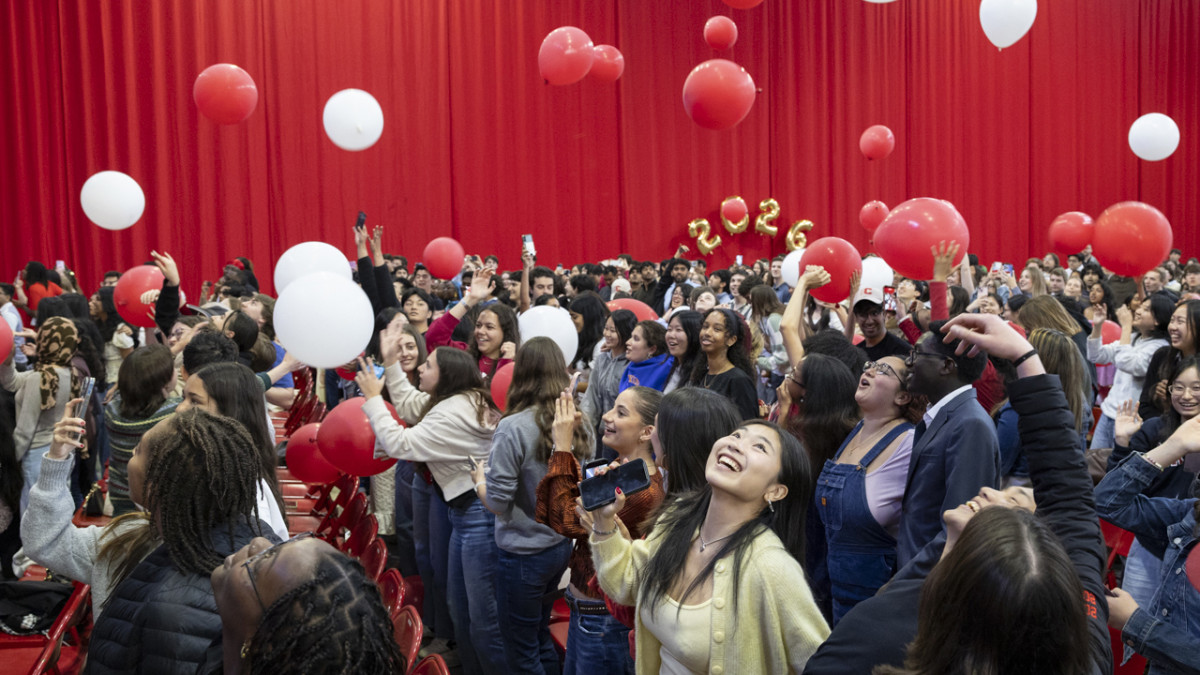
Red and white balloons rain down on the Class of 2026 near the conclusion of Senior Convocation.
She has tried conversing with an AI chatbot – Anthropic’s Claude – beginning by stating that she loved and care about him. Claude informed her that he’s strictly an information tool, “and I never spoke with him again.”
Lynch, best known as cheerleading coach Sue Sylvester in the Fox TV series “Glee,” for which she won a Golden Globe in 2011, admitted that while she must’ve been invited to speak because she had wisdom to impart, “I may not know what I’m talking about, and I may confuse you. On one hand, I’m going to tell you what to do, and on the other hand I’m going to say, ‘Don’t let anyone tell you what to do, OK?’ It’s a paradox – get comfortable with it.”
Her first piece of advice: “Beware of cultural memes, like ‘Walk Your Talk.’ I don’t like it. In fact, I hate it. It’s shame-inducing. It’s a sneaky way of making you adopt a belief system … No matter what, resist this.”
It’s all right to have a plan, goals and a timeline, she said, but it’s also OK to let things just happen.
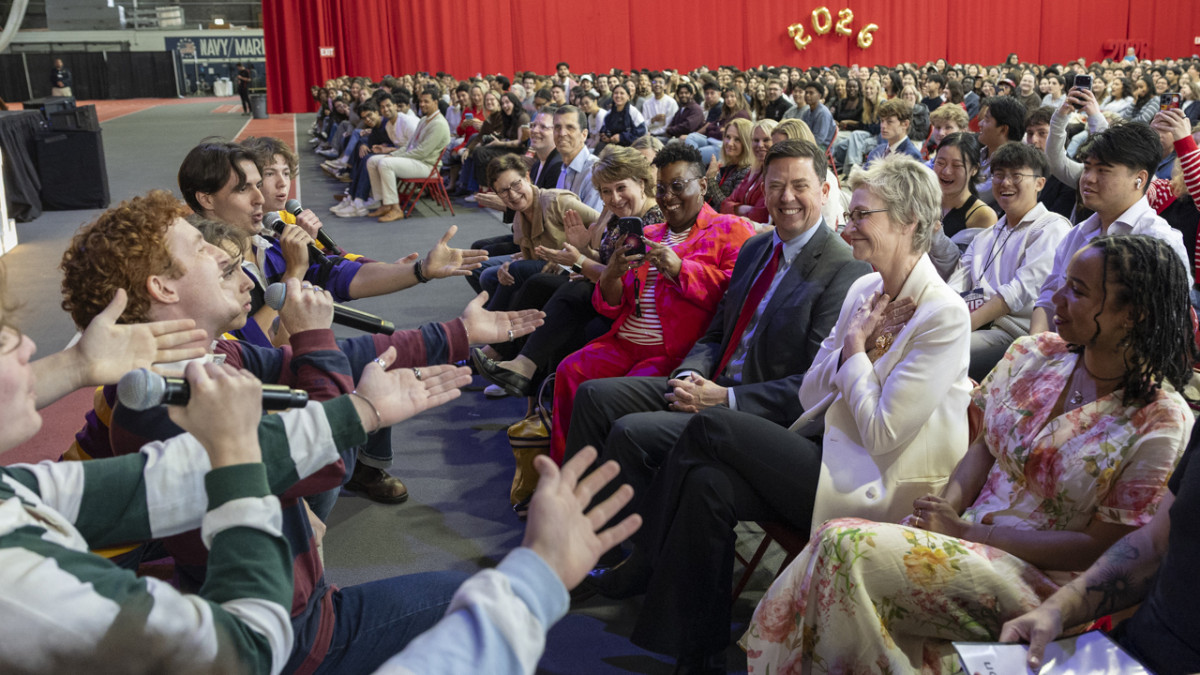
Members of the a cappella group The Hangovers serenade Jane Lynch, MFA ’84, to “(Your Love Keeps Lifting Me) Higher and Higher” during the student group’s performance at Senior Convocation.
“Allow me to relieve you of this pressure: Your life and your ultimate joy doesn’t care about your timeline,” she said. “That burst of inspiration, creative ideas that lead to awesome opportunities – those show up in conversations you weren’t expecting to have. They show up when you finally let go of what you thought you wanted long enough to notice what’s actually right in front of you.
“The best things that ever happened to me, without exception,” she said, “are things I could never have planned.”
Lynch also warned against becoming “the humorless do-gooder” – who gives because they feel a joyless obligation to give back.
“It’s becoming empty virtue-signaling,” she said. “I’m here to tell you, don’t do it unless what you’re doing in your life makes you happy and fulfilled. In this case, you’ll be teeming with authentic beneficence and generosity. You won’t be able to stop yourself from giving, but don’t do it because some silly slogan told you to.”
Lynch hoped that the Class of 2026 could be open to experiencing the intensity of both immense grief and joyous laughter. “Have you ever had one of those cries or one of those laughs?” she said. “They’re delicious, and I suggest that you allow them to overtake you often.”
She closed by urging her soon-to-be-fellow alumni to be selfless. “You know how one candle can light another candle without diminishing its own flame?” she asked. “You be that candle.”
Media Contact
Get Cornell news delivered right to your inbox.
Subscribe