From the Living Lab: Students tackle campus trash and food waste
By Caitlin Hayes, Cornell Chronicle
As a first-year student and employee at Cornell’s Statler Hotel, Ellie Butkovich ’26 noticed a tension between hospitality and sustainability.
For example, a breakfast buffet piled high with food gave guests a sense of plenty, but that abundance led to wasted food.
The conflict posed a challenge and sparked a passion, leading Butkovich to design a concentration within her major and identify a career path – and it spurred her to act. She created a sustainability training for the Statler’s new hires, met with chefs to talk about food waste and at one point was even transporting the hotel’s coffee grounds for reuse at a natural dye lab on campus. As a sophomore, she took a job as a student sustainability coordinator for Cornell Dining, gaining real-world experience in collecting data, communicating with stakeholders and advocating for change.
“With sustainability, it can be underappreciated, how much is being done behind the scenes, and it can be hard to feel optimistic,” Butkovich said. “Anytime we can communicate and make someone aware that we are actually making changes – that feels really good.”
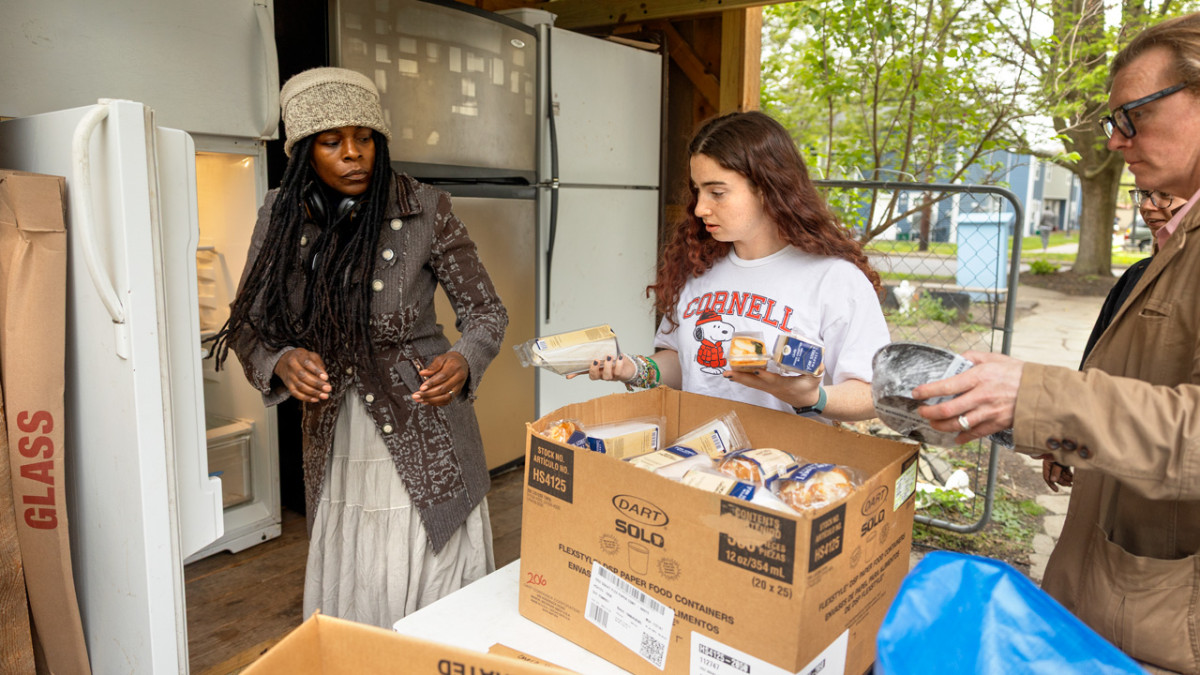
Through her work with the student-run Food Recovery Network, Jenna Rosenberg '29 (center) stocks donations of leftover food with community members in downtown Ithaca.
Butkovich, an environment and sustainability major in the College of Agriculture and Life Sciences (CALS), is one of many students who serve as boots on the ground in advancing sustainability on campus, seeing areas for improvement and taking action. Students often find support from the Campus Sustainability Office (CSO), and CSO director Sarah Carson said their efforts are key to the progress of Cornell’s Living Lab, the use of campus as a real-world testbed and proof of concept for reducing emissions and waste.
“Our students are so passionate and are constantly coming up with unique ideas and perspectives that we wouldn’t otherwise see,” Carson said. “It really takes a village and our students play a crucial part.”
Towards clean plates and zero waste
On any given day in Cornell’s dining halls, students might be asked what they’ve left on their plates – and why.
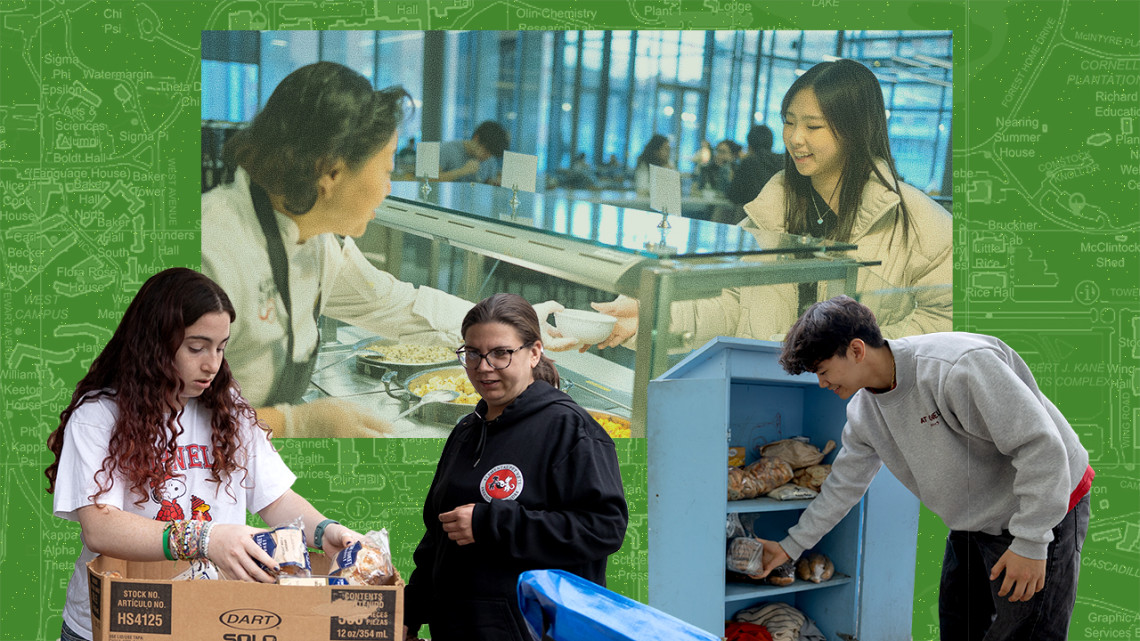
It’s part of the food waste studies conducted by the Cornell Dining student sustainability coordinators – Butkovich and her peers table twice a week, surveying between 30 and 50 students each shift about their food waste and asking them to rate their leftovers.
The student coordinators then provide data and feedback to chefs, who can adjust recipes and quantities; Butkovich said one chef tweaked an over-salted pho dish that students were discarding, and it became a crowd favorite. The food studies have also been an opportunity to raise awareness about food waste, which has been so effective that dining staff say even the presence of the coordinators reduces waste.
“It’s very easy to take too much,” said Anna Ben-Shlomo, Cornell Dining’s staff sustainability coordinator and supervisor for the student program. “The students are great ambassadors – they have ideas, and they have the student perspective, so it really helps.”
Butkovich said the food waste studies are a true investigation – because people might leave food on their plates for many reasons, from disliking the taste to miscommunication about certain dishes to the lines being too long, so students take more to avoid going back for seconds.
“It’s really rewarding to figure it out and then pass that information on,” Butkovich said.
Bridging the gap between excess food and those in need
While the coordinators are tracking food waste in the front of house, a student group works behind the scenes to donate Cornell Dining’s untouched leftover food to the community.
Founded in 2014, the Food Recovery Network (FRN), with more than 100 student volunteers, collects food five times a week from North and West campus dining halls and has expanded this semester to include seven cafés. The food goes to a local nonprofit, the Friendship Donations Network, which distributes it to nearly 30 programs in the region that provide food to those in need. Students also stock refrigerators on the porch at the Catholic Workers House in downtown Ithaca. The weekly café recoveries alone provide 75 to 100 meals.
“The dining halls can’t know what’s going to be popular on a given day, so there’s only so much they can do,” said Jenna Rosenberg ’29, an agriculture and environment and sustainability major in CALS. “We help bridge that gap.”
Jacob Rodriguez ’29, an economics and Spanish major in the College of Arts and Sciences, joined the group after seeing a nearly full pan of what he described as “amazing” lentil curry and rice dumped in the compost bin at one of the dining halls.
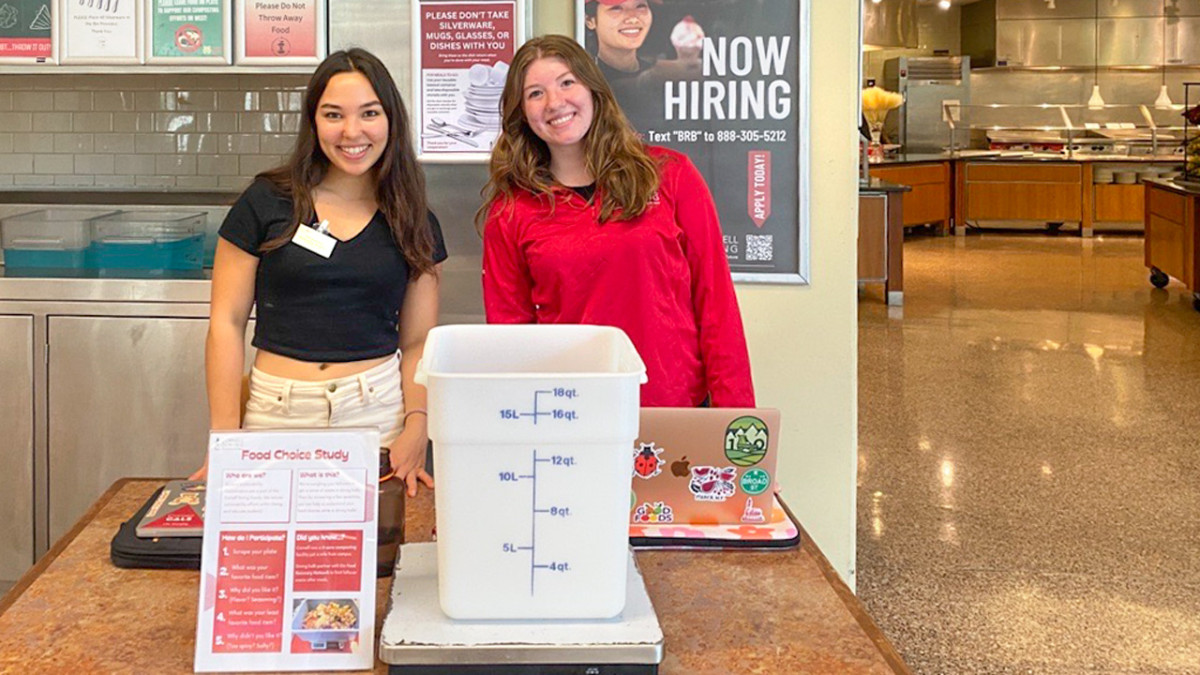
Cornell Dining student sustainability coordinators Noa Dijstelbloem '25 (left) and Ellie Butkovich '26 (right) spent hours surveying peers about their food waste.
Rodriguez said seeing FRN’s impact on the community was the “most incredible part” of his first year at Cornell and that working with Cornell Dining staff has also given him a broader perspective on campus and operations – an added benefit of the Living Lab model.
“The operation is so large, and there are so many people who dedicate their lives to helping us and providing us with food,” Rodriguez said. “That we as students can dedicate an hour of our time each week to making sure that others have what they need – it’s perspective-changing. And I always just have the feeling there’s so much more we can do.”
‘Not just a mental exercise’
Bisrat Abebe ’27, too, learned this year that small changes can have a big impact.
In the Cornell Duffield College of Engineering course “Organizational Communications for Engineers,” which partners with the CSO to create communication campaigns about sustainability issues, Abebe and his team researched the benefits of replacing paper towel dispensers in bathrooms on campus with electric hand dryers.
Accounting for costs of materials and labor, the team estimated that replacing paper towels in just Duffield Engineering buildings alone could potentially save a half a million dollars every five years, in addition to reducing landfill waste and methane emissions from decomposing paper towels.
“I learned in this class that Cornell holds itself to a very high standard in sustainability,” said Abebe, a computer science major in Duffield Engineering. “But there’s still more we can do, and in this case it’s really simple, nothing mind-boggling – just replace the paper towels with electric dryers.”
The student team will communicate their findings in a report to the CSO; CSO will verify the research and possibly pass the document on to facilities staff.
All the students in the course based their projects around a campus waste audit and worked with Meredith Rutherford, the sustainability manager in the CSO, to identify communication needs. Rutherford said the class is among many that incorporate the Living Lab and sustainability into their curriculum.
“We wanted to liven it up and make something real and immediate for the students, that can also have an impact on the Living Lab,” said instructor Allison Hutchison, associate director of the Engineering Communications Program. “The students get to see that their designs and ideas go out into the world and that it’s not just a mental exercise.”
Abebe said having a real impact on campus made the class meaningful.
“There are a lot of classes where you’re there for a grade or a requirement, but in this class, we had a bigger goal in mind,” Abebe said. “Even if it’s not implemented, we’re putting ideas out there to our sustainability leaders that they can consider and iterate on to benefit Cornell.”
Media Contact
Get Cornell news delivered right to your inbox.
Subscribe