Mass timber industry offers sustainable construction, high-quality jobs
By Julie Greco
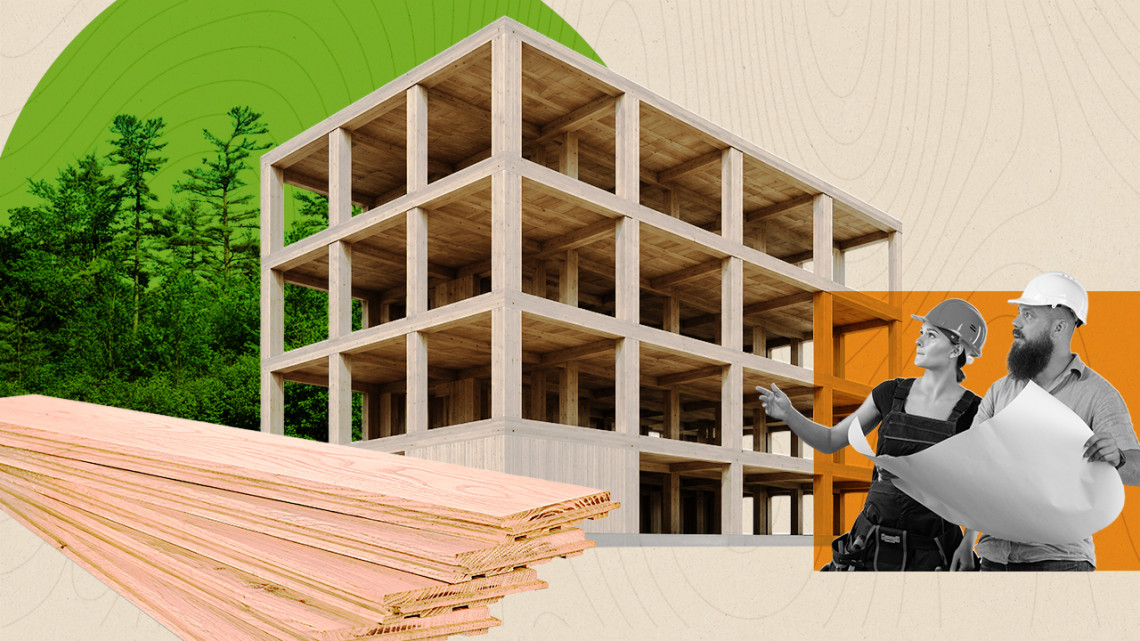
The production of mass timber – engineered wood products used as structural materials for buildings – is an emerging industry in the U.S. that can enhance sustainable construction, create high-quality jobs and accelerate the creation of affordable housing.
To help realize these goals, Cornell’s Climate Jobs Institute (CJI) produced a primer, “Mass Timber: Advancing Sustainable Construction and High-Quality Job Creation,” and presented it at an event held at the Hyatt Place Albany-Downtown on May 11.
The event, hosted by the primer’s authors, Lexi Scanlon and Rohan Palacios of CJI, also included a panel of speakers, including New York State Assemblymember Didi Barrett (D-Hudson Valley) and Jim Mason, president of Carpenters Local 277.
The global mass timber market is projected to grow to over $1.3 billion by 2030, and North America is poised to become the world’s fastest-growing mass timber market over the coming decade.
“Mass timber is more than an alternative, sustainable building material,” said Palacios, training and education support specialist at CJI. “We’re just beginning to unearth all the possibilities. There is so much potential, and how far the industry goes depends on how active a role different policymakers take in understanding and promoting the material in the right way.”
The primer provides four key takeaways for policymakers:
- The construction industry accounts for 10% of global greenhouse gas emissions; mass timber offers an opportunity to lower emissions, reduce costs and meet housing development needs in the U.S.
- High-quality forest management and sustainable harvesting, especially in regions that have historically led the timber industry and have experienced job losses and mill closures, are critical first steps toward a durable, successful mass timber industry.
- In a sector characterized by precarious work and recruitment challenges, labor-management partnerships can help bridge workforce gaps, uphold job quality and maintain consistent production schedules.
- Local sourcing of wood and manufactured timber components will be the most impactful way to reduce emissions and revitalize rural communities.
“This is a really exciting and unique paper for CJI,” said Scanlon, a climate jobs associate. “Most of our reports are recommendation-based, centered around suggested policy changes for industries that are well-established and slow to adapt. When it comes to mass timber, New York has the opportunity to examine the full depth of climate impacts and workforce impacts and build a really strong industry from the ground up.”
At the event, which included state legislators, carpenter union members and architects, Scanlon and Palacios explained how policymakers can spur quality job creation, meet building decarbonization goals and accelerate affordable housing construction by standing up regional timber supply chains.
“There were great organic discussions that connected across participants,” Palacios said, adding that he and Scanlon have already scheduled follow-up meetings with legislators and unions to discuss the future of the industry.
Julie Greco is the director of communications for the ILR School.
Media Contact
Get Cornell news delivered right to your inbox.
Subscribe